How to Save Your Marriage When Nothing Is Actually Wrong
Saving a marriage in which nothing is actually wrong means rebuilding the relationship while the arrangement carries on around it. It almost always begins with one person moving first, changing his own conduct for a sustained period without a commitment that it will be reciprocated, and holding that change for a full season before judging whether it worked. That is a different job from the one most marriage advice describes.
Almost everything written about saving a marriage assumes an event. An affair, an addiction, a blow up, a stated intention to leave. Those marriages have something to work on, which is a real advantage even though it does not feel like one. National marriage and divorce counts are published by the CDC's National Center for Health Statistics and the Census Bureau.
The harder case is the one with no event. Two people who are polite, cooperative, jointly competent, and have not reached for each other in a long time. Pew Research Center describes how much of modern married life is organised around exactly this kind of joint operation. There is nothing to forgive and therefore nothing obvious to repair. Men in this position often do nothing for years, because every framework they can find is built for a fire they do not have.
First, decide what you are saving
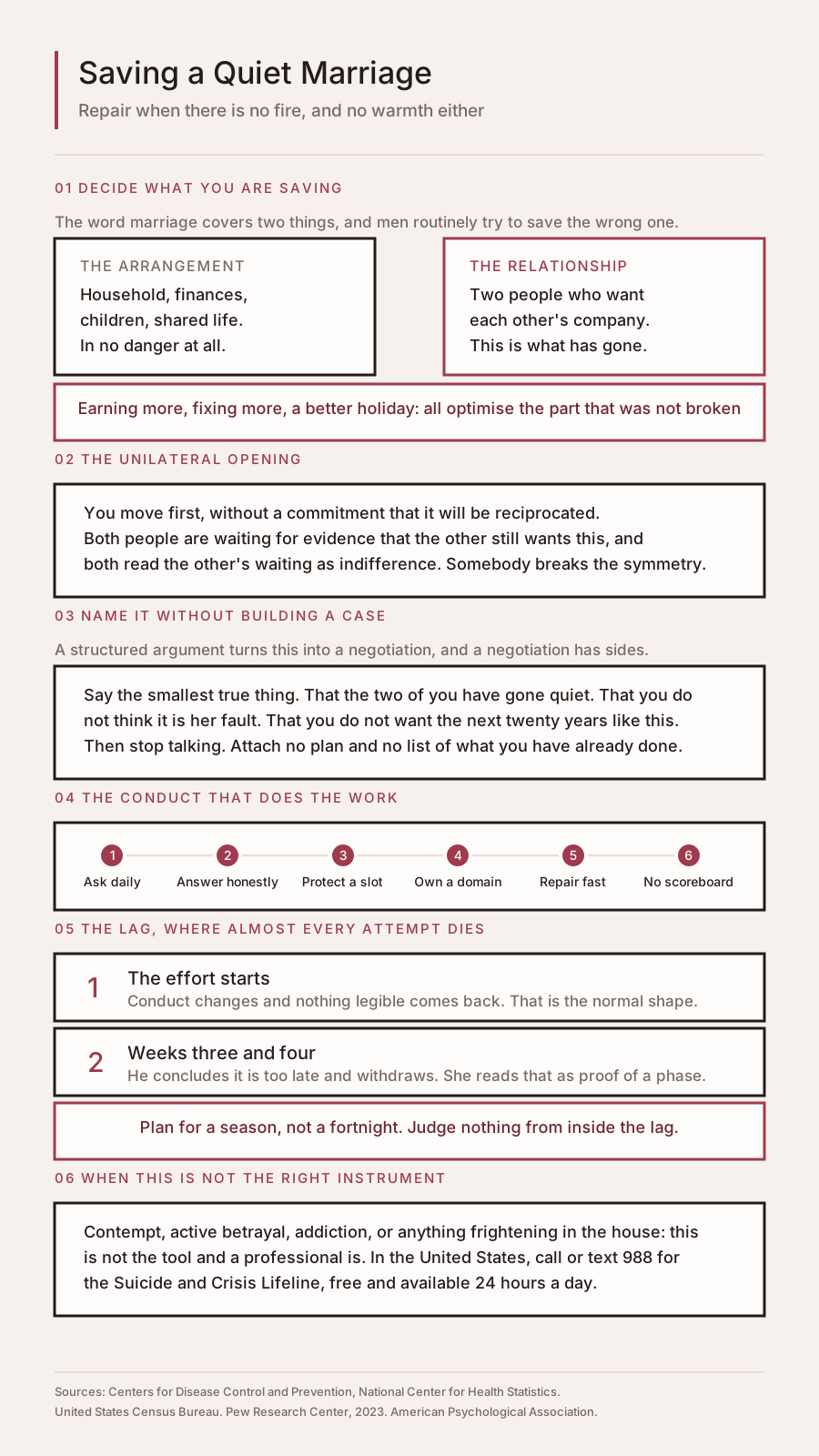
Be precise, because the word marriage covers two different things and men routinely try to save the wrong one.
There is the arrangement: the household, the finances, the children's stability, the shared life. In most quiet marriages the arrangement is in no danger whatsoever. It is running well. Nobody is threatening it.
Then there is the relationship: two people who are known to each other and want each other's company. That is the thing that has gone, and no amount of improving the arrangement will bring it back. This is why men who sense trouble and respond by earning more, fixing more of the house, or planning a better holiday find that nothing changes. They optimised the part that was not broken.
Saving the marriage, in this case, means rebuilding the relationship while the arrangement continues around it.
The unilateral opening
You almost certainly have to move first, and you have to move first without a commitment from her that it will be reciprocated.
This is the part men object to, and the objection is fair. It feels like being asked to invest into an unpriced asset. But the arithmetic is simple. Both people are waiting for evidence that the other still wants this. Both read the other's waiting as indifference. Somebody has to break that symmetry, and the person reading this article is the one who is currently thinking about it.
Moving first is not grovelling and it is not a grand gesture. A grand gesture is actually a way of avoiding the slow version, and most wives in this situation read it accurately as such. Moving first means changing your own conduct for a sustained period without requiring a matching change in return, and doing it long enough that it stops looking like a campaign.
Name it without building a case
The opening sentence matters more than anything that follows, and most men get it wrong in the same way. They prepare. They assemble evidence, anticipate objections, and arrive with a structured argument, because that is how they have won every important conversation of their professional lives.
A structured argument turns this into a negotiation, and a negotiation has sides. You do not want sides.
Say the smallest true thing instead. That you have noticed the two of you have gone quiet. That you do not think it is her fault. That you do not want to live the next twenty years like this. Then stop talking and let it be uncomfortable, because the silence after that sentence is where the conversation actually happens.
Do not attach a plan to it. Do not list what you have already been doing. Do not ask her to confirm she feels the same, because she may not be able to answer that honestly in the first five minutes and forcing it produces a false answer you will both have to live with.
The conduct that does the work
| Move | What it replaces | The trap |
|---|---|---|
| One real question daily | Logistics and status updates | Asking, then not listening to the answer |
| Answer honestly when asked | Fine, good, nothing | Blaming her for not asking again |
| One protected slot a week | Vague plans to spend time | Cancelling it the first busy week |
| Take one domain completely | Offering to help | Handing it back the moment it gets dull |
| Repair fast when you miss | Defending the miss | Turning the repair into another argument |
| Drop the scoreboard | Counting who tried more | Counting silently and calling it dropped |
None of these are impressive. That is deliberate. Impressive is a one off, and a one off is the thing that has already failed several times in most of these marriages.
The scoreboard is the one to watch in yourself. A man who starts this work while privately counting whether she is matching him has not actually started it. He has opened a negotiation with hidden terms, and she will feel the terms long before she can name them.
The lag, and why it ends most attempts
Here is the part nobody says clearly enough. You will change your conduct and nothing will happen for a long time.
That is not a sign it is not working. It is the normal shape of it. Trust is rebuilt on evidence, evidence accumulates slowly, and a pattern has to survive long enough to be believed. Meanwhile she may be waiting to find out whether this is real or a phase, and the only thing that answers that question is time.
The lag is where almost every attempt dies. A man makes a genuine effort for three or four weeks, receives nothing legible back, concludes it is too late or that she does not want it, and withdraws. From her side, that withdrawal is the confirmation that it was a phase. Both people take it as proof, and the marriage goes another two years.
Plan for a season, not a fortnight. Decide in advance that you are not evaluating results before then, because a decision made inside the lag is made with the worst possible information.
When this is not the right instrument
If what you actually want is the narrower question of restoring contact rather than the decision about the marriage itself, how to reconnect with your wife breaks that into three separately evidenced mechanisms and the order to run them in.
If the narrower question is whether talking to each other differently can move any of this on its own, the trial evidence says it moves a little and holds for about two and a half years, which is worth knowing before you stake a season on it.
If you have already begun collecting the advice men pass to each other about divorce, the four instructions that circulate most and what the written rules actually say checks each one against the statute or regulation it claims to rest on.
Two honest limits.
If there is contempt, if either of you has started to find the other faintly ridiculous, that is a different and more serious problem than distance and it does not respond to curiosity alone. If there is an active betrayal, an addiction, or anything frightening in the house, this article is not the right tool and a professional is. Where a betrayal is historical rather than ongoing and there is one nameable incident behind the distance, the work is trust rebuilding after a real breach, which runs on a different mechanism to anything described here. Where that incident was an affair specifically, there is one step that comes before any of it, because the factual record has to stop moving before your conduct can count as evidence of anything. That step covers the opening weeks; the shape the road takes across the months and years after it is a separate question, and the largest survey of people attempting reconciliation found it runs neither straight nor the same way for everyone. The American Psychological Association publishes plain guidance on separation and its effect on children.
And if the quiet has heat under it, a ledger, a running account of who owed what, then start with the ledger rather than the warmth. That is usually the mental load, and it has to be cleared before anything else lands. If you accept that premise and still cannot see why the imbalance holds when neither of you is the villain, a study that measured both partners rather than one explains the mechanism. If the quiet has no heat and is genuinely just absence, then it is the loneliness pattern and the small repeated moves above are the correct instrument. And if what has gone is neither heat nor warmth but the sense that you can be counted on, with nothing either of you could name as a betrayal, then trust is the thing that went and it rebuilds in a fixed order rather than in one long conversation. And if the house only went quiet when the last child left, the timing is misleading and the evidence says so: the panel data puts the lasting dip at the first departure, not the empty nest, which usually means the silence was already there and the children were covering it. Last reviewed by The Quiet Marriage Editorial Team on August 13, 2026. This piece was reviewed editorially, against its published sources. It was not reviewed by a licensed therapist, counsellor or physician, and it is not a substitute for one. Our sourcing and AI use rules are public on the editorial standards page. This is general editorial content and not professional, medical or psychological advice. A marriage in genuine difficulty should be discussed with a licensed professional in your own jurisdiction. If you are in crisis in the United States, dial or text 988 for the Suicide and Crisis Lifeline, which is free and available 24 hours a day.
FAQ
Can a marriage be saved if only one person is trying?
It can be started by one person, which is not the same as being saved by one person. The unilateral phase exists to change the conditions so that the other person can move too. If a long, genuine, unilateral season produces nothing at all, that is information rather than failure.
How long should I give it?
Longer than instinct says. Judge nothing before a full season of changed conduct, because the lag between effort and response is the defining feature of this pattern and every early evaluation is made on incomplete evidence.
Is a big romantic gesture worth trying?
Rarely, in this specific case. A gesture is a single event and the problem is an accumulated absence of events. Most wives in a quiet marriage read a grand gesture as a substitute for the slow version rather than the start of it.
What if she says it is too late?
Take it seriously and do not argue with it, which is the instinct. Ask what would have to be different rather than trying to talk her out of the statement. People say too late from inside the same flatness you have been in, and it is not always a final position.
Should we get professional help?
If there is contempt, betrayal, addiction, or anything frightening, yes, and sooner than feels comfortable. For plain distance with no incident, the daily conduct described here is the work, and it is work no third party can do for you.
What is the difference between saving the marriage and saving the relationship?
The word marriage covers two different things, and men routinely try to save the wrong one. The arrangement is the household, the finances, the children's stability, the shared life. In most quiet marriages the arrangement is in no danger whatsoever, because it is running well and nobody is threatening it. The relationship is two people who are known to each other and want each other's company, and that is the thing that has gone. No amount of improving the arrangement will bring it back, which is why men who sense trouble and respond by earning more, fixing more of the house or planning a better holiday find that nothing changes. They optimised the part that was not broken.
What should you do first to save a marriage when there is no crisis?
Move first yourself, without a commitment from her that it will be reciprocated. That is the part men object to, and the objection is fair, because it feels like being asked to invest into an unpriced asset. The arithmetic behind it is simple. Both people are waiting for evidence that the other still wants this, both read the other's waiting as indifference, and somebody has to break that symmetry. The person reading this is the one who is currently thinking about it. Moving first is not grovelling and it is not a grand gesture, since a grand gesture is a way of avoiding the slow version and most wives in this situation read it accurately as such. It means changing your own conduct for a sustained period without requiring a matching change in return, and doing it long enough that it stops looking like a campaign.
How do you save your marriage when it seems impossible?
Most of the time it seems impossible because you are standing inside the lag rather than at the end of it. You change your conduct and nothing legible comes back for a long stretch, and that is the normal shape of it rather than a verdict. The lag is where almost every attempt dies. A man makes a genuine effort for three or four weeks, receives nothing, concludes it is too late, and withdraws, and from her side that withdrawal is the confirmation that it was a phase. Both people take it as proof and the marriage goes another two years. So decide in advance that you are not evaluating results before a full season of changed conduct, because a decision made inside the lag is made with the worst possible information. If a long, genuine, unilateral season does produce nothing at all, that is information rather than failure, and you will have got it honestly. Two limits sit outside this entirely. If there is contempt, an active betrayal, an addiction, or anything frightening in the house, this is not the right instrument and a licensed professional is.
How do you save your marriage without talking about it?
Almost all of it is conduct rather than conversation, so the honest answer is that you can do most of this without a discussion, and the one part you should not skip is a single sentence rather than a talk. The daily moves are the work: one real question a day instead of logistics, an honest answer when she asks instead of fine, one protected slot a week, taking one domain completely rather than offering to help, repairing fast when you miss, and dropping the scoreboard. None of those require her agreement or a stated plan, which is the point, because a structured conversation turns repair into a negotiation and a negotiation has sides. The sentence worth saying is the smallest true one, that you have noticed the two of you have gone quiet, that you do not think it is her fault, and that you do not want the next twenty years to look like this. Say it, attach no plan to it, and stop. After that the record does the talking, and it does it slowly, so plan for a season and hold through the stretch where nothing comes back.
I have been trying for a month and she has not responded. Does that mean it is too late?
Almost certainly not, because a month sits inside the lag rather than past it. You will change your conduct and nothing will happen for a long time. Trust is rebuilt on evidence, evidence accumulates slowly, and a pattern has to survive long enough to be believed, while she waits to find out whether this is real or a phase. The lag is where almost every attempt dies. A man makes a genuine effort for three or four weeks, receives nothing legible back, concludes she does not want it, and withdraws, and from her side that withdrawal is the confirmation that it was a phase. Both people then take it as proof and the marriage goes another two years. Plan for a season rather than a fortnight, and decide in advance that you are not evaluating results before then.
Sources
- CDC's National Center for Health Statistics (cdc.gov)
- Census Bureau (census.gov)
- Pew Research Center (pewresearch.org)
- American Psychological Association (apa.org)
- Suicide and Crisis Lifeline (988lifeline.org)