Divorce for Men After Forty: What the Decision Actually Involves
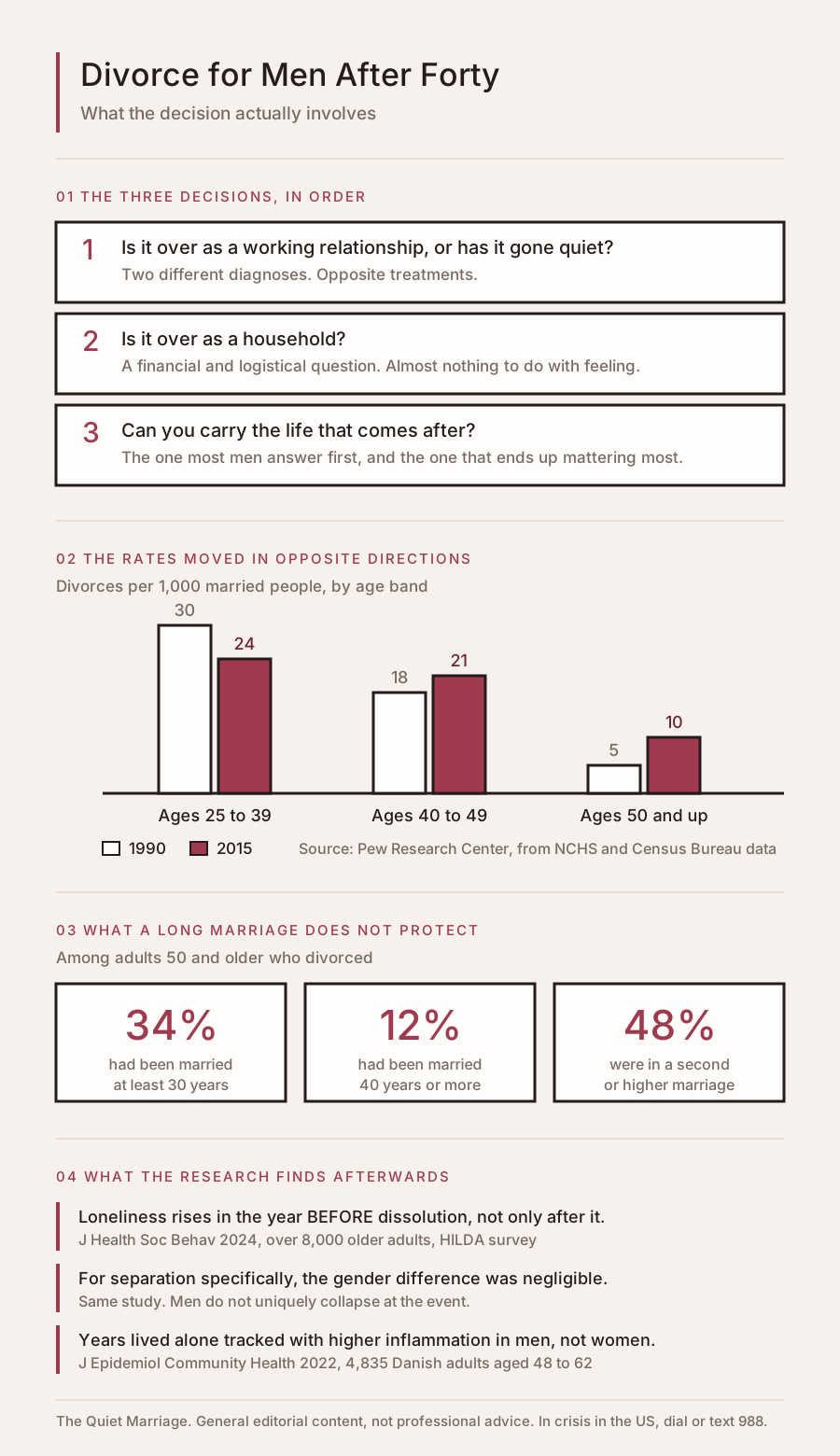
Divorce for a man in a long marriage is not one decision. It is three, taken in order, and most men take them out of order and then wonder why the outcome feels wrong. The first is whether the marriage is over as a working relationship. The second is whether it is over as a household, which is a financial and logistical question with almost nothing to do with feeling. The third is whether you can carry the version of your life that comes after, which is the one nobody rehearses and the one that ends up mattering most. This piece is about all three, and about what actually happens to men on the other side of them.
What the numbers actually say about men leaving late
The rate of divorce has been falling for younger adults and rising for older ones for a quarter of a century. Pew Research Center, working from National Center for Health Statistics and Census Bureau data, found that among adults aged 50 and older the divorce rate roughly doubled between 1990 and 2015, from five per 1,000 married people to ten. Among those 65 and older it roughly tripled, reaching six per 1,000. For adults aged 40 to 49 the rate moved from 18 to 21 per 1,000. For adults aged 25 to 39 it fell, from 30 to 24.
Two things follow from that, and they point in opposite directions.
The first is that you are not an outlier. If you are somewhere past forty and you have spent two years quietly asking yourself whether this is it, you are inside a well documented and growing pattern, not a private failure of character. National counts of marriage and divorce are published by the National Center for Health Statistics and the Census Bureau, and they have been describing this shift for years.
The second is less comfortable. A third of the people divorcing at fifty and over had been married for at least thirty years, and twelve percent for forty years or more. Length of marriage is not the protection men assume it is. A marriage can run for three decades on competence and logistics and then end, because neither competence nor logistics was ever the thing holding it together.
Nor is a second attempt safer. Pew found that among adults 50 and older, those in a remarriage divorced at twice the rate of those who had only been married once, 16 per 1,000 against eight, and that 48 percent of everyone in that age group who divorced in 2015 was in a second or higher marriage. That is worth sitting with before the decision, because the story most men tell themselves at this point is that the problem is this particular marriage.
The decision men usually take first, and should take last
Most men in this position start with the third question. They start by imagining the apartment, the calendar, the money, the explanation to the people at work. That imagining is vivid and exhausting and it feels like thinking, but it decides nothing, because the answer to "could I survive it" is almost always yes and almost always beside the point.
Start with the first question instead. Is this over as a working relationship, or has it simply gone quiet.
Those are different diagnoses, and confusing them is what produces most of the outcomes men regret here. A marriage that has gone quiet is one where two people stopped talking to each other about anything other than logistics and let the silence set. That condition is common, it is unpleasant, and it is not terminal. It is the entire subject of what saving a marriage actually requires, and the honest version of that work takes months before anything in the atmosphere changes. A marriage that is over is a different thing: one or both people have stopped wanting the other person specifically, and no amount of shared calendar or improved logistics moves it.
Men confuse the two constantly, in both directions. Some file on a quiet marriage that had years left in it. Others spend a decade running repair drills on a marriage that ended in fact long before either of them said so.
There is a test that helps, and it is unglamorous. Ask whether you want her back or whether you want the loneliness to stop. If the honest answer is the second, you have not diagnosed the marriage. You have diagnosed what it feels like to be lonely inside one, and that has more than one exit.
What the first years afterwards actually do to men
This is the part that gets skipped, and it is where the data is unusually specific about men.
A 2024 study in the Journal of Health and Social Behavior tracked loneliness across marital dissolution in older age using more than 8,000 respondents from the Household, Income and Labour Dynamics in Australia survey. Its finding was that loneliness rose in the year before dissolution and spiked in the year of it, for both men and women, in both separation and widowhood, though the spike was smaller for separation than for widowhood. Two details matter for anyone reading this while weighing a decision. In that sample loneliness was already climbing before the marriage ended, so the isolation you feel now is not by itself evidence about which way the decision should go. It is population data about when loneliness rises, not a verdict on your marriage, and it cuts against reading the isolation as proof of anything on its own. And for separation specifically, the gender differences in that pattern were negligible, so the widely believed idea that men uniquely fall apart after separation is not what this particular data shows.
The physical picture is less even. A cohort study of 4,835 Danish adults aged 48 to 62, published in the Journal of Epidemiology and Community Health, looked at accumulated partnership breakups and years lived alone across 26 years of adult life against measured inflammatory markers. For men, more breakups and more years living alone were associated with higher levels of inflammation. No such association was found for women. That is an association in one national cohort rather than a verdict on your life, and the authors adjusted for body mass, chronic disease and other factors. But it is worth knowing that the cost of the years alone appears to land differently on men, and that the exposure being measured was time, not the divorce itself.
The practical reading of both studies is the same. The event is survivable. The decade of living alone badly is the thing to plan against, and almost no man plans against it, because he is busy planning against the event. Rebuilding a weekly structure is the specific job that a divorce support group is built to do, and there are four different kinds of them doing four different jobs.
If reading that section put you somewhere darker than planning, stop here and talk to someone. In the United States you can dial or text 988 for the Suicide and Crisis Lifeline, free, any hour. A licensed therapist or counsellor is the right place for this, not an article.
The order of operations
Divorce after a long marriage runs on a sequence. Taking the steps out of order is what produces the outcomes men describe afterwards as unfair, when they were mostly unsequenced.
| Step | What it settles | The usual mistake |
|---|---|---|
| Diagnose quiet versus over | A repair problem, or an exit | Deciding while angry, at night, alone |
| Say it out loud, once, plainly | Whether she already knows | Hinting for years and calling it talking |
| Get the financial picture on one page | What the household actually is | Guessing at numbers you have never opened |
| Take independent legal advice | What your state law actually does | Taking legal advice from friends who lost |
| Decide the children question separately | What the arrangement has to protect | Using the arrangement to win the argument |
| Build the after, before you need it | Whether the next ten years are livable | Assuming you will figure it out later |
The financial page comes before the lawyer, not after, because a lawyer paid to assemble information you already have access to is the most expensive filing clerk you will ever hire. One page means every account, every debt and every titled asset, with its current balance and whose name it is in. Bank and brokerage accounts, retirement accounts and pensions, the house and its mortgage, the cars, credit cards, business interests, and any insurance that runs through one spouse's employer. Most men in long marriages have never seen all of that in one place, which is why the first honest look is usually the most useful hour of the whole process.
It is also worth checking the advice you are already carrying, because several of the instructions men pass to each other about tax, the house and the retirement account do not survive contact with the written rule. That page also tells you which questions are actually yours. After a long marriage the issues that decide the outcome are rarely the dramatic ones. They are the division of retirement savings and pension entitlements built up across the marriage, whether spousal support applies and for how long, what happens to health cover if it runs through one spouse's job, and how long the process realistically takes in your jurisdiction. What each of those means depends entirely on where you live, which is the actual reason to take independent legal advice rather than a general one.
The last row is the one men skip. Building the after means the concrete things: where you will live and whether you can afford it on your own numbers, what a normal Tuesday looks like, who you will still see in six months, and what fills the hours the marriage used to. The men who do worst are not the ones who lost the most in the settlement. They are the ones who arrived on the other side with a lease, a schedule and nothing else, having spent their entire planning budget on the exit and none of it on the arrival.
The part about the children, kept separate
If there are children still at home, the arrangement question has to be handled as its own decision rather than as a lever in the marital one. The American Psychological Association maintains a public resource hub on divorce and child custody, which is a better starting point than the advice of whichever friend had the worst experience.
The one thing worth naming here is that the household load does not disappear when the household splits. It gets duplicated, and for the first time both people carry a full version of it. Men who never held the mental load of running a home discover it in month one of shared custody, usually alone, usually badly, and usually while still describing themselves as the one who was always contributing. That discovery is survivable too, and it is easier if it happens before the move rather than after.
What the long view actually asks
There is a version of this decision that is made properly, and it is quieter than either the leaving or the staying.
It asks you to answer the first question honestly before you answer the third one loudly. Thirty years of marriage does not entitle you to a verdict without evidence, and two years of silence is not evidence either, it is a symptom with more than one cause. Look at what the years alone appear to cost men, and treat building the after as real work with a real budget rather than an afterthought. Then make the call when you are rested and sober, not in the twenty minutes after an argument, because the decision you make in those twenty minutes is almost never the one you would have made.
Whichever way it goes, the version of this you will respect in ten years is the one you took slowly, in order, with the numbers in front of you.
If the next thing you are researching is how to be represented, the phrase you will meet first is divorce for men only. What those services actually are separates the law firms from the coaching programmes, and sets out what the public record on custody can and cannot prove.
Last reviewed by The Quiet Marriage Editorial Team on August 20, 2026. This piece was reviewed editorially, against its published sources. It was not reviewed by a licensed attorney, therapist or financial adviser, and it is not a substitute for one. Our sourcing and AI use rules are public on the editorial standards page. This is general editorial content and not professional, legal or medical advice. Decisions about separation, custody and finances should be taken with a licensed professional in your own jurisdiction. If you are in crisis in the United States, dial or text 988 for the Suicide and Crisis Lifeline, which is free and available 24 hours a day.
FAQ
Is divorce more common for men over forty than it used to be?
Yes, and the trend runs against the direction most people assume. Pew Research Center, using National Center for Health Statistics and Census Bureau data, found the divorce rate for adults aged 50 and older roughly doubled between 1990 and 2015, from five to ten per 1,000 married people, while the rate for adults aged 25 to 39 fell from 30 to 24. One qualification is worth knowing before you read too much into any single year: the Census Bureau only began collecting divorce data annually in 2008, as part of the American Community Survey, and Pew notes the rate for the 50 and older group has been relatively steady since then. The big move happened across the 1990s and 2000s rather than last year.
Does a long marriage protect against divorce?
Less than men expect, and the pattern inside the number is the useful part. Among adults aged 50 and older who divorced, about a third had been in that marriage for at least 30 years and 12 percent for 40 years or more, according to Pew Research Center. But risk in that age group is concentrated in shorter marriages: the rate was 21 per 1,000 for people married under 10 years against 13 per 1,000 for those married 20 to 29 years, which Pew links to remarriages being less stable than first marriages. So length does buy some protection. It just buys much less of it than three decades of shared history feels like it should.
How do I tell the difference between a marriage that is over and one that has gone quiet?
Ask what you actually want back, and be specific about it. If you can name a particular thing about her that you miss, the answer is probably repair. If the picture in your head is of a life rather than a person, and the person in it is interchangeable, you have diagnosed your own isolation rather than the marriage. Two practical constraints on that test. Do not run it in the days after an argument, when the answer is reliably the harsher one, and do not run it once. A verdict you reach the same way three times across a few weeks is worth something. A verdict you reach at eleven at night is not.
Do men cope worse than women after a separation?
Not uniformly, and the popular version of this is too simple. A 2024 study in the Journal of Health and Social Behavior following more than 8,000 older adults found loneliness climbed in the year before dissolution and spiked in the year of it, more sharply for widowhood than for separation, and that for separation specifically the gender differences were negligible. The one place that study did find men markedly worse off was widowhood, where widowed men were substantially more affected than widowed women and stayed vulnerable for long periods. The clearer gender difference in separation shows up over the long run instead: a Danish cohort study of adults aged 48 to 62 found accumulated breakups and years lived alone were associated with higher inflammatory markers in men and not in women. The years alone appear to matter more than the event.
What should I do first if I am seriously considering it?
Get the diagnosis right, then get the numbers on one page, then take independent legal advice for your own jurisdiction, in that order. Independent means your own adviser rather than a shared one, even where you both intend the process to stay civil, because a single adviser cannot represent two positions. Two other points of order that save real money. Say it once, plainly, rather than hinting at it for two years, since the hinting version usually costs more time than the conversation ever would. And do not ask a lawyer to assemble information you can gather yourself in an afternoon from statements you already have access to.
What is different about divorcing after twenty years of marriage?
The same word, a different problem, and three things change it. First, the length itself buys less protection than it feels like it should: among adults aged 50 and older the rate was 21 per 1,000 for people married under 10 years against 13 per 1,000 for those married 20 to 29 years, so risk falls with duration without disappearing. Second, the questions that decide the outcome after a long marriage are rarely the dramatic ones. They are the division of retirement savings and pension entitlements built up across the marriage, whether spousal support applies and for how long, what happens to health cover if it runs through one spouse's employer, and how long the process realistically takes where you live. What each of those means depends entirely on your jurisdiction, which is the actual reason to take independent legal advice rather than a general one. Third, there is far more life to rebuild on the other side, and the men who do worst are not the ones who lost the most in the settlement. They are the ones who arrived with a lease, a schedule and nothing else.
Are divorce laws different for men?
This publication does not give legal advice and cannot tell you how your own jurisdiction treats any part of it, and that is the honest answer to the question as asked. What is worth knowing is that the phrase points at the wrong thing. After a long marriage the issues that decide the outcome are rarely the dramatic ones. They are the division of retirement savings and pension entitlements built up across the marriage, whether spousal support applies and for how long, what happens to health cover if it runs through one spouse's employer, and how long the process realistically takes where you live. What each of those means depends entirely on your jurisdiction, which is the actual reason to take independent legal advice rather than a general one. Independent means your own adviser rather than a shared one, even where you both intend the process to stay civil, because a single adviser cannot represent two positions. The order that saves the most money is fixed: get the diagnosis right, then get every account, every debt and every titled asset onto one page with its current balance and whose name it is in, then take that page to a lawyer. A lawyer paid to assemble information you already have access to is the most expensive filing clerk you will ever hire.
Sources
- Pew Research Center (pewresearch.org)
- National Center for Health Statistics (cdc.gov)
- Census Bureau (census.gov)
- loneliness rose in the year before dissolution and spiked in the year of it (pubmed.ncbi.nlm.nih.gov)
- more breakups and more years living alone were associated with higher levels of inflammation (pubmed.ncbi.nlm.nih.gov)
- Suicide and Crisis Lifeline (988lifeline.org)
- American Psychological Association (apa.org)