Rebuilding Trust After Cheating: Why the Record Has to Stop Moving First
Rebuilding trust after cheating begins with a job that has nothing to do with trust: settling the record. An affair breaks more than a promise. During it, your wife believed one version of events while you held another, and the repair cannot start until she has a version of the past that will not move again. Until then, every good week you put together is provisional, because a fact arriving in month five wipes out the four months of evidence that came before it.
This is the part that makes infidelity different from other injuries in a long marriage. When you were unreachable at a hospital, or you took your mother's side, or you spent money you should not have spent, she knew what had happened at the time she was hurt by it. The facts and the injury arrived together. With an affair, the injury arrives long after the facts, and the facts arrive in pieces, on your schedule, from a source she has just learned she cannot verify. That is a different problem, and the reason most men reach month six feeling that nothing they do lands.
What makes an affair different from every other betrayal
Trust is a forecast, as this site has covered before: observations only count if the ground they sit on holds still. That is the mechanism other repairs can take for granted and this one cannot.
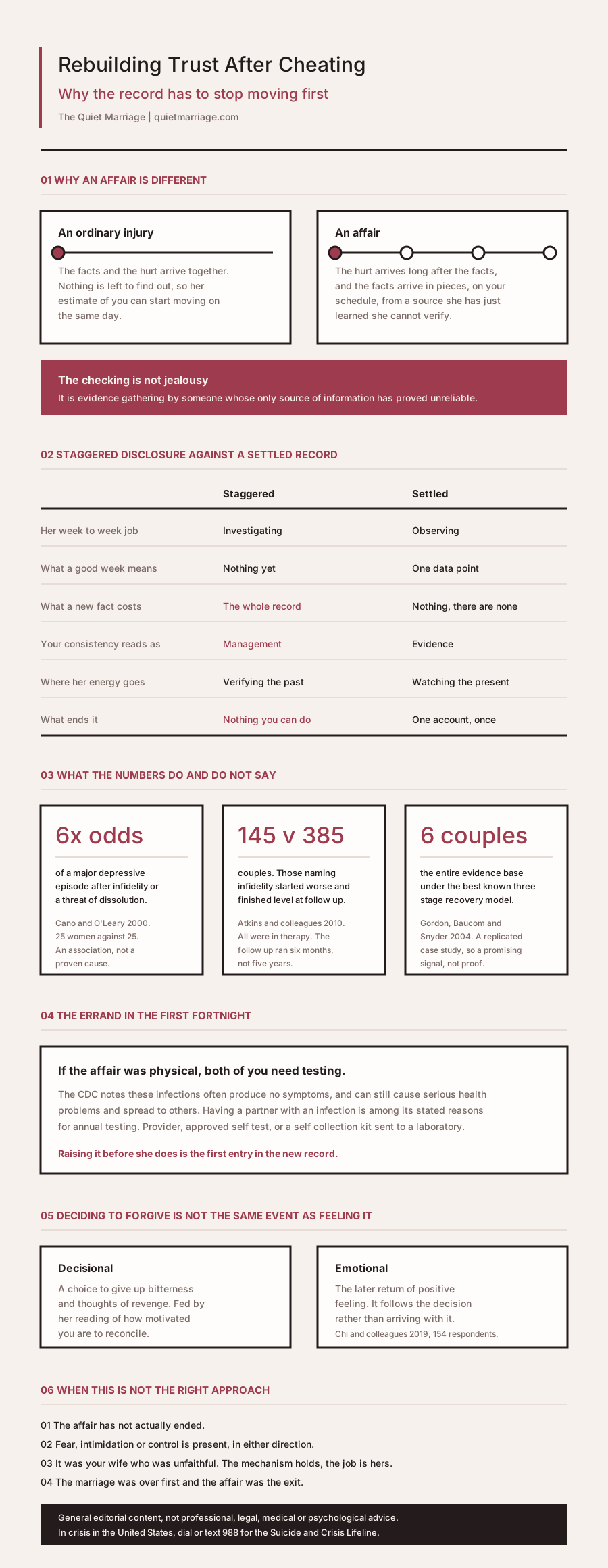
Run the two cases side by side and the asymmetry is obvious. After an ordinary injury, she knows what happened, she knows when it happened, and she knows how bad it was on the day it occurred. Her estimate of you can start moving immediately, because there is nothing left to find out. After an affair, she knows a fragment. She does not know how long. She does not know how many times, where, what was said about her, who else knew, or what she was told on a specific night that she now remembers with unusual clarity. Every one of those is a fact you hold and she does not.
That gap does something specific to her behaviour, and it is routinely mistaken for jealousy. The checking, the questions that arrive at eleven at night, the requests to see a phone she has already seen: these come from a person who has learned that the only available source of information about her own life is unreliable, and who is gathering evidence rather than making a character accusation or punishing you. Treat that behaviour as an insecurity problem and you will try to reassure it away. It is an information problem, so reassurance does not touch it.
The two pieces on this site about trust after other kinds of breach assume the record is already settled. Trust rebuilding after a real breach covers why forgiveness and trust are separate jobs that move at different speeds. Rebuilding relationship trust when nothing was betrayed covers the version where no single event is to blame. Both of those start where this article ends.
Staggered disclosure is why you are still at the beginning
The single most damaging pattern in affair recovery is drip feeding: an initial admission that covers roughly what she already had proof of, followed over weeks or months by a series of corrections, individually true, offered only under pressure, and each one making the previous account false.
Men do this for reasons that feel decent from the inside. You are protecting her from the worst of it, answering the question she asked rather than the one she did not, and waiting for a calmer week that never quite arrives. What she experiences is different and it is simpler. She experiences a fresh betrayal on the day of each correction, and the clock she is running on your reliability goes back to zero, because the person who reset it is you, again, in the present tense.
The clinical literature treats this decision as a genuine fork rather than an obvious one. In a two part paper in the Journal of Marital and Family Therapy, Butler, Harper and Seedall examined what they called an early pivot point in couple therapy: what a therapist should do when one partner privately discloses an infidelity to them and does not want it disclosed to the other. They set out the case that accommodating a secret can look both efficient and compassionate, given how volatile a couple becomes after disclosure. Weighing relationship ethics, the practical consequences, and the effect on attachment intimacy, they concluded that facilitating voluntary disclosure, although difficult and demanding, is the most ethical course and has the better prospects for renewed attachment intimacy.
Two things about that source, stated plainly. It is a reasoned ethical and clinical analysis, not a randomised trial, so it is an argument in the literature rather than a measured outcome. And it addresses the therapist's dilemma, not yours. What carries over is the underlying logic: intimacy is built on the assumption of a shared reality, and a managed release of the truth keeps that assumption suspended for as long as the release continues.
| Staggered disclosure | A settled record | |
|---|---|---|
| What she is doing week to week | Investigating | Observing |
| What a good week means to her | Nothing yet, the account may still change | One data point on the forecast |
| What a new fact costs | The whole accumulated record | Nothing, there are no new facts |
| What your consistency reads as | Management, or a gap not yet found | Evidence |
| Where her energy goes | Verifying the past | Watching the present |
| What ends it | Nothing you can do while facts remain held | One complete account, once |
The bottom row is the uncomfortable one. There is no conduct, however good, that substitutes for the missing information, because conduct answers a question she has not been able to start asking yet. This is the reason the advice to simply be consistent and let time do the work fails so often after an affair, when it is reasonable advice after most other injuries.
The practical implication is narrow and it is not comfortable. If facts remain that she would consider material and you have not said them, the recovery has not begun, and its start date is a decision you are currently making every day by not making it. Doing this well is one of the clearest cases for a couples therapist in the room, because the delivery matters and a third party can keep the conversation from becoming another injury.
What her symptoms actually are, and why they are a medical matter
If your wife has become someone you do not recognise since she found out, the most useful thing you can know is that this is a documented pattern with a name attached to it, and that it sits closer to depression than to anger.
Cano and O'Leary studied what they called humiliating marital events, defined as a husband's infidelity or a threat of marital dissolution. They compared 25 women who had recently experienced one with 25 women reporting similar levels of marital discord who had not. The women who had experienced the event had six times the odds of being diagnosed with a major depressive episode, and the difference held after controlling for family and lifetime histories of depression. They also reported significantly more symptoms of nonspecific depression and anxiety.
Hold that number carefully. Twenty five women per group is a small sample, the design compares groups rather than following them from before the event, and it was published in 2000. What it establishes is not a precise multiplier you can quote at a dinner party. It establishes an association that survived matching on marital discord and on depression history, rather than a proven cause. The comparison group carried similar discord and did not show the same rise in depression, which weighs against discord alone being the explanation, and a design like this still cannot rule out other unmeasured differences between the two groups.
The practical version of that finding is short. Sleeplessness, weight change, an inability to concentrate at work, and a flatness that does not lift are not overreactions to be waited out. They are reasons to see a doctor, and saying so out loud is one of the few genuinely useful things available to you in the first month. The American Psychological Association's psychologist locator will find a licensed clinician by area, and if she is in crisis at any point, in the United States the 988 Suicide and Crisis Lifeline is free and answers day and night.
The errand nobody puts in these articles
There is a concrete task in the first fortnight that most writing on this subject steps around, and stepping around it is a failure of nerve rather than of taste. If the affair was physical, both of you need testing for sexually transmitted infections, and she needs to be able to make that decision with real information rather than your reassurance.
The Centers for Disease Control and Prevention states plainly on its guidance on getting tested that sexually transmitted infections often have no symptoms, so a person may not know they have one, and that infections can cause serious health problems and spread to others even with no symptoms present. Its screening guidance names having a new partner, multiple partners, or a partner who has a sexually transmitted infection among the reasons a woman aged 25 or older should be tested annually. Testing can be done through a healthcare provider, through approved self tests, or through a self collection kit mailed to a laboratory, and the CDC's own Get Tested service lists free or low cost confidential testing nearby.
Volunteering this, before she asks, is also the first piece of evidence in the new record. It is a fact you hold that she needs, produced without being extracted.
What the outcome data honestly supports
The most reassuring finding in this literature is also the most misquoted, so here is what it says.
Atkins and colleagues ran a secondary analysis of couple therapy in a community sample in Germany and Austria, comparing 145 couples who reported infidelity as a problem with 385 couples who sought therapy for other reasons. The infidelity couples were significantly more distressed and reported more depressive symptoms at the start of therapy. They continued improving through the end of therapy and to six months afterwards, and at that follow up they were not statistically distinguishable from the couples who had come in for other reasons. Sexual dissatisfaction did not depend on infidelity status. The authors describe the results as generally optimistic, and note that they replicate earlier work from an efficacy trial.
The limits are worth stating because they change what the finding is good for. Every couple in it was in couple therapy, so this is evidence about a treated population and not about marriages left to recover on their own. The follow up runs to six months, not to five years. There was substantial missing data, which the authors address with sensitivity analyses. And couples who had already separated were not in the sample to be measured.
What survives all of that is still worth having on a bad night. Starting further back did not mean finishing further back. The steeper distress at intake did not predict a worse endpoint. If you are in month two and the distance between where you are and where an ordinary unhappy couple sits looks unbridgeable, that gap is a known feature of the starting position rather than a forecast.
Deciding to forgive and feeling forgiveness are two separate events
One more distinction saves a great deal of confusion, and it explains the months when she says she has forgiven you and behaves as though she has not.
Forgiveness researchers separate a decision to give up bitterness and thoughts of revenge, called decisional forgiveness, from the later restoration of positive feeling, called emotional forgiveness. Chi and colleagues tested how the two arise after infidelity specifically, with 154 respondents who had experienced or were experiencing a spouse's infidelity. Two things fed decisional forgiveness through benign attributions and empathy: a solidarity oriented personality, and her perception of how motivated you are to reconcile. Decisional forgiveness then promoted emotional forgiveness. Separately, the strength of the marital bond before the infidelity directly predicted emotional forgiveness.
The sample was Chinese and the authors present the work as culturally specific evidence, so treat the pathway as a plausible mechanism rather than a settled universal one. Read with that caution, one finding is directly actionable. What predicted the decision was her perception of your reconciliation motivation. Not your actual motivation, which she cannot see. Her reading of it, which is assembled from what you do when it is inconvenient.
That is also why a decision to forgive can arrive months before the feeling does, and why treating the decision as the finish line is the fastest way to lose the ground you have gained. The same trap appears in a slower form when nothing dramatic has happened at all, which is the subject of resentment in marriage.
The one treatment model, and what it rests on
The best known structured approach to affair recovery comes from Gordon, Baucom and Snyder. Their integrative intervention for promoting recovery from extramarital affairs uses a replicated case study design. Six couples entered and completed the treatment. The majority were less emotionally or maritally distressed at the end of it, and the injured partners reported greater forgiveness regarding the affair.
The authors are explicit about the state of the field around them. They note that affairs are a common presenting problem in couple therapy, that there is little empirical treatment research in the area, and that most therapists describe this as one of the more difficult problems to treat. That candour is the reason to cite the paper and also the reason to be careful with it. Six completing couples in an uncontrolled design is a promising signal, not an established efficacy result, and if a book or a coaching programme quotes this model to you as proven, the word proven is theirs and not the authors'.
What it is genuinely good for is the sequence. The model treats affair recovery as stages that run in order, beginning with dealing with the impact, moving through building a shared understanding of how it happened, and only then reaching the question of moving forward. That ordering is the same claim this article makes from a different direction. Understanding comes before rebuilding, and understanding requires facts.
When this is not the right article
If the affair has not ended, none of the above applies yet. There is no version of this work that runs concurrently with the thing it is meant to repair, and a rebuild attempted while contact continues is a second deception layered on the first, running alongside the one it was supposed to end.
This piece is also written from one side of the desk. It assumes you are the one who was unfaithful and are holding facts your wife does not yet have. If it was your wife who was unfaithful and you are the one deciding whether to trust her again, the underlying mechanism is the same, because a forecast still needs a settled record underneath it. The difference is that the job of settling that record belongs to her rather than to you, and the questions you are actually carrying, how you would know the record is genuinely complete and how long doubt stays reasonable before it becomes its own problem, are not the ones answered here.
If there is fear, intimidation or control in the marriage, in either direction, this is not a repair project and it should not be handled as one. Involve a licensed professional first. In the United States the National Domestic Violence Hotline can help you think through safety, at 1.800.799.7233.
If the honest answer is that the marriage was over before the affair and the affair was the exit, that is a different decision and it deserves to be made deliberately rather than by drift. Divorce for men after forty covers what that actually involves. And if what you are dealing with is a marriage that has quietly flattened with no single event to point at, how to save your marriage when nothing is actually wrong is the piece for that instead. And once the record has settled and the question becomes what the following years actually look like, the route back follows neither a linear nor a uniform course, which is worth knowing before you read a bad month in year two as a verdict.
Last reviewed by The Quiet Marriage Editorial Team on September 11, 2026. This piece was reviewed editorially, against its published sources. It was not reviewed by a licensed therapist, attorney or physician, and it is not a substitute for one. This is general editorial content and not professional, legal, medical or psychological advice. Decisions about disclosure, separation, custody and finances should be taken with a licensed professional in your own jurisdiction. If you are in crisis in the United States, dial or text 988 for the Suicide and Crisis Lifeline, which is free and available 24 hours a day.
FAQ
How do you rebuild trust after cheating?
By settling the factual record first and then producing conduct against it, in that order. Trust is a forecast your wife makes about your future behaviour, and a forecast needs stable ground underneath it. While material facts are still held back, each new one that surfaces cancels the evidence built since the last one, which is why consistency alone tends to produce nothing for months. One complete account, delivered once and ideally with a therapist present, is what allows ordinary reliable behaviour to start counting as evidence rather than as management.
Why does my wife keep asking questions she already asked?
Because she is verifying rather than accusing. She has learned that the only source of information about a period of her own life is one she cannot check, so she is testing the account for consistency the way anyone would test an unreliable source. Repetition is what verification looks like from the outside. It reduces when the account stops changing, and it does not reduce in response to reassurance, because reassurance is not the thing being sought.
Should I tell her everything or will details make it worse?
The clinical argument in the literature favours disclosure over accommodation. Butler, Harper and Seedall weighed relationship ethics, practical consequences and the effect on attachment intimacy, and concluded that facilitating voluntary disclosure, while difficult and demanding, is the most ethical course with the better prospects for renewed intimacy. Their paper is a reasoned analysis rather than a trial, and it addresses a therapist's dilemma rather than a husband's, so read it as a well argued position rather than a proven result. The practical point that carries over is that it is the staggering that does the damage, not the content.
How long does it take to rebuild trust after an affair?
No trustworthy published figure exists, and anyone quoting a specific number of months is inventing it. The nearest real evidence is that in a community sample, 145 couples naming infidelity kept improving through therapy and to six months afterwards, at which point they were not statistically distinguishable from couples who came in for other reasons. That is a treated population with a six month follow up, so it is not a timeline for a marriage working through it alone. The one variable genuinely under your control is when the record stops moving, and until it does the clock has not started.
Is it normal for her to be depressed rather than angry?
It is documented. Cano and O'Leary found that women who had recently experienced a husband's infidelity or a threat of dissolution had six times the odds of being diagnosed with a major depressive episode compared with women reporting similar marital discord without such an event, with the difference holding after controlling for family and lifetime histories of depression. That is a small matched sample from 2000 rather than a precise multiplier. Persistent sleeplessness, weight change or an inability to function at work are reasons to involve a doctor rather than things to wait out.
She says she forgives me but nothing has changed. What is happening?
Most likely she has made a decision she has not yet felt. Forgiveness research separates decisional forgiveness, a choice to give up bitterness and thoughts of revenge, from emotional forgiveness, the later return of positive feeling. Chi and colleagues found the decision was fed by her perception of your motivation to reconcile, and that the decision then promoted the feeling over time. Hearing the words and concluding the matter is closed is the most reliable way to stall the process in the month after it looks fixed.
Do we need a therapist for this?
For the disclosure conversation specifically, there is a strong case for it, because the sequencing matters and a third party can keep the conversation from becoming another injury. Beyond that, the honest position is that the outcome evidence in this area describes couples who were in therapy. The community sample followed couples in treatment, and the best known structured model was tested on six couples who completed a therapist delivered programme. None of that measures what happens without one. The American Psychological Association's locator lists licensed clinicians by area.
Should we get tested for sexually transmitted infections?
If the affair was physical, yes, and raising it before she does is the right move. The CDC notes that these infections often produce no symptoms, that they can still cause serious health problems and spread to others, and that having a partner with an infection is among the reasons for annual testing. Options include a healthcare provider, approved self tests, and self collection kits mailed to a laboratory, with free or low cost confidential testing listed on the CDC's Get Tested service.
Can a marriage genuinely recover from infidelity?
The available evidence says it happens often enough to be worth attempting, and stops well short of a guarantee. In the community sample, couples who arrived more distressed and more depressed than everyone else finished therapy and six month follow up indistinguishable from couples who had come in for other reasons. Set against that, the sample was in treatment, the follow up was short, and couples who had already separated were not present to be counted. Starting further back did not mean finishing further back, which is a narrower claim than recovery being likely, and it is the one the data actually supports.
Can trust be rebuilt while the affair is still going on?
No. If the affair has not ended, none of the rebuilding work applies yet. There is no version of this work that runs concurrently with the thing it is meant to repair, and a rebuild attempted while contact continues is a second deception layered on the first, running alongside the one it was supposed to end. Ending contact is not the first step of the repair. It is the condition that has to be met before any of the steps count as evidence of anything.
Sources
- Butler, Harper and Seedall examined what they called an early pivot point in couple therapy (pubmed.ncbi.nlm.nih.gov)
- The women who had experienced the event had six times the odds of being diagnosed with a major depressive episode (pubmed.ncbi.nlm.nih.gov)
- American Psychological Association's psychologist locator (locator.apa.org)
- 988 Suicide and Crisis Lifeline (988lifeline.org)
- guidance on getting tested (cdc.gov)
- 145 couples who reported infidelity as a problem with 385 couples who sought therapy for other reasons (pubmed.ncbi.nlm.nih.gov)
- 154 respondents who had experienced or were experiencing a spouse's infidelity (pubmed.ncbi.nlm.nih.gov)
- integrative intervention for promoting recovery from extramarital affairs (pubmed.ncbi.nlm.nih.gov)
- National Domestic Violence Hotline (thehotline.org)