How to Improve Communication Skills in Marriage: Fix the Conditions, Not the Sentences
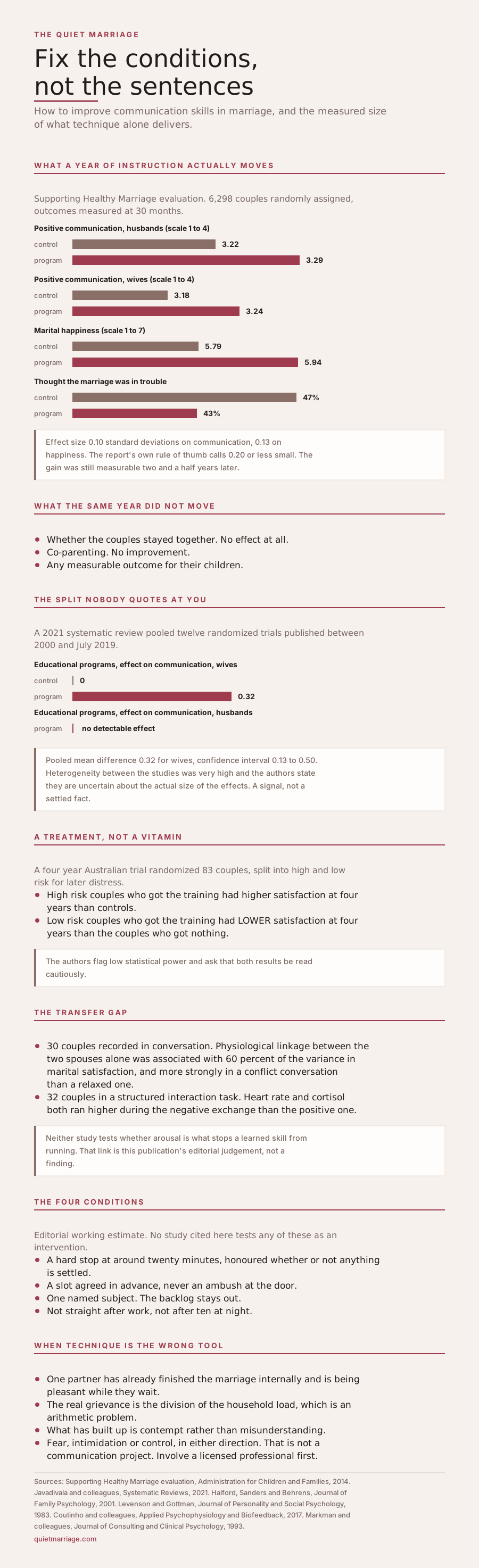
Communication skills in a marriage are trainable. That is the part most people never get told, because the advice arrives either as a promise or as a dismissal and almost never as a measurement. The largest randomized test of teaching married couples these skills in the United States assigned 6,298 couples and measured them at 30 months, and it found a gain in positive communication of about a tenth of a standard deviation, statistically solid, still there two and a half years later. The gain is real, small, and durable.
That number matters more than it looks, and not because it is impressive. It sets the ceiling on technique. Whether communication drives marital satisfaction in the first place is a separate and much shakier question, and what the evidence on communication skills in marriage actually supports is the piece that takes it apart. This one starts from the assumption that you want to get better at it, and asks what actually moves. If a year of structured instruction, delivered by trained staff to couples who volunteered for it, moves the needle by a tenth of a standard deviation, then the thing standing between you and a better conversation at nine at night is not your ignorance of a sentence format. You probably already know to say "I felt" instead of "you always". Knowing it has not helped, and the reason is not that you learned it wrong.
The short version, for anyone who does not want the evidence first: change the conditions rather than the wording. Agree the conversation in advance instead of starting it cold, hold it to one named subject, give it a hard stop at around twenty minutes, and pick an hour when neither of you is already spent. The rest of this page is why the conditions carry more weight than the vocabulary, and where that claim stops being measured and starts being editorial judgement. The studies below report their results by husband and wife because that is how the data was collected. The pattern they describe, two nervous systems reacting to each other in real time, is not specific to who is in the marriage.
What improving your communication actually buys you
The Supporting Healthy Marriage evaluation ran from 2007 to 2009 across eight local programs, randomly assigning 6,298 low income married couples to a year long relationship education program or to a control group, then following 6,095 of them to 30 months. The program taught the standard curriculum: managing conflict, speaking and listening in structured turns, building affection and friendship.
On a four point scale, husbands in the program group reported positive communication skills at 3.29 against 3.22 for control husbands. Wives reported 3.24 against 3.18. Both differences held at the strictest significance threshold the report used, and both amount to an effect size of 0.10. Reported warmth and support moved by a similar margin. Negative behaviour and emotions moved down, slightly more for wives than husbands. Marital happiness on a seven point scale sat at 5.94 in the program group against 5.79 in the control group, an effect size of 0.13. The share of couples who had thought in the previous three months that their marriage was in trouble ran to over 47 percent in the control group against 43 percent in the program group.
And the program did not increase the likelihood that couples stayed together at all. It did not improve co-parenting. It produced no measurable benefit for the children.
So the honest summary is this. A full year of professional instruction reliably makes the conversation somewhat better and does not change whether the marriage survives. If you came here looking for the sentence that fixes it, none exists, which is better news than it sounds, because it points the attention somewhere more productive than wording.
The finding nobody quotes at you
A 2021 systematic review and meta-analysis in Systematic Reviews pooled twelve randomized trials of marriage and relationship programs published between 2000 and July 2019, and broke the results out by gender. For the educational and communication skills programs specifically, the pooled effect on relationship communication was small to medium for wives, at a mean difference of 0.32 with a confidence interval running from 0.13 to 0.50, and there was no effect on husbands.
The authors are careful about their own result, and so should anyone quoting it be. Heterogeneity across the studies was very high, the pooled estimates for the enrichment programs came with a confidence interval stretching from 0.13 to 2.50, and the review states plainly that it is uncertain about the actual size of the effects. That is a limitation rather than a disqualification. What the review cannot tell you is why the gap runs in that direction, whether it reflects who enrols, who does the work of practising at home between sessions, how each spouse rates their own behaviour on a questionnaire, or something the studies never measured.
There is a second result in the same shape. An Australian trial randomized 83 couples, stratified into high and low risk for later distress, into a self regulatory version of the PREP curriculum or a control condition, and followed them for four years. The high risk couples benefited and the low risk couples did not. Among low risk couples, relationship satisfaction at four years was actually higher in the control condition. The authors flag low statistical power and ask that the result be read cautiously, which is the right caveat to carry forward, but the pattern holds either way: skills training helped the couples who were already struggling and did nothing visible for the couples who were fine.
Both findings point the same way. Communication training is a treatment, not a vitamin. It does something when there is a specific problem for it to act on, and applying it generically, to a marriage that has gone quiet for reasons that have nothing to do with technique, is the most common way people spend a year of effort and feel nothing change.
Why you cannot perform a skill in the state where you need it
The advice skips a physiological pattern worth naming.
In 1983, Levenson and Gottman recorded thirty married couples during two conversations, one low in conflict about the events of the day and one high in conflict about a marital problem, tracking heart rate, skin conductance, pulse transmission time and somatic activity in both spouses at once. They measured the degree to which the two bodies moved together, which they called physiological linkage. Linkage alone accounted for 60 percent of the variance in marital satisfaction, and the effect was more pronounced in the high conflict conversation than in the low conflict one.
A 2017 study put 32 couples through a structured conversation about the positive and the negative aspects of their relationship while measuring heart rate, skin conductance and cortisol. Heart rate and cortisol were both higher during the negative condition than the positive one. Skin conductance, curiously, ran higher in the positive condition, which is a reminder that arousal is not a single dial and that anyone selling you a simple physiological story is overselling. The study also found the expected inverse relationship between heart rate variability and the arousal the task evoked.
Be careful about what this does and does not establish. Neither study tests a technique, neither tests whether arousal is what stops a learned skill from running, and neither says that lowering your heart rate saves a marriage. What they show is narrower: arousal runs higher in a conflict conversation than in a relaxed one, and the degree to which two spouses' bodies track each other is strongly associated with how satisfied they are.
The working idea on this page, which those studies do not themselves test, is that a skill rehearsed in a calm room is harder to execute in a body under load. If that is right, what you have is a transfer problem, and transfer problems are solved by changing the conditions of performance rather than by studying harder.
The four conditions, and what each one is doing
Everything below is an editorial working estimate built on the mechanism above. No study cited here tests any of these as an intervention, and anyone presenting them as proven is going further than the evidence goes. What they have going for them is that each one attacks the transfer problem rather than the knowledge problem.
| Condition | What it is actually doing | The failure it replaces |
|---|---|---|
| A hard stop on the clock | Ends the conversation while both bodies are still inside the band where a skill can run | The two hour conversation that was fine for twenty minutes |
| A scheduled slot, agreed in advance | Removes the ambush, which is most of the initial arousal spike | Raising it the moment your spouse comes through the door, before either of you has landed |
| One subject, named before you start | Keeps the backlog out, since twenty years of grievance arriving at once is what pushes arousal past the band | The argument about the dishes that becomes the argument about 2019 |
| Not immediately after work, not after ten at night | Starts the conversation lower on the curve so there is more room before the crossing | The nightly attempt at the exact hour both people have least capacity |
None of that is about what you say. All of it is about where on the curve you are standing when you say it, and how long you stay there.
One caution about the table. Scheduling a conversation sounds cold, and for some couples the coldness is itself the problem, so the slot has to be short and it has to actually end, or it turns into a standing appointment with dread. Twenty minutes is the figure many practitioners work with. Treat it as a starting point rather than a finding. And if a fixed slot, a single permitted topic or a hard stop is being used to stop you raising something at all, that is not structure, it is control, and the note near the end of this piece applies instead.
Where practice actually belongs
The standard advice has you practising the skill in the hardest available conditions: the live disagreement, at the worst hour, with the thing you care most about on the table. Nobody learns a motor skill that way, and there is no reason to expect a conversational one to behave differently.
The low stakes version is the one that transfers. Levenson and Gottman's calm condition was a conversation about the events of the day, and the reason it matters is that it is the same two people, the same room, the same nervous systems, with the linkage effect weaker, though the paper does not say by how much. A marriage that can hold fifteen minutes about the events of the day is a marriage where the skill has somewhere to live. A marriage that cannot has no practice ground at all, and dropping technique into the one conflict conversation a month is asking for a performance nobody rehearsed.
If your evenings currently contain no low stakes conversation whatsoever, that is the first project, before any of this. How to reconnect with your wife deals with rebuilding that ground floor, and the same mechanics run in reverse if you are the one trying to reach a quiet husband. Where the silence itself is the obstacle rather than the schedule, what is actually happening when a husband is emotionally unavailable separates four different causes that look identical from the outside and need opposite responses.
Does any of it hold for years
The PREP curriculum, five sessions of communication and conflict management training, was followed up at four and five years in a 1993 paper in the Journal of Consulting and Clinical Psychology. At the five year mark, couples who had taken the program showed higher positive and lower negative communication skills, and lower levels of marital violence, compared with controls.
Read the same paper's own discussion before quoting that at anyone. The authors raise selection effects directly, and report separately on the couples who declined the program, because who signs up for five sessions of conflict management training is not a random slice of married people. The durable finding is that the gains do not evaporate across five years. People routinely stretch that into a claim that five sessions changed the trajectory of a marriage, which the paper does not make.
The three long follow ups agree with each other. Communication skills rise and the gain holds for years, and none of the three found that the trajectory of the marriage changed with it.
When this is the wrong project entirely
Technique is the wrong tool when the problem is not technique, and there are four common cases where reaching for it wastes the year.
When one person has already finished the marriage internally and is being pleasant while they wait, better conversations will be pleasant and go nowhere. When the real distribution of the household is the grievance, no wording fixes an arithmetic problem, and the mental load is the piece for that. When what has actually built up is contempt rather than misunderstanding, resentment in marriage needs to be dealt with on its own terms first, because a well run conversation between two people who have stopped respecting each other is still a conversation between two people who have stopped respecting each other. And when the marriage is quiet without any identifiable fault, which is the commonest case on this site, how to save your marriage when nothing is actually wrong is the more honest starting point.
There is a fifth case that overrides all of it. If there is fear, intimidation or control in the marriage in either direction, this is not a communication project and it should not be handled as one. Involve a licensed professional first. In the United States the National Domestic Violence Hotline can help you think through safety, at 1.800.799.7233, and if you are in crisis you can dial or text 988 for the Suicide and Crisis Lifeline at any hour.
Last reviewed by The Quiet Marriage Editorial Team on September 12, 2026. This piece was reviewed editorially, against its published sources. It was not reviewed by a licensed therapist, attorney or physician, and it is not a substitute for one. This is general editorial content and not professional, legal, medical or psychological advice. Our sourcing and AI use rules are public on the editorial standards page. If you are looking for a therapist in the United States, the American Psychological Association maintains a psychologist locator. If you are in crisis in the United States, dial or text 988 for the Suicide and Crisis Lifeline, which is free and available 24 hours a day.
FAQ
How do you improve communication skills in a marriage?
Change the conditions before the wording, in this order. First, agree the conversation in advance rather than starting it cold. Second, name the single subject before you begin and keep the backlog out. Third, set a hard stop at around twenty minutes and honour it whether or not anything is settled. Fourth, hold it at an hour when neither of you is already spent, which usually rules out the moment either of you walks in and anything after ten at night. Fifth, build a low stakes conversation into the week that has nothing to ride on it, because that is the only place the skill gets rehearsed. In a trial of 6,298 couples, a year of professional instruction raised self reported positive communication by about a tenth of a standard deviation, which is the honest size of what technique alone delivers.
Do marriage communication courses work?
They work in a measurable and modest way. The Supporting Healthy Marriage evaluation found small improvements in communication, warmth and marital happiness that lasted two and a half years, and no effect at all on whether couples stayed together, on co-parenting, or on outcomes for their children. A four year Australian trial found benefits for couples already at high risk of distress. Among the low risk couples, satisfaction at four years was higher in the group that got no training than in the group that did, though the authors flag low statistical power and ask that the result be read cautiously. A course is worth taking if there is a specific problem for it to act on.
Why does this seem to work for one of us and not the other?
There is a real finding behind that impression, and it runs in a consistent direction. A 2021 meta-analysis of twelve randomized trials found that educational and communication skills programs produced a small to medium improvement in relationship communication for wives, at a pooled mean difference of 0.32, and no detectable effect for husbands. The authors stress that heterogeneity between the studies was high and that they are uncertain about the true size of the effects, so treat it as a signal rather than a settled fact about your own marriage. What the review cannot tell you is why the gap runs that way.
Why do I know what to say and still not say it?
The likeliest explanation is that you are being asked to execute in a state you did not train in, though no study has tested that directly. What has been measured is this: physiological linkage between two spouses is associated with around 60 percent of the variance in marital satisfaction, the effect is stronger in a conflict conversation than in a relaxed one, and heart rate and cortisol both run higher during a negative exchange. None of that proves arousal is what blocks the skill. It does mean the conditions you are performing in are different from the conditions you learned in.
How long should a difficult conversation last?
Shorter than feels natural, and it should end on a clock rather than on a resolution. Roughly twenty minutes is the figure many practitioners work with, though no study cited here tests a duration, so this is an editorial working estimate. The purpose of a hard stop is that the conversation stays survivable, and survivable is what makes the next one possible.
Can communication improve if only one of us is trying?
Partly. One person can set the conditions, which is most of what matters here: choosing the hour, naming the single subject, ending on time, refusing the ambush. What one person cannot do is supply both halves of the exchange. If months of that produce nothing at all, the honest read is usually that the problem was never technique, and how to save your marriage takes it from there.
Do I statements actually help?
They help a little, as part of a curriculum that helps a little. No trial cited here isolates that one instruction, so nobody can honestly tell you what an I statement is worth on its own. What is measurable is the whole package of instruction moving communication by about a tenth of a standard deviation over a year. Expecting a sentence format to carry more than that is where the disappointment comes from.
Should we see a couples therapist instead of reading about it?
In the 2021 meta-analysis, therapy programs produced a larger effect on relationship satisfaction than the educational or enrichment ones, at a pooled mean difference of 0.53 with a confidence interval of 0.35 to 0.71, and the effect was larger for wives than for husbands. The same caution applies, since heterogeneity across the pooled studies was high. If the marriage is in real trouble, that still points toward a therapist rather than a book. The APA psychologist locator is a starting point in the United States.
How long before better communication changes anything?
Assume months, not weeks, and assume the first visible change is that conversations stop ending badly rather than that anything gets resolved. The long follow ups are the useful guide here: the gains in the trials were measured at 30 months and at five years, and they were modest at both points. Anything promising you a transformed marriage by next month is selling something.
When is working on communication the wrong thing to be doing?
When the problem is not technique. Four cases come up repeatedly. One person has already finished the marriage internally and is being pleasant while they wait, so better conversations stay pleasant and go nowhere. The real grievance is the distribution of the household, which is an arithmetic problem no wording fixes. What has built up is contempt rather than misunderstanding, which has to be dealt with on its own terms first, because a well run conversation between two people who have stopped respecting each other is still a conversation between two people who have stopped respecting each other. Or the marriage is quiet with no identifiable fault, which is the commonest case on this site. A fifth case overrides all of them: if there is fear, intimidation or control in the marriage in either direction, this is not a communication project and should not be handled as one. Involve a licensed professional first. In the United States the National Domestic Violence Hotline is at 1.800.799.7233, and if you are in crisis you can dial or text 988 for the Suicide and Crisis Lifeline at any hour.
Sources
- Supporting Healthy Marriage evaluation (acf.gov)
- no effect on husbands (pubmed.ncbi.nlm.nih.gov)
- The high risk couples benefited and the low risk couples did not (pubmed.ncbi.nlm.nih.gov)
- Linkage alone accounted for 60 percent of the variance in marital satisfaction (pubmed.ncbi.nlm.nih.gov)
- Heart rate and cortisol were both higher during the negative condition (pubmed.ncbi.nlm.nih.gov)
- couples who had taken the program showed higher positive and lower negative communication skills, and lower levels of marital violence (pubmed.ncbi.nlm.nih.gov)
- National Domestic Violence Hotline (thehotline.org)
- Suicide and Crisis Lifeline (988lifeline.org)
- psychologist locator (locator.apa.org)