Rebuilding Relationship Trust When Nothing Was Betrayed
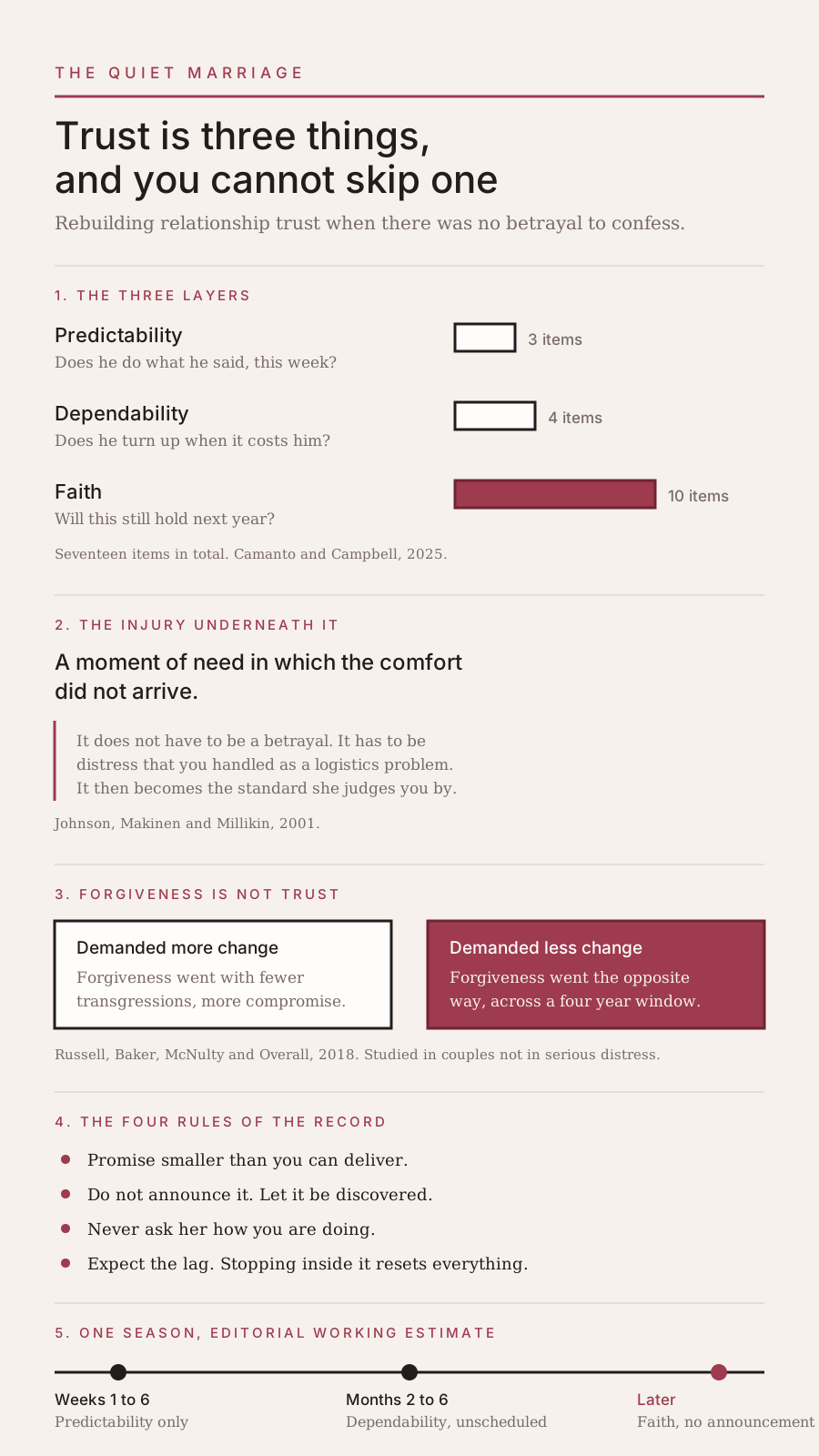
Rebuilding relationship trust means rebuilding three separate things that are built on each other rather than added up, and the common mistake is starting with the one that needs the other two underneath it. Measurement work on trust in close relationships resolves it into predictability, dependability and faith, published as Trust in close relationships revisited in the Journal of Social and Personal Relationships in 2025. Predictability is a short forecast about behaviour. Dependability is a judgement about character when the behaviour costs something. Faith is a bet about a future that no amount of evidence fully settles. A man who senses his wife no longer trusts him almost always reaches straight for faith, in one long earnest conversation, and finds the conversation changes nothing at all.
This piece is about the version of the problem with no betrayal in it. No affair, no secret account, no lie anybody could point at. Two people who have been married a long time, who are still perfectly civil, and where one of them has quietly stopped counting on the other. That case gets far less attention than the dramatic one, because the standard article about trust assumes there is a confession to make.
Before any of it, one line that should not wait until the end. If there is fear in the house, contempt, addiction, coercion or anything that frightens either of you, the method in this piece is not the right tool and delay is not neutral. That belongs with a licensed professional now. If you are in crisis in the United States, dial or text 988 for the Suicide and Crisis Lifeline, which is free and available 24 hours a day.
Trust is three things, not one
The 2025 study ran two samples, 494 people and then 847, and confirmed a structure first proposed by Rempel and colleagues in 1985. Trust holds together as three factors rather than one feeling.
Predictability is the short run. Does he do the thing he said he would do, this week, in the ordinary case where it costs him almost nothing? It is the cheapest layer to move and the quickest to read.
Dependability is about conduct under cost. Will he show up when showing up is expensive, inconvenient, embarrassing or badly timed? Predictability is answered by a diary. Dependability is only ever answered by events you cannot schedule.
Faith is the leap. Will he still be the person I think he is next year, in situations neither of us has seen yet? No evidence closes this question, which is exactly why it is a leap.
The authors describe trust developing as a process of construction rather than addition, and that distinction is the whole practical point. You are not accumulating points in an account. You are building a structure in which the upper floors rest on the lower ones. Faith without dependability underneath it is not trust. It is hope, and your wife almost certainly stopped running on hope some years ago.
That structure also explains the length of the refined measure. Ten of its seventeen items sit in the faith factor, three in predictability and four in dependability. The factor that carries the most weight is also the one that takes the most description to capture.
One thing to be clear about, because it matters for what follows. The three factor structure is the study's finding. The order of work set out in the rest of this piece, and the timings later on, are this publication's reading of what that structure implies for a rebuild. The research validated a shape. It did not put a clock on it.
The injury you probably cannot name
Trust in a long marriage rarely ends. It gets a specific injury, and then it stops being renewed.
The clinical construct for this is the attachment injury, defined in the Journal of Marital and Family Therapy in 2001 by Johnson, Makinen and Millikin, Attachment injuries in couple relationships. Their definition is precise and worth quoting closely. An attachment injury occurs when one partner violates the expectation that the other will offer comfort and caring in times of danger or distress. It is characterised by an abandonment or a betrayal of trust at a critical moment of need. The paper's central observation is the one that matters here: the incident is then used continuously as the standard for the dependability of the other partner, and it creates an impasse that blocks repair.
Read that again with a quiet marriage in mind. The event does not have to be a betrayal in the ordinary sense. It has to be a moment of need in which the comfort did not arrive. Where there was a betrayal in the ordinary sense, an admitted one with a name and a date, the job divides differently and forgiveness stops being the same task as trust. That case is covered separately in trust rebuilding after a real breach.
A hospital corridor. A miscarriage. A funeral where you handled the arrangements beautifully and never once sat down next to her. The night her father's diagnosis came through and you researched the treatment. You remember these as competence. She filed them as absence. Men in this position often have no idea which night is on the file, because on your side of it nothing went wrong.
This is also why the flat, agreeable version of a marriage can be the one in trouble. If you have read our piece on being lonely in a marriage, the mechanism is the same one. Nothing is happening, which is not the same as nothing being wrong. If the pattern on your side is that feeling arrives as blankness rather than as words, the piece on a husband who is emotionally unavailable sets out what is underneath that.
| Layer | Question it answers | What builds it |
|---|---|---|
| Predictable | Does he do what he said? | A run of small kept dates |
| Dependable | Does he turn up when it costs? | Being there at the hard moments |
| Faith | Will this hold next year? | Time, and nothing but time |
One caution about the table. The three layers are not stages you complete and leave behind. Predictability has to keep running underneath the whole thing for years. The moment the small kept promises stop, the upper layers lose their footing, and they lose it much faster than they gained it.
Why she forgave you and nothing changed
Forgiveness on its own does not rebuild trust. Pairing it with a clear standing expectation is what does, and that distinction explains a very common dead end.
In 2018 the Journal of Family Psychology published You're forgiven, but don't do it again by Russell, Baker, McNulty and Overall. Two studies. The first was experimental, with couples led to believe their partner was either forgiving or unforgiving and then given an opportunity to transgress. The second followed newlywed couples for four years, asking every six months how satisfied each person was with the other's considerateness.
Both studies pointed the same way. Among people who directly demanded more change from their partner, forgiveness went with the partner transgressing less and compromising more. Among people who demanded less change, forgiveness went with the opposite. Forgiveness on its own did not protect the relationship. Forgiveness paired with a clear standing expectation did.
Two honest limits on that. It was studied in couples who were not in serious distress, and the behaviour measured was everyday transgression and considerateness rather than anything catastrophic. It is not a licence to hand anybody a list of demands.
What it does mean is that a wife who forgave you easily and asked for nothing was not necessarily being generous. Very often she had already stopped expecting the change, which is a quieter and far worse thing. If asking has been replaced by not asking, the ledger described in our piece on resentment in a marriage is usually already open, and it has been running without your knowledge.
The rebuild is a record, not a conversation
Everything above points at one method, and it is unglamorous.
Start at predictability, deliberately, and stay there longer than feels dignified. Predictability is the only layer you can move on your own initiative, on a schedule, without her cooperation and without a single conversation about the state of the marriage.
Four rules make it work.
Promise smaller than you can deliver. The purpose of this phase is a clean record, not an impressive one. Ten small kept things beat one large kept thing, because you are rebuilding a forecast and a forecast needs frequency.
Do not announce it. An announced campaign asks her to evaluate you, which puts her back in the position of judge and puts you back in the position of waiting for a verdict. The record has to be discoverable rather than presented.
Never ask how you are doing. Asking transfers the work back to her. It also tells her the effort was aimed at the scoreboard rather than at the thing itself.
Expect the lag. Nothing visible happens for a while. This is where most men conclude it is not working and stop, which resets the record to zero and adds a fresh data point saying his efforts run out. That one dynamic ends more attempts than any argument does.
| What actually moves it | What does not |
|---|---|
| Small kept promises, week after week | One large gesture |
| Turning up when it costs you | Explaining why you were right |
| Being ordinary and consistent | Asking her to notice |
| Letting her keep her doubt | Requiring credit early |
If a fair share of the running of the house is one of the things that has quietly stopped being reliable, the load itself is the record. Our piece on the mental load covers what that looks like in practice, and it is one of the few areas where predictability and dependability are visible in the same act.
What a season of this looks like
The timings below are an editorial working estimate, drawn from the shape of the research rather than from any published schedule. No study puts a clock on this. Treat them as an order of magnitude.
The first six weeks are pure predictability. Small, dated, boring. You will feel like you are doing nothing, and you are doing the only part you control.
Months two to six belong to dependability, and you cannot plan them. Dependability is proven by cost events, which arrive on their own timetable. A crisis at her work. A sick parent. A night that is going badly for her and is not about you. What you do in those hours is worth more than the whole preceding period.
Faith comes last and it does not announce itself. There is no moment where she tells you she trusts you again. You notice instead that she has started telling you things before she has finished deciding what she thinks about them. That is the signal, and it is the only one.
If you are working on this alongside a broader effort to reconnect, our piece on how to save your marriage when nothing is actually wrong sets out the wider pattern this fits inside, and the piece on communication skills in a marriage covers what to do in the conversations themselves.
When this is not a trust problem
Some of what gets called lost trust is something else, and the something else needs a different instrument.
If there is fear in the house, contempt, addiction, coercion or anything that frightens either of you, the method above is not the right tool and delay is not neutral. That belongs with a licensed professional now rather than after a season of small kept promises. The American Psychological Association publishes general guidance on marriage and relationships and on finding a qualified practitioner.
It is also worth being honest that the marital form itself carries some of this. Pew Research Center's report on marriage and cohabitation in the United States found married adults reporting higher satisfaction, trust and closeness in their relationships than cohabiting adults, and that the difference held after controlling for demographic factors including gender, age, race, religion and education. Being married is not a small amount of accumulated structure. It is worth remembering what you already have underneath you before concluding the whole thing has gone.
And if the question has moved past repair, the piece on divorce for men covers that ground plainly, and the piece on divorce support groups for men covers what to do with the year that comes after it. Last reviewed by The Quiet Marriage Editorial Team on August 28, 2026. This piece was reviewed editorially, against its published sources. It was not reviewed by a licensed therapist, counsellor or physician, and it is not a substitute for one. Our sourcing and AI use rules are public on the editorial standards page. This is general editorial content and not professional, medical or psychological advice. A marriage in genuine difficulty should be discussed with a licensed professional in your own jurisdiction. If you are in crisis in the United States, dial or text 988 for the Suicide and Crisis Lifeline, which is free and available 24 hours a day.
FAQ
How long does it take to rebuild trust in a relationship?
Predictability can read within about six weeks, dependability has no fixed timeline because it waits on a costly moment arriving, and faith comes last and without announcement. Those timings are an editorial working estimate rather than a published schedule, since no study puts a clock on it. The practical consequence is that the middle of the process is the part you cannot shorten by working harder, because you do not control when the moment that proves you turns up.
Can trust be rebuilt if there was never an affair?
Yes, and that is the more common case. Trust in a long marriage usually does not end in a single betrayal. It takes a specific injury at a moment of need, the kind the 2001 attachment injury literature describes, and then it simply stops being renewed. There is often no confession available to make, which is precisely why the standard advice does not fit.
Is forgiveness the same as rebuilt trust?
No, and treating them as the same is a common dead end. The 2018 Journal of Family Psychology research found that among people who demanded less change from their partner, forgiveness went with the partner behaving worse rather than better, across a four year follow up. Forgiveness settles the past. Trust is a forecast about the future, and only a record of conduct moves a forecast.
What is the first step in rebuilding relationship trust?
Predictability, deliberately and for longer than feels dignified. Promise something small, deliver it, and repeat that at a steady frequency without announcing what you are doing. It is the only layer that moves on your own initiative, without her cooperation and without a conversation about the state of the marriage.
Can you rebuild trust on your own if your partner will not discuss it?
The predictability layer, yes, entirely. It requires nothing from her except that she is present to observe a record she never agreed to watch. Dependability follows from that on its own. What one person cannot do alone is address a named attachment injury, because that specific work is a conversation, and it is the part most likely to need a professional in the room.
Why does nothing seem to change when I am clearly making an effort?
Because a forecast updates on accumulated evidence rather than on the first few data points, so nothing visible moves for weeks even when the record underneath is intact. The useful correction is to fix the review date in advance and hold to it. Judge the method at the six week mark rather than the six day mark, and keep the small kept promises running until then. Deciding it has failed on day nine is a judgement made on a sample too small to carry it.
Does one big gesture help rebuild trust?
Rarely, and often it sets things back. A gesture happens once, and what you are rebuilding is a rate rather than an occasion. A large gesture also asks to be noticed, which puts your wife back in the position of judging you and puts you back in the position of waiting for a verdict. There is a second cost that is easy to miss. A gesture is legible as effort, so it can be read as an attempt to settle the account in one payment, which is the opposite of the signal a rebuild needs to send.
What are the steps to rebuilding trust, and do trust exercises for couples work?
The steps are the three layers in order, predictability first, then dependability, then faith, and the reason exercises disappoint is that they mostly sit outside that order. Step one is six weeks of small kept promises at a steady frequency, promised smaller than you can deliver, not announced, with no asking how you are doing. Step two is not a step you can schedule at all, because dependability is only ever answered by cost events that arrive on their own timetable, a crisis at her work, a sick parent, a night that is going badly for her and is not about you. Step three is not an action, it is the signal that the first two landed, and it shows up as her telling you things before she has finished deciding what she thinks about them. That is where a set of exercises breaks down. An exercise is a scheduled occasion, and what you are rebuilding is a rate, so the drill can be completed perfectly without moving the layer that needed the evidence. A scheduled exercise also asks to be noticed, which puts her back in the position of judging you and you back in the position of waiting for a verdict. If you want something to do this week, the list is short: small kept promises week after week, turning up when it costs you, being ordinary and consistent, and letting her keep her doubt for as long as she needs it.
Sources
- Trust in close relationships revisited (pmc.ncbi.nlm.nih.gov)
- Suicide and Crisis Lifeline (988lifeline.org)
- Attachment injuries in couple relationships (pubmed.ncbi.nlm.nih.gov)
- You're forgiven, but don't do it again (pubmed.ncbi.nlm.nih.gov)
- American Psychological Association (apa.org)
- marriage and cohabitation in the United States (pewresearch.org)