Lonely in Marriage: The Particular Isolation of Living Beside Someone
A man can be lonely in an empty house and understand exactly what is happening to him. The same man can be lonely in a full one and have no idea what to call it, because every fact in front of him says he should be fine. She is there. The marriage is not in crisis. Nobody is shouting. There is nothing to point at.
That is the version that does the damage, precisely because it has no incident attached to it.
The difference between alone and lonely
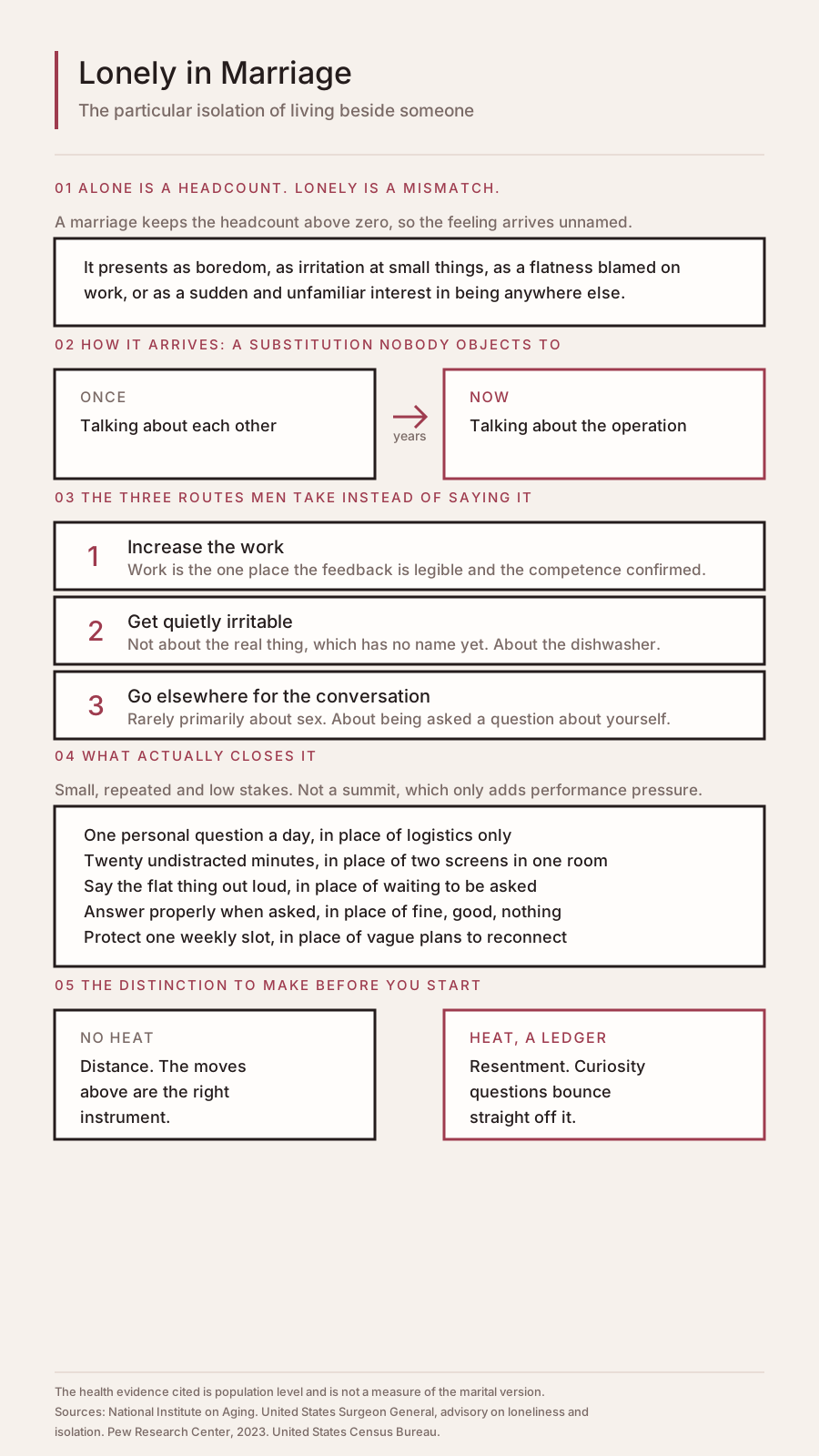
Alone is a headcount. Lonely is a mismatch between the connection you have and the connection you need. Those two facts are why a marriage is the easiest place in the world to be lonely without noticing.
You have company constantly. You have logistics, weekends, a shared calendar, a shared bed, in-laws, all the machinery of a life built with somebody. The headcount is never zero. So when the feeling arrives, it does not present itself as loneliness. It presents as boredom, or irritation at small things, or a flatness you blame on work, or a sudden and unfamiliar interest in being anywhere else.
The National Institute on Aging is blunt that loneliness and social isolation carry consequences beyond mood, which is worth stating plainly for a reader who has spent his life treating feelings as optional. This is not a soft problem. It is a load bearing one.
Why it happens to competent marriages
This kind of distance almost never arrives through a betrayal or a fight. It arrives through a substitution, and the substitution is so reasonable that neither person objects to it at the time.
Two people who once talked about themselves start talking about the operation. The children, the schedule, the house, the money, the parents, the car. Every one of those conversations is necessary. Together they can fill every available minute for fifteen years, and they can be conducted successfully by two people who have not asked each other a real question since the second child was born.
The marriage is not failing during this period. It is functioning. That is what makes it hard to catch. A failing marriage produces alarms. A marriage that has quietly become an operation produces a well run household and two people who are increasingly alone inside it.
The three things men do instead of saying it
Men rarely report this. They route around it, and the routes are predictable enough to list.
They increase the work. Work is the one place the feedback is legible and the competence is confirmed. A man who feels unseen at home will reliably spend more hours somewhere he feels seen. This is why so much of this territory overlaps with overwork, and why the pattern is often mistaken for ambition.
They get quietly irritable. Not about the real thing, which has no name yet, but about the dishwasher, the noise, the way something was said. The irritation is disproportionate because it is not actually about its stated subject.
They go elsewhere for the conversation. Sometimes into friendships, often into a screen, occasionally into something that ends the marriage. The affair, when it happens in this pattern, is almost never primarily about sex. It is about being asked a question about yourself by somebody who seems interested in the answer.
None of these three solve anything, and all three widen the gap they were caused by.
What actually closes it
The instinct is to schedule a big conversation. Resist it. A summit is a high stakes, one shot format, and it puts a person who has not talked about themselves in years under performance pressure. It usually produces either an argument or a polite nothing.
Small, repeated, low stakes is the format that works. The goal is not to resolve the marriage in an evening. The goal is to restart the habit of two people being curious about each other, and habits restart in small units. The same shape shows up in the research on how to reconnect with your wife, where the only causally tested intervention lasted seven minutes.
| Move | What it replaces | Why it works |
|---|---|---|
| One personal question a day | Logistics only | Rebuilds the habit, not the summit |
| Twenty undistracted minutes | An evening in the same room on two screens | Presence is measured in attention, not hours |
| Say the flat thing out loud | Waiting to be asked | She usually cannot see it either |
| Answer properly when asked | Fine, good, nothing | Most men close the door and blame her for not opening it |
| Protect one weekly slot | Vague plans to reconnect | The calendar is where intention becomes real |
The personal question is the whole engine and it is almost embarrassingly simple. What was the best part of your day. What are you dreading this week. When did you last feel like yourself. These are not romantic gestures. They are the questions two people asked each other constantly before the operation took over, and stopped asking without deciding to.
Answering properly matters as much as asking. A great many men in this position have trained their wife over a decade that the honest answer to how are you is fine, and then experience her not asking as evidence she has stopped caring. She stopped asking because she stopped getting anything back.
When it is not loneliness but resentment
One distinction worth making before you start, because the wrong tool makes it worse.
If the flatness has heat in it, if there is a ledger, if you notice you are keeping score, then the problem underneath is not distance. It is unaddressed resentment, and curiosity questions bounce off resentment. It needs the specific work of naming and clearing the ledger first.
If the flatness has no heat, if it is genuinely just quiet, then it is distance and the small repeated moves above are the right instrument. The most common reason men in this territory carry an invisible ledger is described in the mental load, which is worth reading if any of that landed. If reading it leaves you wanting the version you can work through rather than think about, there is a checklist for splitting the load in practice. And if the question you are left with is why an arrangement that makes her unhappy survives years of goodwill on both sides, that has a measured answer.
If you are reading this from the other side of the same silence, watching a husband who has gone flat and wondering what is behind it, that surface has more than one interior and each one needs a different first move.
If the flatness is neither heat nor plain absence, and what you notice is that she has quietly stopped counting on you, then the missing thing is trust with no betrayal under it, which rebuilds in a fixed order and not in one earnest conversation. If there was a betrayal under it, and it was an affair, the first move is not repair at all and doing repair first is why most of these never get started.
And if you have concluded the marriage is beyond this, read what saving it actually requires before you decide, because the version of that decision most men make in this state is made from the flattest possible vantage point.
And if that decision is already made, or already happening to you rather than by you, the part most men skip is other men who have been through it, which is a directory problem rather than a decision problem. The practical instructions that arrive with that decision, the ones other men repeat as settled fact, are worth checking against the rules they claim to rest on before you act on any of them. And if the quiet arrived on the day the youngest moved out, that coincidence is worth testing rather than trusting, because the marital satisfaction evidence at the empty nest points upward rather than down.
One note before the rest. If the flatness has moved into territory that frightens you, or if you are weighing a decision this large from inside it, no article is the right instrument for it. In the United States the Suicide and Crisis Lifeline answers around the clock on 988, by call or by text, free of charge. A marriage in genuine difficulty rather than ordinary disrepair belongs in a room with a licensed counsellor, and that is the right place to take a decision of this size.
Last reviewed by The Quiet Marriage Editorial Team on August 12, 2026. This piece was reviewed editorially, against its published sources. It was not reviewed by a licensed therapist, counsellor or physician, and it is not a substitute for one. Our sourcing and AI use rules are public on the editorial standards page. This is general editorial content and not professional, medical or psychological advice. A marriage in genuine difficulty should be discussed with a licensed professional in your own jurisdiction. If you are in crisis in the United States, dial or text 988 for the Suicide and Crisis Lifeline, which is free and available 24 hours a day.
FAQ
Can you be lonely in a marriage that is not in trouble?
Yes, and it is the most common version. Loneliness is a mismatch between the connection you have and the connection you need, so it does not require conflict, betrayal or any incident at all. A marriage can be functioning well as an operation and leave both people unseen inside it. For the shape of American marriage and household life see Pew Research Center and the Census Bureau.
Is this the same as falling out of love?
Usually not, though it is very often mistaken for it, and that mistake ends marriages that were recoverable. Distance produces flatness, and flatness is easy to interpret as absence of feeling. The test is whether curiosity returns anything when you actually try it for a season.
Why do I feel this more since the children got older?
Because children generate enormous volumes of shared operational subject matter, and when that volume drops the marriage is left with whatever conversation existed underneath it. Many couples discover at that point that the underneath had gone quiet years earlier.
Should I tell her I feel lonely in our marriage?
Yes, and expect the first attempt to land badly. The sentence sounds like an accusation, so pair it with the fact that you are not blaming her for it, and be ready for her to say she has felt it too, which is the most common response and the one men least expect.
Does the health point apply to marriage specifically?
The National Institute on Aging addresses loneliness and social isolation broadly rather than marriage specifically. The US Surgeon General's advisory on loneliness and isolation takes the same population-level view. We cite it to establish that loneliness has consequences beyond mood, not to claim it has measured the marital version.
What causes emotional distance in a marriage when there has been no fight or betrayal?
A substitution, and one so reasonable that neither person objects to it at the time. Two people who once talked about themselves start talking about the operation instead: the children, the schedule, the house, the money, the parents, the car. Every one of those conversations is necessary, and together they can fill every available minute for fifteen years. The marriage is not failing while that happens, it is functioning, and that is what makes it hard to catch. A failing marriage produces alarms. A marriage that has quietly become an operation produces a well run household and two people who are increasingly alone inside it.
What do I do if my wife says she feels lonely in our marriage?
Take it as information rather than as an accusation, and resist the instinct to schedule a big conversation about it. A summit is a high stakes, one shot format, and it puts a person who has not talked about themselves in years under performance pressure, which usually produces either an argument or a polite nothing. Small, repeated and low stakes is the format that works, and it has two halves. The first is asking a personal question rather than a logistical one: what was the best part of your day, what are you dreading this week, when did you last feel like yourself. The second is answering properly when you are asked, and that is the half men skip. A great many men in this position have trained their wife over a decade that the honest answer to how are you is fine, and then experience her not asking as evidence she has stopped caring. She stopped asking because she stopped getting anything back. If that is the history in your house, the first thing to change is your own answer.
How do I know if this is loneliness or resentment?
Check whether the flatness has heat in it. If there is a ledger, if you notice you are keeping score, then the problem underneath is not distance. It is unaddressed resentment, and curiosity questions bounce off resentment rather than closing it, so the naming and clearing of that ledger has to happen first. If the flatness has no heat, if it is genuinely just quiet, then it is distance and the small repeated moves are the right instrument. The distinction is worth making before you start anything, because the wrong tool here makes the situation worse rather than leaving it unchanged.
Is he a workaholic, or is he avoiding home?
Often it is both, and the useful distinction is not the number of hours but what the hours are doing for him. Work is the one place where the feedback is legible and the competence is confirmed, so a man who feels unseen at home will reliably spend more hours somewhere he feels seen. This is why so much of this territory overlaps with overwork, and why the pattern is so often mistaken for ambition. It is one of three routes men take instead of saying the thing. The other two are a quiet irritability aimed at the dishwasher or the noise rather than at the real subject, and taking the conversation elsewhere, into friendships, often into a screen, occasionally into something that ends the marriage. None of the three solves anything and all three widen the gap that caused them, which is the practical answer here: whichever it started as, more hours away make the house he is avoiding harder to come back to. The correction is also not simply more hours at home. Presence in this territory is measured in attention rather than in hours, so an evening in the same room on two screens does not close what twenty undistracted minutes would.
Why do I feel lonely in my marriage?
Because loneliness is not a headcount. Alone is a headcount. Lonely is a mismatch between the connection you have and the connection you need, and a marriage is the easiest place in the world to have that mismatch without noticing, because the company never stops. You have logistics, weekends, a shared calendar, a shared bed, all the machinery of a life built with somebody, so when the feeling arrives it does not announce itself as loneliness. It presents as boredom, or irritation at small things, or a flatness you blame on work, or a sudden and unfamiliar interest in being anywhere else. That is why the name arrives late, and usually only once somebody says it out loud. What produced the mismatch is almost never a betrayal or a fight. It is a substitution: two people who once talked about themselves started talking about the operation instead, and the operation is so reasonable that neither of them objected at the time.
Sources
- National Institute on Aging (nia.nih.gov)
- Suicide and Crisis Lifeline (988lifeline.org)
- Pew Research Center (pewresearch.org)
- Census Bureau (census.gov)
- advisory on loneliness and isolation (hhs.gov)