The Mental Load: Why the Man Who Runs Operations at Work Cannot See the Job at Home
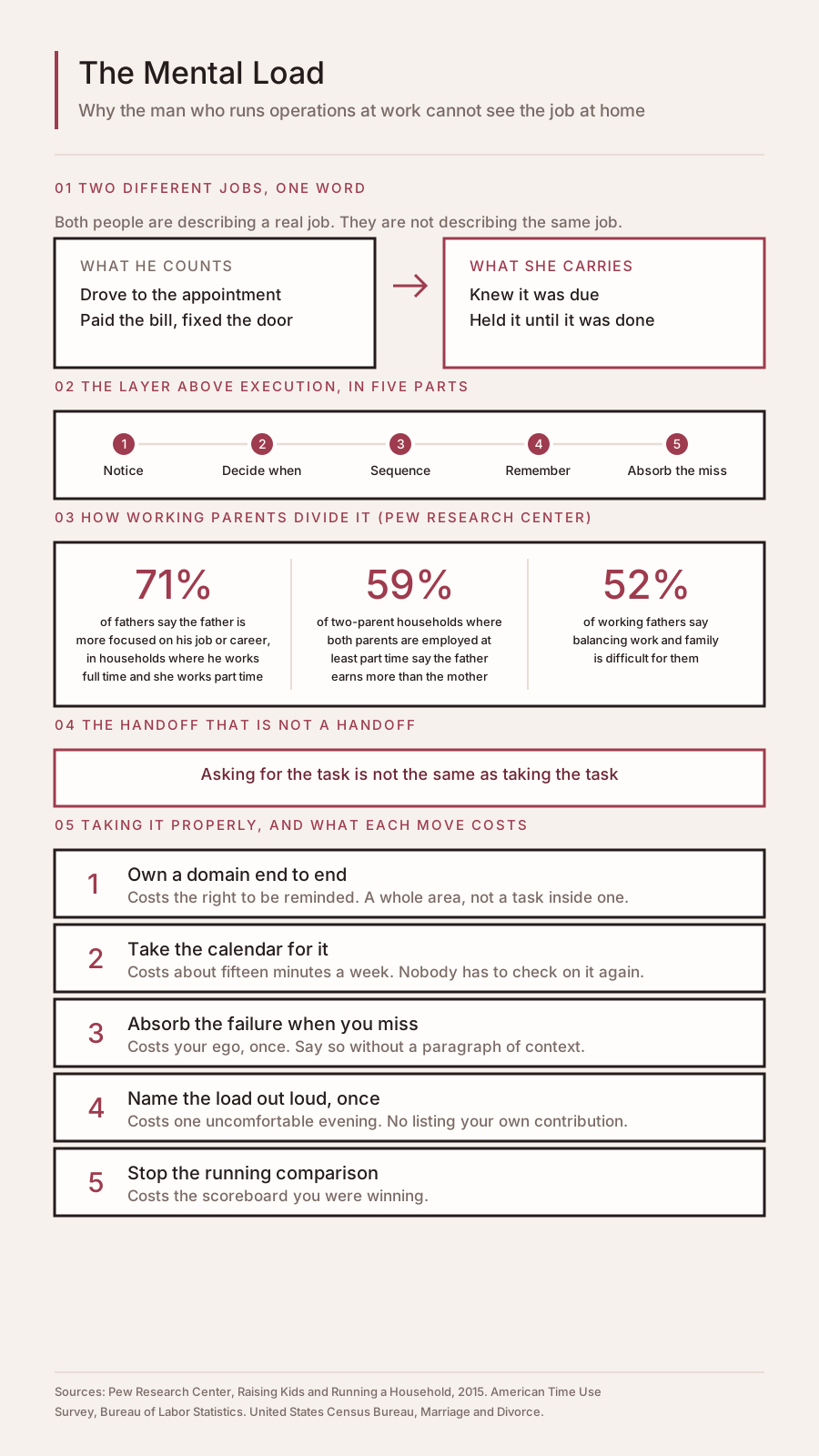
The mental load is not chores. It is the layer above them: noticing that something needs doing, deciding when it must happen, sequencing it against everything else, remembering it until it is done, and carrying the consequence if it is not. It is the difference between being handed a ticket and owning the backlog, which is why a man can list everything he did this week and still be told, accurately, that he does not carry the load.
There is a specific argument that happens in competent households. It goes like this. She says she carries everything. He says he does plenty, and starts listing. She says that is not what she means. He genuinely does not know what she means, because by any audit he would run at work, he is contributing.
He is not lying and neither is she. They are describing two different jobs and using one word for both.
What the mental load actually is
The mental load is not chores. This is the part that costs men years of argument.
Chores are execution. Loading the dishwasher, driving to the appointment, paying the invoice. Execution is visible, it is finite, and it can be pointed at afterwards. When a man defends himself in this argument, he lists execution, because execution is the only part he can see.
Many men meet this idea for the first time through the 2017 comic their wife sent them, which is a different entry point to the same argument.
The mental load is the layer above execution. It is noticing that something needs doing, deciding when it must happen, sequencing it against everything else, remembering it until it is done, and carrying the consequence if it is not. It is the difference between being handed a ticket and owning the backlog. Household time use at this level is tracked by the American Time Use Survey, and marriage and household composition by the Census Bureau.
You already know this distinction. You have used it professionally for twenty years. The person who executes a task and the person who owns the outcome are not doing the same job, and you have never once confused them at work. You would never say a project manager and a contractor contribute equally because both were on site.
At home, most men have quietly assumed the role of contractor and then argued about the invoice.
Why it is invisible from where you stand
The load is invisible for a structural reason, not a moral one.
Anticipation leaves no evidence. When the load is carried well, nothing happens. The appointment is made before the deadline, the form is signed before the reminder, the gift is bought before the birthday. A load carried well produces an absence of crisis, and absence is not something anyone can point to.
Your entire professional training runs the opposite way. Work rewards visible output. You have spent decades in an environment that measures what is shipped, and you have become excellent at reading that scoreboard. Then you walk into a house whose scoreboard measures what was prevented, and you cannot read it at all.
This is also why the high performer is often worse at this than an average man, not better. The better you are at your work scoreboard, the more completely you have trained yourself to look for the wrong signal.
The handoff that is not a handoff
Here is the moment the argument usually turns.
He says: tell me what to do and I will do it.
He means it as cooperation. It lands as an insult, and he cannot understand why.
It lands badly because it hands the load back in the same sentence that offers to take it. Telling him what to do requires her to notice the task, judge its urgency, sequence it, translate it into an instruction, deliver it at a moment he can receive it, and then track whether it happened. That is the entire job. He has offered to do the five minutes of execution at the end of it.
This is the single most useful thing a man can understand in this territory. Asking for the task is not the same as taking the task. Taking the task means owning the noticing.
Why this becomes distance and not just friction
An unequal load is survivable. Plenty of marriages run on one. What corrodes is the second thing, and it is the reason this belongs in a publication about distance rather than one about housework.
Carrying an invisible job next to someone who sincerely believes it does not exist is a lonely experience. Not an unfair one, a lonely one. She is not primarily angry that the form was not signed. She is alone in a house with someone who cannot see what she is doing, and being unseen by the person closest to you is its own specific isolation. That is the thread that connects this to being lonely inside a marriage.
On his side, the same conversation produces a man who feels permanently in deficit. He works hard, earns, shows up, and is told it does not count. Nobody sustains goodwill in a system where their effort is scored as insufficient by a rule they cannot read. So he stops raising it, she stops explaining it, and the household runs on silence with a ledger underneath it.
That is the mechanism. Two people who both feel unrecognised, neither of whom is wrong.
Taking the load, properly
The fix is not doing more chores. Doing more chores while she still owns the noticing changes nothing and often makes it worse, because now she is managing a second person.
The fix is transferring whole domains, permanently, including the noticing.
| Move | What it replaces | What it actually costs |
|---|---|---|
| Own a domain end to end | Asking what needs doing | The right to be reminded |
| Take that domain's calendar | Being told the date | Fifteen minutes a week |
| Absorb your own misses | Explaining why you missed | Your ego, once |
| Name the load out loud | Defending your contribution | One uncomfortable evening |
| Stop the running comparison | Listing what you also do | The scoreboard you were winning |
A domain is a whole area of the household, not a task inside it. Medical, or school, or the car, or the finances of the house as distinct from the finances of the business. Owning it means nobody has to check on it, nobody reminds you, and when it fails it is your failure and you say so without a paragraph of context.
Start with one. One domain fully owned beats five domains half assisted, and it is the only version she will actually feel, because the thing she feels is not the work. It is the not having to think about it. If you want to know which domain to start with rather than guessing, the thirteen item checklist and what the research says about who was holding each one is the shortest route to an honest answer. For why the arrangement stays in place at all, rather than which part of it to fix first, the dyadic evidence is the more useful read.
The conversation to have
Do not open with a solution. Men in this position almost always try to fix the argument by proposing a system, and the system reads as another way of avoiding the point.
Open by naming what you have not been seeing. One sentence, no defence attached, no listing of your own contributions in the same breath. The listing is what turns every previous version of this conversation into a negotiation, and this is not a negotiation.
Then ask which domain would help most if you took it completely. Then take it. Then keep taking it after the credit has stopped, because the credit stops long before the trust returns, and a man who quits when the applause fades has proved the original point.
This is slow, and the lag is the hardest part of it. Months of carrying something properly before the atmosphere in the house changes is normal, not a sign it is not working. If you want the wider version of that patience problem, it is the whole subject of saving a marriage that has gone quiet rather than hostile.
Last reviewed by The Quiet Marriage Editorial Team on August 10, 2026. This piece was reviewed editorially, against its published sources. It was not reviewed by a licensed therapist, counsellor or physician, and it is not a substitute for one. Our sourcing and AI use rules are public on the editorial standards page. This is general editorial content and not professional, legal, medical or psychological advice. Decisions about separation, custody and finances should be taken with a licensed professional in your own jurisdiction. If you are in crisis in the United States, dial or text 988 for the Suicide and Crisis Lifeline, which is free and available 24 hours a day.
FAQ
Is the mental load a real thing or a way of moving the goalposts?
It is a real and well documented division in how household responsibility is distributed and perceived. Pew Research Center's work on how working parents share the load found that fathers and mothers report the split differently, and that fathers are considerably more likely to describe responsibilities as shared equally. Two people reporting the same household differently is exactly the pattern this describes.
My wife works fewer hours than I do. Does that not settle it?
It settles the execution question and leaves the ownership question untouched. Pew Research Center found that across two-parent households where both parents are employed at least part time, 59% say the father earns more. In the specific arrangement you are describing, where the father works full time and the mother works part time, 71% of fathers say the father is the one more focused on his job or career. So the imbalance is the norm rather than a defence. The argument is about who holds the backlog, which is a separate job from who has more free hours.
I have offered many times to help. Why does that not land?
Because help is the wrong word and she is hearing it accurately. Help implies the job belongs to her and you are lending capacity. Ownership implies the job is yours and she never thinks about it again. Almost every man in this argument has offered the first and believed he was offering the second.
How long before it makes a difference?
Longer than feels fair. The recognition does not arrive when you start, it arrives when the pattern has held long enough to be trusted, and trust rebuilds on a lag. Treat anything under a season as too early to judge.
Is this really about housework?
No, and that is the point of putting it in this publication rather than a domestic advice column. It is about one person doing something demanding in the same house as someone who cannot see it, which is a description of loneliness rather than a description of chores.
How do you explain the mental load to your husband?
Use the distinction between being handed a ticket and owning the backlog, because that is a division he already understands from work. Executing a task that somebody else noticed, scheduled and remembered is a ticket. Holding the list of everything that will need doing, deciding when each item happens, remembering it until it is done and carrying the consequence if it is not, is the backlog. Then name the reason it stays invisible: anticipation leaves no evidence, so a load carried well produces an absence of crisis rather than anything he can point to. He has spent decades reading a scoreboard that measures what was shipped, and the house keeps a scoreboard that measures what was prevented.
What is the mental load?
The mental load is not chores. It is the layer above them: noticing that something needs doing, deciding when it must happen, sequencing it against everything else, remembering it until it is done, and carrying the consequence if it is not. It is the difference between being handed a ticket and owning the backlog. That is why a man can list everything he did this week and still be told, accurately, that he does not carry the load. He is describing tickets he closed. She is describing a backlog she never put down.
What are some examples of the mental load?
The clearest examples are the ones that leave no evidence. Knowing the appointment was due and booking it before the deadline. Knowing the form had to be signed before the reminder arrived. Knowing the birthday was coming and buying the gift before anybody asked. Holding the item in mind until it was done, and absorbing the consequence when nobody did. Set those against what usually gets counted on the other side of the same week: drove to the appointment, paid the bill, fixed the door, did the shop. Both columns are real work and only one of them can be pointed at afterwards. The test that separates them is not how long a task takes, it is whether somebody else had to notice it first. If somebody else noticed, scheduled and remembered it for you, you executed a ticket. If nobody did, you were carrying the backlog. At the level of whole areas rather than single tasks, it looks like owning medical, or school, or the car, or the finances of the house, end to end, including the noticing.
Why is the mental load usually described as a women's or mothers' problem?
Because the surveys that measure it keep finding a perception gap that falls the same way, and because the person carrying an invisible job is the one who ends up having to name it. Pew Research Center's work on how working parents share the load found that fathers and mothers report the same household differently, and that fathers are considerably more likely to describe responsibilities as shared equally. In two-parent households where both parents are employed at least part time, 59% say the father earns more, and in the specific arrangement where he works full time and she works part time, 71% of fathers say the father is the one more focused on his job or career. None of that makes the load a female capacity. It is a role, and the role is invisible from inside it for a structural reason rather than a moral one: anticipation leaves no evidence, so a load carried well produces an absence of crisis, and absence is not something anyone can point to. Which is why the gendered framing is worth setting aside once the mechanism is clear. The useful question is not whether men or women are better at noticing. It is who currently owns the noticing in your house, and what it would take to transfer one whole domain of it permanently, including the noticing.
Sources
- American Time Use Survey (bls.gov)
- Census Bureau (census.gov)
- Suicide and Crisis Lifeline (988lifeline.org)
- Pew Research Center's work on how working parents share the load (pewresearch.org)