Trust Rebuilding After a Real Breach: Why Forgiveness and Trust Are Two Different Jobs
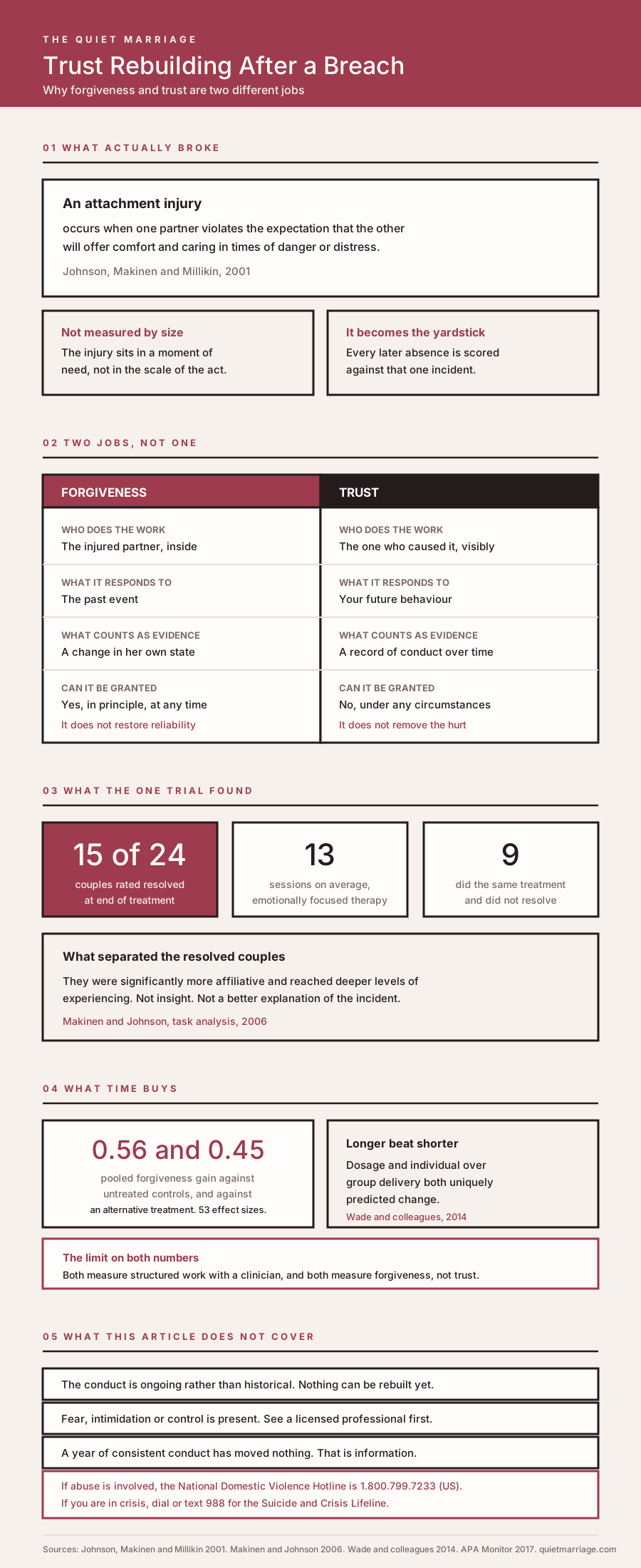
Trust rebuilding is the work of becoming predictable again in the exact place you were not, and the reason most attempts at it stall is that the couple is working on the wrong job. Forgiveness and trust are not two words for one thing. Forgiveness happens inside the injured person and can be granted at any time, for any reason, including exhaustion. Trust is a forecast the other person makes about your future conduct, and it cannot be granted at all. It has to be earned back at the site of the breach, and only there.
That distinction is not a matter of wording. It is why a marriage can be genuinely reconciled and still feel guarded years later, and it is why the sentence "I told you I forgave you" tends to end conversations rather than settle them.
Forgiveness is one job. Trust is another.
Everett Worthington has spent a career on forgiveness research, including applying his own model after his mother was murdered in a home invasion. His summary, quoted in the American Psychological Association's Monitor on Psychology, is the cleanest statement of the boundary anyone has written: forgiveness is not the same as justice, it does not require reconciliation, and, in his phrase, "forgiveness happens inside my skin."
The same article records the corollary that matters here. A former victim of abuse should not reconcile with an abuser who remains potentially dangerous, and can still arrive at empathy and understanding. Forgiveness and reconciliation come apart cleanly. One is an internal change in the injured person. The other is a two-person arrangement contingent on future conduct.
Set them side by side and the reason couples stall becomes obvious.
| Forgiveness | Trust | |
|---|---|---|
| Who does the work | The injured partner, internally | The partner who caused the injury, visibly |
| What it responds to | The past event | Your future behaviour |
| What counts as evidence | A change in her own state | A record of your conduct over time |
| Can it be granted on request | Yes, in principle, at any time | No, under any circumstances |
| What it does not do | Restore reliability | Remove the hurt |
| How it fails | It is faked to end an argument | It is demanded rather than demonstrated |
The bottom two rows explain the most common failure in a long marriage after a breach. She forgives, genuinely, because she wants the household to stop hurting. You take the forgiveness as a verdict of restored trust and behave accordingly, which is to say you stop demonstrating anything. Nothing in her actual reliability estimate has moved, because nothing you have done since has spoken to it. Six months later she is still watchful, you feel unfairly convicted, and both of you are correct.
The reverse failure is quieter. You set out to rebuild trust through conduct, doggedly and well, while she has not forgiven and cannot yet see the conduct at all. Good behaviour observed through an unresolved injury does not read as evidence. It reads as management.
Why the small incident can outrank the big one
The clinical name for what broke is the attachment injury, defined by Johnson, Makinen and Millikin in 2001 and covered at length in the companion piece on rebuilding trust when nothing was betrayed. Two features of it bear directly on the case where something was betrayed, and they are the reason a proportionate apology so often fails.
The first is that the injury is located in a moment of need rather than in the size of the act. An affair is the obvious candidate. So is the debt she learned about from a collections letter rather than from you. So is a promise you made explicitly and broke on a date you both remember. What these have in common is not their magnitude. It is that each one arrived at a point where being reachable was the entire requirement.
The second is that the incident stops being an event and becomes the measuring stick. The 2001 paper puts it directly: the incident is continually used as a standard for the dependability of the offending partner. Every later absence, delay or flat response gets scored against it. That is why you feel you are being tried repeatedly for one offence. In a sense you are, and the mechanism is not spite. It is that no newer measurement has been allowed to replace the old one.
Together they explain the argument that runs in circles. You point out, accurately, that a ledger of the last twenty years would come out heavily in your favour. She agrees with the ledger and is unmoved by it, because size of contribution is not the instrument being used. A large deposit made in an ordinary week does not settle a withdrawal made in a critical one. This is also why an apology scaled to the offence as you scored it lands as further evidence that you still do not understand what was asked of you.
What separated the couples who resolved it
In 2006 Makinen and Johnson published a task analysis in the Journal of Consulting and Clinical Psychology testing whether a proposed attachment injury resolution model actually discriminated between couples who resolved an injury and couples who did not. Twenty-four couples with an identified attachment injury received an average of 13 sessions of emotionally focused therapy. At the end of treatment, 15 of the 24 were rated as resolved.
Segments of the best sessions from every couple were transcribed and rated on two process measures. The resolved couples were significantly more affiliative and reached deeper levels of experiencing than the couples who did not resolve, and they showed significantly greater improvement in both dyadic satisfaction and forgiveness.
Three things in that paragraph deserve more weight than they usually get.
Fifteen of twenty-four is not a promise. It is roughly three in five, in a small sample, with a trained therapist, inside a structured model. The paper reports how many sessions there were and not how far apart they fell, so how many months that treatment covered is not something it tells us. Nine couples did the same work and did not resolve. Any account of trust rebuilding that reads as a guarantee is not describing this literature.
The two things that distinguished the resolved couples were affiliation and depth of experiencing. Not insight, and not agreement about what happened. What separated them was whether the injured partner could stay in contact rather than withdrawing, and whether both of them could reach a genuine emotional response in the room rather than an account of one. If you have been building a better explanation of the incident, that is not what moved in this study.
Satisfaction and forgiveness improved together in the resolved group. They travelled as a pair, which is consistent with the two-track picture above and does not tell you which one led.
The practical shape that falls out of this is narrow and worth stating without embellishment. The injured partner names the injury in terms of what was needed and not received, rather than in terms of what was done. The other partner stays present and takes it in, which in practice means leading with a response to her experience rather than with the context, the timeline or the ledger. That is a description of what a small group of couples did with a therapist in the room. It is not a script for a Tuesday evening at the kitchen table, and the distinction matters enough that a reader should not treat the paragraph above as instructions.
What time actually buys
The single most useful finding for anyone in year two of this comes from a meta-analysis of forgiveness interventions. Wade, Hoyt, Kidwell and Worthington pooled 53 post-treatment effect sizes covering 2,323 participants, and 41 follow-up effect sizes covering 1,716. People who received an explicit forgiveness treatment reported significantly more forgiveness than untreated participants, with a pooled effect of 0.56, and more than participants given an alternative treatment, at 0.45. The treatments also produced greater changes in depression, anxiety and hope than no treatment at all.
The moderator analysis is the part to hold onto, and it is narrower than it is usually reported. Treatment dosage, meaning longer interventions, and individual rather than group delivery both uniquely predicted change against no-treatment controls. Offence severity was only marginally predictive, and only in the comparison against alternative treatments rather than against no treatment at all. Worthington's own summary in the APA Monitor is blunter than the abstract: there is a strong dose-response relationship between the amount of time people spend trying to forgive and the amount of forgiveness they achieve.
Two limits before anyone borrows that number. This is a meta-analysis of professionally delivered interventions aimed at forgiving a specific hurt, so it is evidence about structured work with a clinician and not about what happens on its own at home. And it measures forgiveness, which is the upper track in the diagram. It is not a measurement of restored trust, and no comparable pooled estimate for trust rebuilding after an injury exists that we are aware of.
The cost of leaving it where it is
Unresolved injuries do not sit still. In 2023 a team writing in the Journal of Sex Research recruited 145 adults who reported an attachment injury in their current relationship and measured injury severity, event-related stress, forgiveness and sexual satisfaction. Their path analysis found an indirect association: the more severe the injury was perceived to be, the higher the injury-related stress symptoms and the lower the forgiveness, and through those two, the lower the sexual satisfaction.
The design is cross-sectional, so it cannot establish direction, and the authors say so. Lower satisfaction could plausibly make an old injury feel more severe rather than the other way round. What the study does establish is that the two things are linked through a stress pathway rather than through a grievance, which fits a pattern many couples describe: the bedroom went quiet before either of them consciously connected it to an incident two years earlier. If that is your marriage, the piece on resentment in marriage covers the slower version of the same accumulation, and communication skills in marriage covers what the evidence does and does not support about talking it through.
What this article does not cover
If the conduct that caused the injury has not stopped, none of the above applies yet. Trust rebuilding assumes the behaviour is historical. If it is not, the first step is stopping it and the second is telling the truth about the gap between when it stopped and when you said it did.
If fear, intimidation or control is present, this is not an attachment injury and it is not a repair project. Get a licensed professional involved before anything else. If you are in the United States and this involves abuse, the National Domestic Violence Hotline can help you think through safety, at 1.800.799.7233, and if you are in crisis, dial or text 988 for the Suicide and Crisis Lifeline.
If a year of consistent conduct has moved nothing at all, that is information rather than failure, and it deserves a real conversation with a therapist about whether the marriage is being kept alive out of hope or out of habit. Some readers arrive at that conversation and conclude the answer is separation, which is its own long project rather than a verdict on either of you. Divorce for men after forty covers what that decision actually involves.
And if the deeper problem is that nothing is identifiably wrong and the marriage has simply gone flat, how to save your marriage when nothing is actually wrong is the piece for that.
Last reviewed by The Quiet Marriage Editorial Team on September 1, 2026. This piece was reviewed editorially, against its published sources. It was not reviewed by a licensed therapist, attorney or physician, and it is not a substitute for one. Our sourcing and AI use rules are public on the editorial standards page. This is general editorial content and not professional, legal, medical or psychological advice. Decisions about separation, custody and finances should be taken with a licensed professional in your own jurisdiction. If you are in crisis in the United States, dial or text 988 for the Suicide and Crisis Lifeline, which is free and available 24 hours a day.
FAQ
What does trust rebuilding actually mean?
Trust is a forecast your partner makes about your future conduct, so the only thing that moves it is a record of conduct in the area that broke. An apology speaks to the past event and a change in habit speaks to the forecast, which is why habit change is the kind of evidence trust is actually built from, rather than because it is guaranteed to work. The narrow target matters: a general improvement across the marriage does not answer a specific failure to be reachable at a moment of need, because that is not what is being measured.
How long does it take to rebuild trust after a betrayal?
There is no reliable published number for trust specifically, and anyone quoting one is inventing it. The nearest evidence is that 24 couples with an identified attachment injury received an average of 13 sessions of emotionally focused therapy and 15 of them were rated resolved at the end of treatment, which is about three in five couples working with a therapist. That paper reports the session count but not the interval between sessions, so it does not tell you how many months were involved. The forgiveness meta-analysis adds that longer interventions produced more change than shorter ones. Both point the same way: this is measured in seasons, and the time deliberately spent on it is one of the few variables under your control.
Can you forgive someone and still not trust them?
Yes, and it is the ordinary case rather than an inconsistency. Forgiveness is an internal change in the person who was hurt and it can happen without any change in the relationship. Trust is a separate estimate of your future reliability that she cannot grant by deciding to, because it is assembled from evidence she has not collected yet. Hearing "I forgive you" and concluding the matter is closed is the single most common way a repair stalls in the month after it looks fixed.
Why does my wife keep bringing up the same incident?
Because it has become the measuring stick rather than a memory. The 2001 paper that defined the attachment injury describes the incident as continually used as a standard for the dependability of the offending partner. It stops being raised when a newer measurement is available to replace it, and that requires conduct in a comparable moment of need. A better account of the original incident does not qualify, however accurate it is.
She says a small thing hurt her more than a big one. Is that reasonable?
On this framework it is expected. An attachment injury is defined by an abandonment or a betrayal of trust during a critical moment of need, not by the magnitude of the act. Twenty years of contribution is real and it is answering a question nobody asked, because the instrument in use measures reachability at one moment rather than total contribution over two decades.
What should I not do when she raises it?
Lead with a response to her experience before you lead with an explanation. In the study that distinguished resolved from unresolved couples, what separated them was affiliation and depth of emotional experiencing rather than insight or agreement about the facts. Context, timelines and the ledger are not lies, and offered first they tend to occupy the place where something else was being asked for. That describes couples working with a therapist in the room rather than a rule for every conversation, and if part of what needs saying involves safety or facts she genuinely needs, say it.
Does couples therapy actually help with this?
The evidence is specific rather than general. The 2006 task analysis supports the attachment injury resolution model and also shows that a substantial minority of couples did the same structured work without resolving, so it is support rather than a guarantee. The forgiveness meta-analysis found professionally delivered interventions outperformed no treatment by 0.56 and alternative treatments by 0.45, with longer interventions doing better than shorter ones. Both describe structured work with a clinician rather than anything done alone.
We stopped having sex after it. Is that connected?
Possibly, through stress rather than through grievance. A 2023 study of 145 adults reporting an attachment injury found an indirect path from perceived injury severity to lower sexual satisfaction, running through higher injury-related stress and lower forgiveness. The design is cross-sectional so the direction is not established, and the practical implication survives that limit: treating the quiet bedroom as the problem to solve is likely to be less useful than treating the unresolved injury it may be downstream of.
What if the breach was mine and she will not talk about it?
Then the work is unilateral for now, and it is still work. Conduct in the injured area accumulates whether or not it is discussed, and it is the only material that will be available when she is ready. What does not accumulate is pressure. Asking repeatedly whether she is ready to talk converts your repair into another thing she has to manage, which is the opposite of the reliability you are trying to demonstrate. If the silence has held for months rather than weeks, that is a reason to see a therapist yourself rather than a reason to push harder.
Does any of this apply after cheating, or is an affair a different problem?
It applies, and an affair is the obvious instance of the mechanism rather than a separate category with its own rules. The injury is located in a moment where being reachable was the entire requirement, not in the size of the act, which is why a debt she learned about from a collections letter and a promise you broke on a date you both remember sit in the same class. The practical consequence is the part most repairs get wrong. Because the mechanism is the same, the job is the same: conduct in the exact area that broke, accumulated over seasons, rather than a response scaled to how bad it was. Scaling the apology to the magnitude answers a question nobody asked, in the same way twenty years of contribution does. And the distinction between forgiveness and trust matters more here than anywhere, because forgiveness after a breach of this kind usually arrives with more visible feeling attached, which makes it that much easier to mistake for a verdict that the matter is closed.
Sources
- quoted in the American Psychological Association's Monitor on Psychology (apa.org)
- Johnson, Makinen and Millikin in 2001 (pubmed.ncbi.nlm.nih.gov)
- Twenty-four couples with an identified attachment injury (pubmed.ncbi.nlm.nih.gov)
- Wade, Hoyt, Kidwell and Worthington (pubmed.ncbi.nlm.nih.gov)
- 145 adults who reported an attachment injury in their current relationship (pubmed.ncbi.nlm.nih.gov)
- National Domestic Violence Hotline (thehotline.org)
- Suicide and Crisis Lifeline (988lifeline.org)