Divorce Advice for Men: Which Standard Instructions Survive Contact With the Written Rules
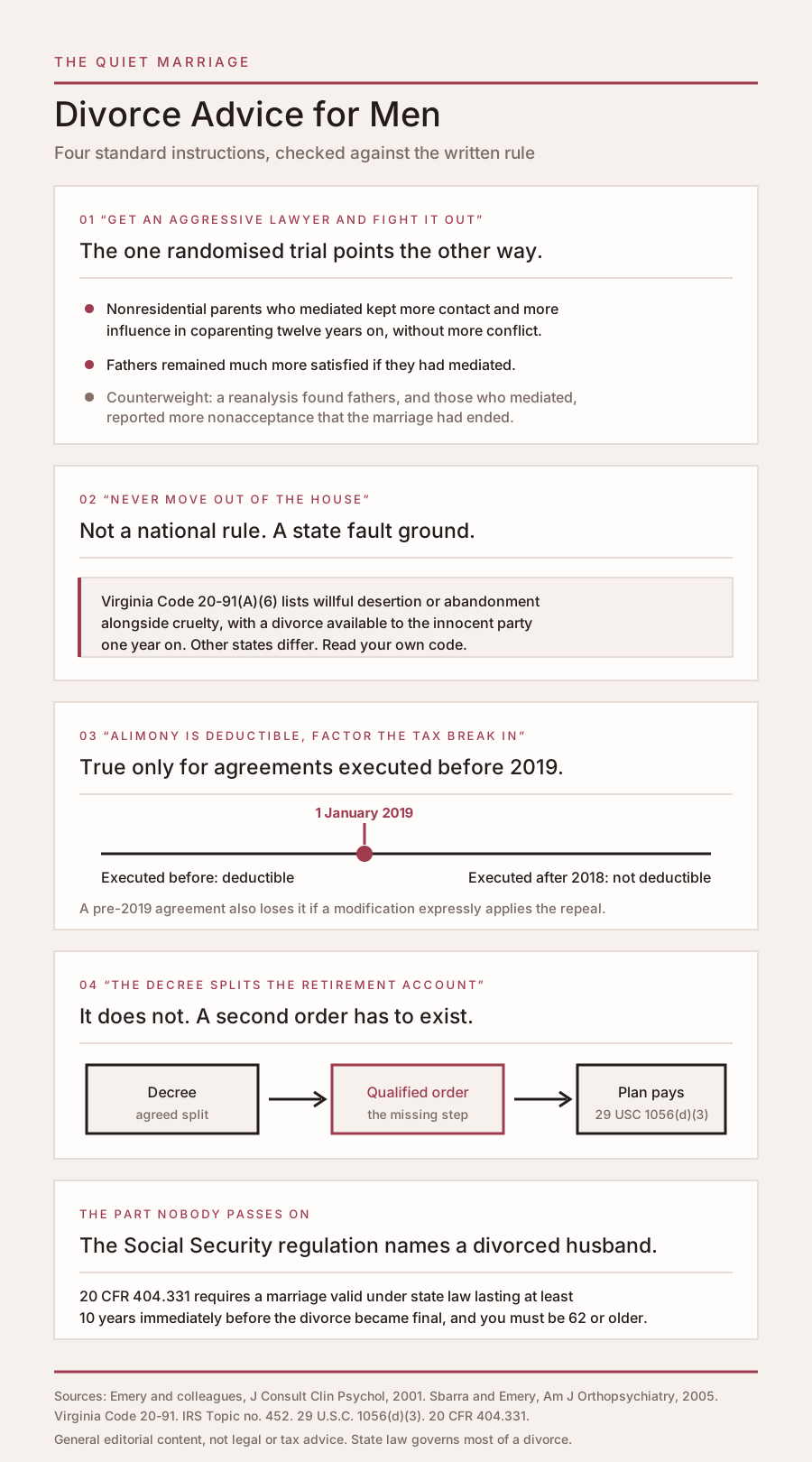
Four instructions get repeated to men going through divorce, and checked against the text each one claims to rest on, they do not all hold. Alimony is deductible, so factor the tax break in: deductible only under an agreement executed before 2019, and not under one executed after 2018. The decree splits the retirement account: it does not, because a plan must bar assignment of benefits until an order determined to be a qualified domestic relations order arrives. Never move out of the house: not a national rule at all, but a compressed reference to a desertion ground that exists in some state codes and not others. Get the most aggressive lawyer and fight it out: the strongest evidence available runs the other way, since in a trial that randomly assigned contested custody cases, the nonresidential parents who mediated kept more contact and more influence over decisions about their children twelve years later, without more coparenting conflict.
The text in each case is public and linked below: the Internal Revenue Service topic, the United States Code paragraph, one state's code, and the one randomized trial that followed families for twelve years. Two of the four instructions are wrong as commonly stated, one is a state question being passed off as a national rule, and the fourth is the one broadly supported by the evidence and also the one men are least likely to take. The advice arrives with the confidence of experience and none of the checking, which would matter less if the rules held still, and they do not.
Something to settle before any of the rest. If thinking about this divorce has started you thinking about harming yourself, or you have been reaching for a drink most evenings to get through it, put this article down. In the United States, dial or text 988 for the Suicide and Crisis Lifeline, free and answered around the clock. Reading statutes is work for a mind that is not currently underwater, and the statutes will still be there next week.
Why this advice keeps circulating uncorrected
Divorce advice fails for more than one reason. It goes out of date, it travels away from the state whose law it described, and it compresses a mechanism until the mechanism disappears. All three are visible in the four instructions below, and none of them requires anybody to have lied.
Take ageing first, because it is the most common. The emotional content of divorce advice does not change much from decade to decade, so a man who went through his own separation in 2012 is often still right about what the second Christmas feels like. The mechanical content changes underneath him without announcement, because it lives in tax law, in federal benefit regulations and in state statutes that get amended. He has no reason to go back and check. He tells you what worked, and the part of it that was about feeling is still true, and the part of it that was about money quietly stopped being true.
The other two failures are not about time at all. Advice crosses a state line and keeps the confidence it earned on the other side of it, which is how a fault ground that exists in some codes becomes a rule everybody repeats. And advice gets shortened by each person who passes it on, until a two-step legal process arrives at you as one step, with the missing step sitting quietly with a plan administrator you have never spoken to.
That is the shape to hold while reading the rest of this. The men giving you this advice are not lying to you. They are describing, accurately, a system they saw from one position, at one time, in one state.
Everything below is general editorial content, not legal or tax advice. State law governs most of what actually happens in a divorce, and no article can tell you what your state does. What an article can do is show you which of the things you have been told are written down somewhere you can go and read, and which are not. The point of this piece is to hand you the citation so you can check it against your own situation with somebody who is licensed to advise you.
Instruction one: get the most aggressive lawyer you can find and fight it out
This is the most common piece of divorce advice for men and it has the least support behind it of the four.
The strongest evidence available runs the other way, and it is unusually strong for this field because families were randomly assigned rather than allowed to select themselves. In a study of contested custody cases, families were assigned either to mediate or to litigate, then followed up. Emery and colleagues reported the twelve year results in the Journal of Consulting and Clinical Psychology in 2001. Compared with families who litigated, the nonresidential parents who mediated were more involved in multiple areas of their children's lives, kept more contact with their children, and had greater influence in coparenting twelve years after the dispute was resolved. That extra involvement did not come with an increase in coparenting conflict. Satisfaction declined for parents in both groups over the twelve years, and it declined especially for fathers, but fathers remained much more satisfied if they had mediated rather than litigated. Among mothers there were few differences between the two groups.
An earlier follow-up of the same programme, reported by Dillon and Emery in the American Journal of Orthopsychiatry in 1996, found the same shape nine years out: noncustodial parents assigned to mediation reported more frequent current contact with their children, greater involvement in current decisions about them, and more frequent communication about them across the intervening years.
Read those two results carefully, because the thing they measure is the thing men say they want. Fathers who mediated did not get a warmer feeling. They got more contact with their children nine and twelve years later, and more say in the decisions. The adversarial route, chosen precisely to protect access, is associated in this trial with less of it.
The counterweight, because it is real and it is from the same research programme. Sbarra and Emery reanalysed the twelve year follow-up in the American Journal of Orthopsychiatry in 2005 using statistical imputation to recover power, and found that fathers, and parents who had mediated, reported significantly more nonacceptance of the marriage ending at the twelve year mark. Mediation is associated with staying involved. It appears also to be associated with finding it harder to accept that the marriage is over. Both of those can be true, and a man choosing his route deserves to know the second one rather than only the flattering half.
What this evidence does not cover. These were contested custody disputes, so the finding is about parents fighting over children, not about a childless divorce or an uncontested one. The trial is decades old and mediation practice has changed since. And the comparison is mediation against litigation, not any lawyer against no lawyer. Nothing here argues for going unrepresented. It argues against choosing your representative on the strength of how much they enjoy a fight. If you want the wider frame on the decision itself rather than the process, the three decisions a man in a long marriage is actually making sets it out.
Instruction two: never move out of the house
This one is repeated as though it were a national rule. It is not a rule at all. It is a compressed reference to a fault ground that exists in some states, and the compression is what makes it dangerous, because the man hearing it cannot tell whether it applies where he lives.
Here is the underlying thing in one state's actual text. Virginia Code section 20-91 lists the grounds on which a divorce from the bond of matrimony may be decreed, and subsection A(6) covers the case "where either party has been guilty of cruelty, caused reasonable apprehension of bodily hurt, or willfully deserted or abandoned the other," with the divorce available to the innocent party after a period of one year from the date of that act. Desertion is a named ground with a defined waiting period, sitting in the same subsection as cruelty.
So the folklore has a source. Somewhere in the chain, a man in a state with a desertion ground was told by his own attorney not to leave, and the specific advice travelled onward with the state stripped off it.
Two things follow. The first is that "never move out" is a question about your jurisdiction, and the answer is written down in your state code, which is published and free to read. The way in, if you have never done this: go to your own state legislature's website, find the title covering domestic relations or family law, which is where Virginia keeps section 20-91 above, and read the section listing the grounds for divorce. The words to look for are desertion and abandonment. The second is that leaving a shared house and willfully deserting a spouse are not automatically the same act even where the ground exists, which is exactly the kind of distinction a licensed attorney in your state exists to draw and an article cannot. What no man should do is treat a rule of thumb about somebody else's state as a reason to stay in a house that has become unsafe or unbearable.
Instruction three: remember that alimony is deductible, so build the tax break into the number
This instruction was correct for decades. It stopped being correct for new agreements at the start of 2019, and it is still being handed to men in 2026.
Internal Revenue Service Topic no. 452 states the position in plain terms. Alimony or separate maintenance payments are deductible by the payer spouse and includible in the recipient spouse's income if they are paid under a divorce or separation agreement executed before 2019. The payer spouse cannot deduct alimony or separate maintenance paid under an agreement executed after 2018. The same paragraph closes the obvious loophole: an agreement executed before 2019 but later modified also loses the deduction if the modification expressly states that the repeal applies to it. And under an agreement in the non-deductible category, the recipient does not include the payments in gross income.
The size of the mistake depends on which side of the arrangement you are on. A man told to negotiate a higher gross figure on the understanding that he will recover part of it at filing time is negotiating against a tax treatment that no longer exists for his agreement, and the recovery does not arrive. A man on the receiving end who is bracing for a tax bill on payments received under a post-2018 agreement is bracing for something the same topic says does not apply.
Notice how the exception is written, because it is the part that gets lost. The date that governs is the date the agreement was executed, not the year you are paying. Older agreements were not converted. That is precisely why the advice keeps circulating in a form that used to be right: the man giving it may still be operating under a pre-2019 agreement where it remains true for him.
Instruction four: the decree splits the retirement account
The decree does not split the retirement account. A separate order does, and the governing statute is explicit about it.
Section 1056 of Title 29 of the United States Code requires that each pension plan provide that benefits under the plan may not be assigned or alienated. Paragraph (d)(3)(A) then applies that prohibition to the creation, assignment or recognition of anybody else's right to a benefit under a domestic relations order, and carves out one exception: the prohibition does not apply if the order is determined to be a qualified domestic relations order. Each plan must then pay benefits in accordance with the requirements of any such order.
The statute goes on to define the terms. A domestic relations order is a judgment, decree or order, including approval of a property settlement agreement, that relates to child support, alimony payments or marital property rights and is made under a state or tribal domestic relations law. It becomes qualified only when it creates or recognises an alternate payee's right to receive all or part of the benefits and meets the further requirements set out in the same paragraph, which include clearly specifying the name and last known mailing address of the participant and of each alternate payee.
The practical shape of that is worth stating flatly. Two people can agree on a fifty-fifty split of a retirement account, a court can enter a decree reflecting that agreement, and the plan administrator can still be barred by the anti-alienation rule from paying anything to the former spouse until a qualifying order arrives and is determined to qualify. A settlement that is silent on the mechanism has left a step undone, and the step lives with the plan, not with the court. The failure mode is not dramatic. It is a folder that everybody assumes is finished.
Two questions follow from that, and both are yours to ask. If the divorce is still open, ask your attorney directly whether a qualifying order is being drafted and put in front of the plan administrator, and whether that is inside the fee you have agreed or a separate piece of work, because drafting these orders is often referred out rather than done in house. If the divorce is already final and nobody has raised the subject, call the plan administrator yourself and ask whether an order is on file against the account. The statute above tells you what the administrator is required to have before it can pay anybody other than you, so the answer to that one question tells you whether the step was ever taken.
The four instructions, audited
| What you are told | What the written rule actually says | Where to read it yourself |
|---|---|---|
| Get the most aggressive lawyer and fight it out | In a trial that randomly assigned contested custody cases, nonresidential parents who mediated kept more contact and more influence twelve years later, without more coparenting conflict, and fathers remained much more satisfied. A reanalysis of the same follow-up also found more nonacceptance of the marriage ending among fathers and among those who mediated | Emery and colleagues, Journal of Consulting and Clinical Psychology, 2001; Sbarra and Emery, American Journal of Orthopsychiatry, 2005 |
| Never move out of the house | Not a national rule. Desertion is a named fault ground in some state codes. Virginia's lists willful desertion or abandonment alongside cruelty, with the divorce available to the innocent party after one year from the act | Virginia Code section 20-91, subsection A(6), and the equivalent section of your own state code |
| Alimony is deductible, so factor the tax break in | Deductible only under an agreement executed before 2019. Not deductible under an agreement executed after 2018, or one executed before 2019 and later modified with express repeal language. The recipient does not include those payments in gross income | Internal Revenue Service, Topic no. 452 |
| The decree splits the retirement account | Plans must bar assignment or alienation of benefits. The prohibition is lifted only for an order determined to be a qualified domestic relations order, which has its own specified contents | 29 U.S.C. 1056(d)(3) |
The thing nobody tells you, which is in the regulation
There is a piece of the record that runs the other way, in a man's favour, and it almost never appears in the advice because it is filed under retirement rather than under divorce.
Section 404.331 of Title 20 of the Code of Federal Regulations sets out who is entitled to a wife's or husband's benefit as a divorced spouse, and it is written in both directions. It refers throughout to "the insured's divorced wife or divorced husband." The conditions are that your marriage to the insured was valid under state law and lasted at least 10 years immediately before the divorce became final, that you apply, that you are not currently married, that you are aged 62 or older in a month when the other conditions are met, and that you are not entitled to a benefit of your own equal to or larger than the full spouse's benefit. Where the insured person is not yet drawing benefits but is at least 62, the section adds a further condition that you have been divorced for at least two years.
Two implications for a man reading his own situation. The regulation is gender-neutral on its face, so a man whose wife has the stronger earnings record is inside this section on the same terms she would be. And the ten year figure is a threshold measured immediately before the divorce becomes final, which means the timing of a filing can sit on either side of it. That is a fact worth knowing before a date is chosen rather than after, and it is the kind of question to put to somebody licensed to advise you rather than to an article.
How to check any piece of advice you are given
The four above are the ones that come up most. The method generalises, and it costs an evening.
Ask the man giving you the advice when his agreement was executed. If it was before 2019, assume that anything he tells you about the tax treatment of alimony describes his agreement and not yours. Ask which state he divorced in, and treat every procedural instruction as a statement about that state until you have read your own code. For anything involving a retirement plan, ask whether a separate order was entered, because the answer tells you whether he ever met the mechanism described above. And for anything about how to conduct yourself in the process, notice whether the advice is about winning or about what he still has ten years later, because those two turn out not to point the same way in the one trial that followed people that far.
The written sources are free. The Internal Revenue Service topics, the Code of Federal Regulations, the United States Code and every state code are published online and readable by anybody. That is a low bar to clear before you accept an instruction that will shape the next decade of your finances and your access to your children.
What this piece does not cover
It does not cover child support, which is set by state guidelines and is a separate mechanism from everything above. It does not cover property division rules, which differ between community property states and equitable distribution states. It does not tell you whether to divorce, which is a different question addressed in what the decision actually involves for a man in a long marriage. It does not evaluate the firms and coaches who market specifically to men, which is covered in what those services are and what the numbers can and cannot tell you. And it is not a substitute for support, which has its own evidence base and its own four distinct forms, set out in which kind of group does what.
Last reviewed by The Quiet Marriage Editorial Team on September 10, 2026. This piece was reviewed editorially, against its published sources. It was not reviewed by a licensed attorney, tax professional, therapist or physician, and it is not a substitute for one. It is general editorial content and not legal, tax, financial, medical or psychological advice. The statutes and regulations quoted here are quoted as published on the dates given and can be amended. State law governs most of what happens in a divorce and is not covered here. If the end of this marriage has reached the point of despair, speak to a licensed professional. If you are in crisis in the United States, dial or text 988 for the Suicide and Crisis Lifeline, which is free and available 24 hours a day.
FAQ
What is the single most useful piece of divorce advice for a man?
Ask when the person advising you got divorced, and in which state. Those two facts determine whether their tax advice, their procedural advice and their instructions about the house apply to you at all. The alimony deduction is the cleanest test: it was correct for decades, and it does not apply to an agreement executed after 2018 (Internal Revenue Service, Topic no. 452). A man who divorced in 2015 can still be describing his own situation accurately and yours incorrectly.
Is it true that you should never move out of the marital home?
No, not as a general rule, because there is no general rule. Desertion and abandonment are fault grounds that appear in some state codes and not others, which is where the instruction comes from. Virginia Code section 20-91 lists willful desertion or abandonment in subsection A(6), alongside cruelty, with a divorce available to the innocent party one year on. Whether your state has anything comparable, and whether your particular departure would meet it, are two separate questions and both belong with a licensed attorney in that state. Neither is a reason to stay in a house that has stopped being safe.
Can I still deduct the alimony I pay?
Only under an agreement executed before 2019. Internal Revenue Service Topic no. 452 states that the payer spouse cannot deduct alimony or separate maintenance paid under an agreement executed after 2018, nor under a pre-2019 agreement later modified where the modification expressly applies the repeal. Where the deduction is gone the mirror rule applies too, and the recipient leaves those payments out of gross income. What matters is the execution date of the agreement, not the tax year in which a payment is made, which is why the same instruction can be right for the man giving it and wrong for you.
Does the divorce decree divide my 401(k) or pension?
No, not on its own. Under 29 U.S.C. 1056(d)(3), pension plans must provide that benefits cannot be assigned or alienated, and that prohibition is lifted only for an order determined to be a qualified domestic relations order. The statute defines a domestic relations order as a judgment, decree or order relating to child support, alimony or marital property rights made under state or tribal domestic relations law, and it qualifies only once it creates or recognises an alternate payee's right to the benefits and carries the further contents the paragraph requires, including the name and last known mailing address of the participant and of each alternate payee. If nobody has mentioned such an order to you, the practical move is to ask the plan administrator directly whether one is on file.
Should I fight for custody in court rather than mediate?
The strongest evidence available points the other way, and it is worth reading with its limits attached. Families in contested custody disputes were randomly assigned to mediate or to litigate. Twelve years on, nonresidential parents who had mediated kept more contact with their children, were more involved across multiple areas of their lives and had more influence in coparenting, without more coparenting conflict, and fathers remained much more satisfied than fathers who had litigated (Emery and colleagues, 2001). A reanalysis of the same follow-up found fathers, and those who mediated, reporting significantly more nonacceptance that the marriage had ended (Sbarra and Emery, 2005). The trial is decades old, covered contested custody disputes, and compared mediation with litigation rather than representation with none.
Can I claim Social Security on my ex-wife's record?
Potentially, and the regulation is written to cover a man on the same terms. 20 CFR 404.331 refers throughout to the insured's divorced wife or divorced husband, and sets out the conditions: a marriage valid under state law that lasted at least 10 years immediately before the divorce became final, an application, that you are not currently married, that you are 62 or older in a month when the other conditions are met, and that your own benefit is not equal to or larger than the full spouse's benefit. Where the other person is 62 or older but not yet drawing, the section adds that the divorce must be at least two years old. The ten year mark is measured against the date the divorce becomes final, so it is a question with a deadline rather than a question to look at afterwards.
Does any of this replace hiring a lawyer?
No. What it replaces is arriving at a first meeting with a list of things you were told at work. Every source quoted here is a published federal or state text anybody can read, and reading the four of them takes an evening. State law governs most of what will actually happen in your divorce, none of it is covered by the federal sources above, and applying any of this to your own facts is work for somebody licensed to do it.
Sources
- Suicide and Crisis Lifeline (988lifeline.org)
- Emery and colleagues reported the twelve year results (pubmed.ncbi.nlm.nih.gov)
- reported by Dillon and Emery (pubmed.ncbi.nlm.nih.gov)
- Sbarra and Emery (pubmed.ncbi.nlm.nih.gov)
- Virginia Code section 20-91 (law.lis.virginia.gov)
- Internal Revenue Service Topic no. 452 (irs.gov)
- Section 1056 of Title 29 of the United States Code (govinfo.gov)
- Section 404.331 of Title 20 of the Code of Federal Regulations (ecfr.gov)