Rebuilding Trust After Infidelity: The Path Is Not a Line
Rebuilding trust after infidelity works through verifiable conduct held steady over a long period, and the single most useful finding about that period is that it does not run in a straight line. A 2026 survey of 3,429 people who had either had an affair or been on the other side of one reported that relationship preservation followed neither a linear nor a uniform course, and was not necessarily a complex one either. Some routes back were short and direct. Others were long and doubled back on themselves. The survey classified the routes people took to a preserved relationship rather than the ups and downs inside a continuing one, so carrying it across to your own bad week in month fourteen is this publication's reading rather than the study's. It is the reading this piece is built on, and it changes what that week means.
Most writing on this subject implies a staircase: disclosure, remorse, transparency, forgiveness, recovery, each step following the last. Couples who take that model seriously tend to conclude, somewhere in the second year, that they are doing it wrong. The evidence does not describe a staircase. This piece is about the shape of the road rather than the first week on it. If you are still in the first week, and new facts are still arriving, the record has to stop moving before any of this applies.
What the largest reconciliation survey actually reported
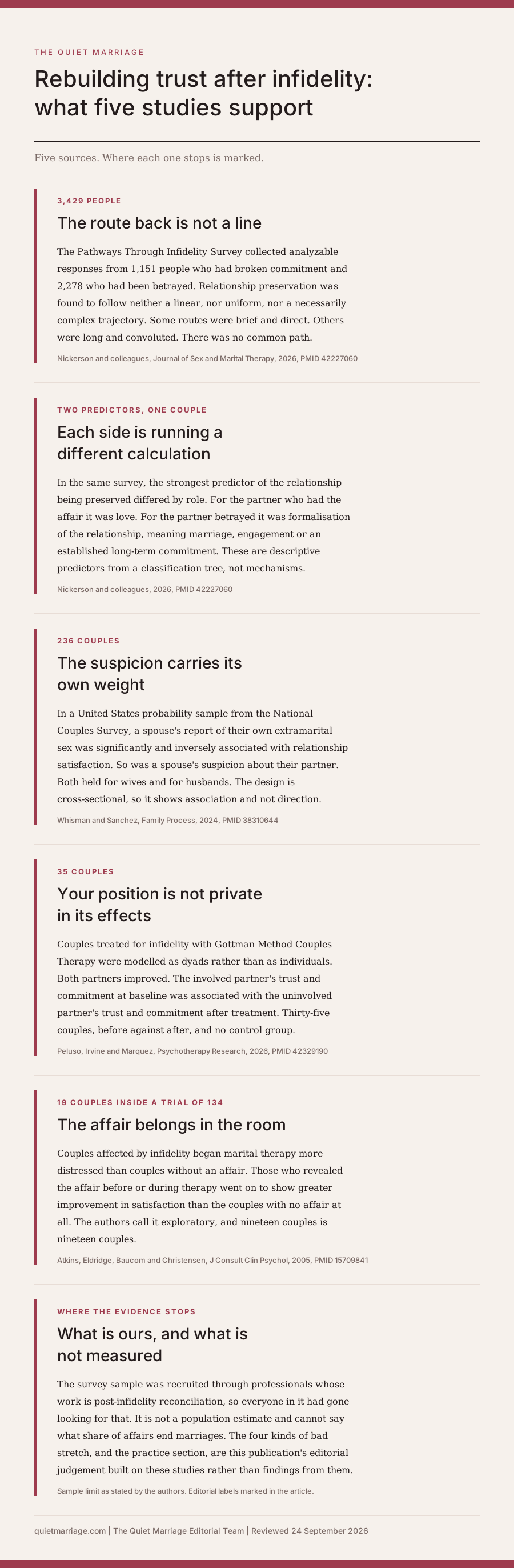
Nickerson and colleagues administered a survey they called Pathways Through Infidelity and obtained analyzable responses from 1,151 people they term commitment-breaking partners and 2,278 they term betrayal-experiencing partners. They analysed the results with descriptive statistics and with classification and regression trees, a method that looks for the splits in the data that best sort people into outcomes rather than assuming a single equation applies to everyone.
Two findings carry the weight, and the second is the one nobody quotes.
The first is about predictors. For the partner who had the affair, the strongest predictor of the relationship being preserved was love. For the partner who had been betrayed, the strongest predictor was formalisation of the relationship, meaning marriage, engagement or an established long-term commitment. Those are different variables doing the work on the two sides of the same couple. Do not assume the two of you are running the same calculation.
The second is about shape. The authors state that preservation followed neither a linear nor a uniform nor a necessarily complex trajectory, and that a variety of pathways were identified, some brief and direct, others long and convoluted. There was no common route.
Now the limit, because this study has a large one and reporting the finding without it would be dishonest. Participants were recruited through the social media profiles of three mental health professionals whose work is post-infidelity recovery and reconciliation. Everyone in that sample had gone looking for reconciliation content. The authors scope their own conclusion precisely to that group: among individuals accessing such content, preservation is likely and predictable. It is not a population estimate, and it cannot tell you what share of affairs end marriages. What it can tell you, because the sample is drawn from exactly the population reading an article like this one, is what the road looks like for people who are trying.
Why month fourteen can feel like month two
The staircase model creates a specific failure. A couple does the early work, sees real improvement across the first half year, and then hits a stretch where the betrayed partner is suddenly back to sleeplessness and questions that were answered eleven months ago. Under the staircase model that reads as a collapse, which invites the worst available response from the partner who had the affair: exasperation, the sense that nothing counts, the suggestion that it is time to move on.
The survey does not measure that stretch. What it classifies is the route people took to arrive at a preserved relationship at all, and it found those routes varied widely, some brief and direct and others long and convoluted. Stepping across from that variation to what a bad month means inside a marriage that is still going is this publication's editorial inference rather than a finding of the study. It is the inference this article rests on, and it is worth stating plainly: if the road there is that irregular for that many people, a return of earlier distress is better read as terrain than as a verdict.
There is a practical consequence, and it is the reason this distinction is worth an article. What the partner who had the affair does during those returns is the part that is actually under anyone's control. Meeting the fourteenth month with the same steadiness as the second is difficult precisely because it feels unearned by then. It is also the behaviour most likely to be read, correctly, as evidence.
What was damaged is a belief, and beliefs do not run on a schedule
Whisman and Sanchez worked with a United States probability sample of 236 couples from the National Couples Survey and did something most of this literature skips. Alongside asking each spouse about their own history of extramarital sex, they asked what each spouse believed about their partner's history.
Both mattered. A spouse's report of their own extramarital sex was significantly and inversely associated with relationship satisfaction, for wives and for husbands. So was a spouse's suspicion about their partner, and the association held for both.
The design is cross-sectional, so it establishes association rather than direction, and the authors present it as such. A suspicion could depress satisfaction, low satisfaction could breed suspicion, or a third thing could drive both. What the study does establish is that the belief is a variable in its own right, sitting in the same model as the behaviour and carrying its own association with how the marriage is going.
That is the finding this publication builds its reading on, and the reading needs naming as such. What is being rebuilt is not only a fact about what happened, which was settled the day the disclosure finished. It is a belief about what happens next, which the injured partner assembles from accumulated observation. Calling that belief a forecast is our shorthand rather than a measured construct, and because the study is cross-sectional nothing here establishes how fast such a belief moves. A partner who has been faithful for eighteen months and cannot understand why that has not landed is describing the gap between the fact and the belief. What the evidence supports is that the belief sits in the model in its own right. The claim that time plus consistency is the input it runs on is editorial judgement.
This site takes up the general version of that problem separately: forgiveness and trust are two different jobs, and working the wrong one is how a repair stalls without anyone noticing.
Your side of this is not independent of theirs
Peluso, Irvine and Marquez took 35 couples who had completed Gottman Method Couples Therapy following infidelity and modelled them using actor-partner interdependence modelling, which estimates the effect of each person on their own outcomes and on their partner's outcomes at the same time. Both partners improved from before treatment to after it.
The result worth carrying is where the cross-partner links turned up. The involved partner's baseline trust and commitment was associated with the uninvolved partner's post-treatment trust and commitment. Repair attempts and hostile communication showed effects running in both directions. Relationship satisfaction showed correlated change across the two partners, meaning the pair moved together rather than separately.
Three limits before anyone builds a plan on it. Thirty-five couples is small. The design compares before with after and has no control group, so improvement cannot be attributed to the treatment rather than to time or to the fact that these couples stayed in therapy. And associations between partners are not levers: nothing here says that raising your own commitment will produce trust in your spouse.
What survives the limits is still useful, and it is a caution as much as an encouragement. In a couple, a private position is not private in its effects. The partner who arrives at therapy already half out of the marriage while presenting as committed is contributing that to a shared system. Whether the other partner consciously detects it is not something this study tested, and we are not going to claim it does. What it found is a statistical link across the sample between where one partner started and where the other finished, which is reason enough to treat a private position as having effects rather than none.
What therapy does, and the part clients say it misses
Two studies bracket this, twenty-one years apart, and they are worth reading against each other.
Atkins, Eldridge, Baucom and Christensen pulled the 19 couples affected by infidelity out of a randomised trial of marital therapy with 134 couples in total. The infidelity couples started treatment more distressed than the couples without an affair. Couples who had an affair and who revealed it before or during therapy went on to show greater improvement in satisfaction than the couples with no affair at all. The authors call it an exploratory study, and 19 couples is 19 couples, so this is an encouraging signal rather than a settled result. It is nonetheless the finding that gave the paper its title, and the mechanism it points at is disclosure: the couples who got the affair into the room did better than the couples who had nothing to disclose.
Irvine and Peluso surveyed 5,233 people internationally who identified as the involved or the uninvolved partner in a relationship affected by infidelity, combining quantitative measures with written responses about what helped and what did not. Their stated conclusions include critical gaps in training and treatment and limitations in current therapeutic approaches, drawn from what clients themselves reported about therapist behaviour and about what recovery required of them.
Put the two together and you get a claim this publication is willing to make plainly. Therapy helps, the affair belongs in the room rather than outside it, and a therapist without specific competence in infidelity work is a real risk rather than a theoretical one. When a couple screens for a therapist, asking directly about training and experience with affairs is a reasonable question with evidence behind it, not an insult.
Four things that get called a relapse
This table is editorial judgement built on the studies above rather than a finding from any of them. Its use is diagnostic. A returning bad stretch is not one thing, and the four listed here call for different responses. None of the responses below apply if the pattern comes with fear of your partner, threats, surveillance or punishment. That is coercion rather than a relapse, and it is a safety matter rather than a repair one.
| What it looks like | What it usually is, and what it is not | The response that fits |
|---|---|---|
| Questions already answered, asked again months later | The forecast updating slowly against a fact that was settled long ago. Not an accusation, and not a sign the earlier answer was disbelieved. | Answer it again at the same length and in the same words, without commenting on having answered it before |
| A sharp collapse on a specific date or in a specific place | An anniversary or a location reactivating the memory on its own schedule. Not evidence that the rest of the year counted for nothing. | Name the date in advance and plan for it rather than being surprised by it annually |
| New suspicion attached to something ordinary | A belief that has not finished updating, which the evidence treats as its own variable. Not paranoia, and not a demand for more punishment. | Supply the specific verification asked for, once, without negotiating the principle |
| Flat withdrawal after a long stable stretch | Often the first point at which the betrayed partner feels safe enough to stop managing the marriage. Nearly always read as loss of interest, which is not what it is. | Ask rather than wait, and treat the answer as information rather than as a verdict |
The fourth row is the one couples get wrong most often, in our editorial reading. Distress that arrives after a period of calm tends to be read by both partners as deterioration, when the more ordinary explanation is that holding a marriage together in crisis takes effort that nobody can sustain indefinitely, and the effort comes off at the point it feels safe to put down.
The two predictors, and what can honestly be done with them
The survey named love as the strongest predictor on the side of the partner who had the affair, and formalisation of the relationship on the side of the partner betrayed. Neither is an instruction, and treating either as one would be a misuse of a classification tree.
What they support is a narrower reading, and it is uncomfortable in a useful way. On one side of this couple, what predicts the relationship surviving is an internal state that cannot be performed into existence. A partner who is executing transparency correctly while feeling nothing is doing the observable half of the work, and in this sample the predictor that came out strongest for that partner was the unobservable one. The survey did not test conduct and feeling against each other as competing variables, so read this as a reason not to assume conduct alone is sufficient rather than as a measured comparison. The conduct should not stop. The point is that conduct by itself is not enough, and that being honest with yourself about what is under it matters too.
On the other side, what predicts preservation is structural rather than emotional. The formal commitment already made is doing work here, which fits an ordinary observation about long marriages: people who have built something with an architecture are weighing whether to dismantle it, not only whether they feel like staying.
Both of those come from one cross-sectional survey of a self-selected sample, analysed with a method that finds the splits that sort the data best. Read them as descriptions of a population of people trying to reconcile, not as a mechanism and not as advice.
What this looks like as a practice
One instruction follows from the evidence with the least interpretation added, which is to keep the conduct constant across a period long enough to be worth something as evidence. Expecting the return stretches rather than treating each one as a fresh crisis is a step further out and belongs with what comes next. The rest of this section is this publication's editorial judgement, drawn from the same material and labelled as such.
Give the returns a plan before they arrive. A couple that has agreed in month four what they will do in the difficult weeks of month fourteen will handle those weeks better than a couple improvising in the middle of one. The agreement can be small. What it buys is the removal of the argument about whether the difficulty means anything.
If any part of what is happening in your household involves fear of your partner, coercion or control, that is a safety matter and takes precedence over everything in this section. Keep the verification specific and finite. Trust is a forecast, and forecasts update on accumulated observation, so the observation has to be available. Open access to whatever was concealed, for as long as it is asked for, is the mechanism. A running demand for reassurance in words is a different thing and tends to substitute for the verification rather than deliver it.
Stop grading the marriage weekly. The variation across a fortnight carries almost no information about the direction of the whole. If the two of you are auditing the relationship every Sunday, the audit has become the problem.
And say the private position out loud once. The dyadic modelling gives the reason: in a couple, an unspoken stance is not a neutral one. If one of you is quietly not sure, the other is likely already sensing it and attributing it to something worse than uncertainty.
When this is not the right article
None of this applies if the affair has not ended, and the sequence there is not negotiable. If the facts are still arriving in instalments, the correct first step is the disclosure problem rather than the trust problem. Where the silence in the marriage predates the affair by years, what is underneath may be a ledger rather than a betrayal, and if the quiet has no identifiable injury behind it at all, that is a different condition with a different repair.
Some of what follows an affair is not a relationship problem. Persistent low mood, sleep or appetite changes lasting weeks, intrusive images that will not stop, or any thought of harming yourself are matters for a licensed professional rather than for a repair plan. In the United States the American Psychological Association maintains a psychologist locator. If you are in crisis, dial or text 988 for the Suicide and Crisis Lifeline, free and available 24 hours a day. If any part of what is happening in your household involves fear of your partner, coercion or control, that is a safety matter and takes precedence over everything written here.
A note on how the evidence is reported. The studies cited above collected data by partner role, involved and uninvolved, and two of them also report by husband and wife because that is how the samples were constructed. Nothing in this article assumes which role either reader holds.
Last reviewed by The Quiet Marriage Editorial Team on September 24, 2026. This piece was reviewed editorially, against its published sources. It was not reviewed by a licensed therapist, attorney or physician, and it is not a substitute for one. This is general editorial content and not professional, legal, medical or psychological advice. Our sourcing and AI use rules are public on the editorial standards page.
FAQ
How long does it take to rebuild trust after infidelity?
No study has produced a reliable number, and any specific figure offered to you was invented. What the largest survey of people attempting reconciliation reports is that the routes vary widely in length and in shape: some were brief and direct, others long and doubled back, with no common trajectory. The useful planning assumption is therefore not a duration but a posture, which is that the conduct has to stay constant across a period long enough for accumulated observation to mean something, and that the difficult stretches will recur inside that period rather than stopping once.
Is it normal to go backwards after months of progress?
Yes, and the framing of going backwards is part of what makes it painful. The survey found that the routes people took to a preserved relationship were neither linear nor uniform, some brief and direct and others long and convoluted. It did not track distress inside an already continuing relationship, so the step from that variation to your own bad week is this publication's editorial reading rather than a study finding. On that reading, a difficult stretch is part of the shape rather than proof of failure. The section above sets out four different things that get called a relapse and why they call for different responses.
Why does my partner still not trust me when I have done nothing wrong for a year?
Because what is being rebuilt is a belief rather than a fact. In a United States probability sample of 236 couples, a spouse's suspicion about their partner's history of extramarital sex was significantly and inversely associated with relationship satisfaction, alongside their report of their own. The belief carries its own weight in that model. The design is cross-sectional, so it cannot say how quickly a suspicion changes as faithful conduct accumulates, and no study cited here measures that rate. Describing the belief as a forecast that updates slowly is this publication's way of naming the gap rather than a finding. What the evidence does support is that the belief is a variable in its own right, which is reason enough not to read the lag as a refusal to acknowledge the year.
Does couples therapy work after an affair?
The evidence is encouraging and thinner than the confidence with which it is usually quoted. In an exploratory analysis of 19 infidelity couples inside a randomised trial of 134, those couples began more distressed and, where the affair was revealed before or during therapy, showed greater improvement in satisfaction than couples with no affair. A separate international survey of 5,233 people affected by infidelity reports critical gaps in therapist training and limits in current approaches, drawn from what clients themselves said. The practical reading is that therapy helps, that the affair belongs in the room, and that a therapist's specific experience with affairs is a fair question to ask before booking.
What predicts whether a relationship survives infidelity?
In the Pathways Through Infidelity Survey, the strongest predictor differed by side. For the partner who had the affair it was love. For the partner betrayed it was formalisation of the relationship, meaning marriage, engagement or an established long-term commitment. Those are descriptive predictors from a self-selected sample of people already seeking reconciliation content, analysed with classification and regression trees. They describe who tended to stay, and they are not instructions or mechanisms.
Should I keep answering the same questions?
Yes, and answering them the same way each time is the part that carries the information. A question returning months later may be a belief that has not caught up with a fact settled long ago rather than a fresh accusation. No study cited here measures how such a belief changes over time, so treat that as our editorial reading. The response that fits is to answer it again at the same length and in the same words, without remarking on having answered it before. Commenting on the repetition converts an act of verification into an argument about whether verification is still owed. All of that assumes good-faith repair. If the questions arrive with threats, monitoring or punishment attached, that is coercive control rather than repair, and a domestic violence advocate or the Suicide and Crisis Lifeline at 988 is the right next call rather than another answer.
My partner seems to have withdrawn after a good stretch. Has something happened?
Possibly. In this publication's editorial judgement, and not as a finding from any study cited here, a more ordinary explanation is that vigilance cannot be maintained indefinitely, and it tends to lift at the point the relationship starts to feel safe enough to stop bracing. That drop in effort is commonly misread as loss of interest by the other partner. The way through is to ask directly instead of guessing, and to take the answer as new information about where things stand rather than as a verdict on whether the repair is failing.
Can trust be rebuilt if there was never an affair?
Yes, and the work has a different shape. Trust in a long marriage resolves into predictability, dependability and faith, and those rebuild at different speeds. This site covers that case separately in rebuilding relationship trust when nothing was betrayed, which is written for the injury that has no single incident attached to it.
Is forgiveness the same as trust?
No, and confusing them is one of the most common reasons a repair stalls. Forgiveness happens inside one person and can be granted at any time, including before anything has changed. Trust is a prediction about future conduct and cannot be granted at all, only accumulated. A partner who has genuinely forgiven and still does not trust is not being inconsistent. The distinction is worked through in full in trust rebuilding after a real breach.
We are both exhausted. Is stopping the repair the same as ending the marriage?
Not necessarily, though it is worth being accurate about which one is being proposed. A pause in the intensity of active repair work is a different decision from a decision about the relationship, and couples who do not separate the two often find themselves negotiating both at once while too tired to do either well. If the exhaustion has reached the point where one of you is contemplating harming yourself, that is a medical matter and not a relationship one. Dial or text 988 for the Suicide and Crisis Lifeline.
Sources
- Nickerson and colleagues (pubmed.ncbi.nlm.nih.gov)
- Whisman and Sanchez (pubmed.ncbi.nlm.nih.gov)
- Peluso, Irvine and Marquez (pubmed.ncbi.nlm.nih.gov)
- Atkins, Eldridge, Baucom and Christensen (pubmed.ncbi.nlm.nih.gov)
- Irvine and Peluso (pubmed.ncbi.nlm.nih.gov)
- psychologist locator (locator.apa.org)
- Suicide and Crisis Lifeline (988lifeline.org)