Resentment in Marriage: Where It Comes From and What Actually Clears It
Resentment is the one thing in a marriage that never announces itself. Anger announces itself. Anger has a date and a cause and a raised voice, and afterwards both people know something happened. Resentment has none of that. It accrues. It goes into a ledger that one person has been keeping for years, in a currency the other person cannot see, and by the time it gets mentioned out loud the balance is so large that the mention itself sounds unhinged. That is the whole problem in one sentence: the person keeping the ledger thinks they are describing a total, and the person hearing it thinks they are being tried for a single Tuesday.
Resentment is an accounting problem, not an emotional one
The useful reframe treats resentment as a bookkeeping discrepancy that has been allowed to compound, rather than a mood in need of management.
Somebody in the marriage has been recording contributions. Not deliberately, not maliciously, and usually not consciously. They just noticed, week after week, who did the thing that had to be done, who remembered the appointment, who absorbed the inconvenience, who gave up the evening. Each observation was too small to raise at the time. Raising it would have made them the difficult one over a dishwasher. So each one went into the ledger instead, and the ledger kept perfect records, and nothing was ever settled because nothing was ever stated.
The other person, meanwhile, has been running no ledger at all. Not because they are careless, but because you do not keep accounts on a transaction you never registered as a transaction. This is why the eventual confrontation lands so strangely for them. They are not defending themselves against an accusation they dispute. They are being handed an invoice for a service they did not know had a price.
Both of those positions are honest, which is what makes resentment so durable. Neither person is lying. They are working from two different records of the same decade, and only one of those records was ever written down.
Where the entries actually come from
Affairs, money and in-laws get the attention. The column with the clearest data behind it is duller than any of them: the daily distribution of unglamorous work, and specifically the gap between the split both people would describe and the split that actually happens.
Pew Research Center built its 2023 report on opposite sex marriages from three separate sources, and the distinction matters for how much weight each number carries. Census Bureau earnings data classified which spouse out-earns the other. Government American Time Use Survey diaries measured how those couples actually spend their paid work, leisure, caregiving and housework hours. A separate nationally representative survey of 5,152 United States adults measured public attitudes about gender roles, and nothing else. Every hours figure below comes from the time diaries rather than from that survey. The headline finding was economic: the share of marriages where the husband is the sole breadwinner fell from 49 percent in 1972 to 23 percent. The finding that matters for resentment sits underneath it.
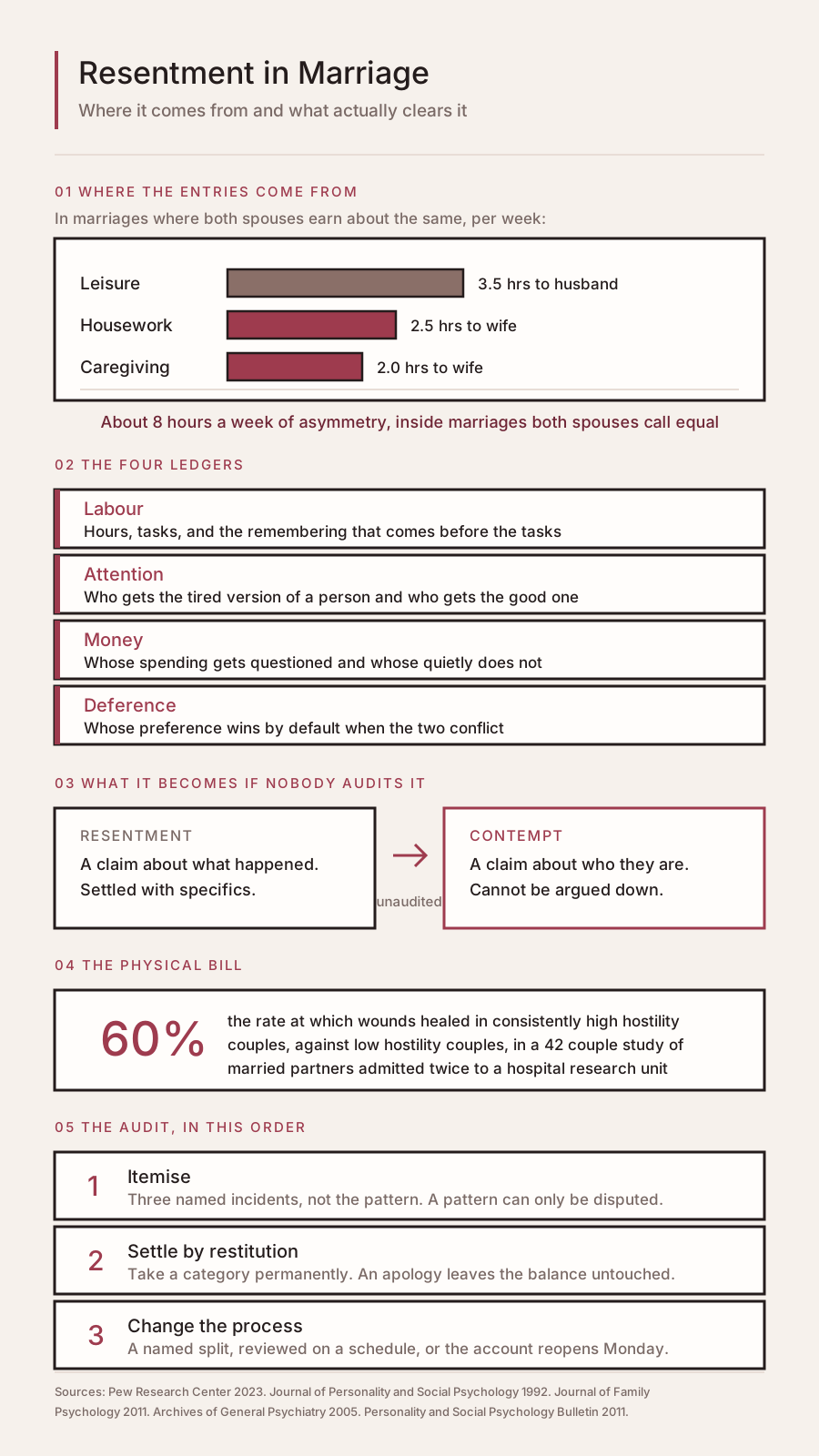
In egalitarian marriages, meaning marriages where husband and wife earn about the same, husbands spend about 3.5 hours more per week on leisure than their wives. Wives in those same marriages spend roughly 2 hours more per week on caregiving and about 2.5 hours more on housework. Those are two different currencies rather than one, roughly three and a half hours of whose time is free and roughly four and a half hours of whose time goes to the house, but together they come to about eight hours a week of imbalance inside the exact category of marriage both partners would describe as equal, because the thing they are measuring equality by is the paycheque.
Eight hours is a working day. It is not a rounding error and it is not a feeling. And notice what the number cannot tell you: whether either person minds. Plenty of couples run an uneven split by open agreement and carry no resentment at all, because the split was chosen out loud rather than settled by default. The ledger does not open when the division is unequal. It opens when the division is unequal and unacknowledged.
The mechanics of how that happens, and why the invisible half of the work is the half that never gets credited, is the whole subject of the mental load of running a household. What matters here is the consequence. Eight hours a week, unnamed, works out to somewhere around four hundred hours a year of contribution that one person made and the other never registered. That annual figure is our own arithmetic applied to the Pew averages rather than a measured quantity, and it will be wrong for any particular household. It is offered as a sense of scale.
The four ledgers, and what each one is really recording
In practice resentment tends to show up in four recurring categories. This is an organising frame from our own editorial reading rather than a clinical taxonomy, and it earns its place only by making the counting visible. Most marriages have entries in more than one column, and the column that gets voiced out loud is not necessarily the one carrying the largest balance.
| The ledger | What gets counted | What the other person sees |
|---|---|---|
| Labour | Hours, tasks, and the remembering behind them | An evenly split list of chores |
| Attention | Who gets the tired version of you | A busy period that will pass |
| Money | Whose spending gets questioned | Two adults with reasonable discretion |
| Deference | Whose preference wins by default | A partner who is easy going |
Each ledger has a sentence that opens it without an accusation attached to it:
- Labour. I need us to look at the actual week, not the list.
- Attention. Everyone else gets you at your best and I get what is left.
- Money. We apply different rules to your purchases and mine.
- Deference. I have been the flexible one for a long time and I stopped choosing it.
The attention column is often the one that catches men off guard, because nothing is being withheld deliberately and nothing on the surface has changed. The household still functions. The bills are still paid. But the version of him that comes through the door at seven is depleted, and it has been for years, and his wife has been receiving that version while colleagues and clients received the other one. Nothing in that is a betrayal. It is a routing problem. It still produces a ledger entry every single evening, and after a decade the balance in that column can be larger than anything in the labour column.
The deference column is the quietest and the most corrosive. It records who bends. Somebody in the marriage has been the flexible one on holidays, on which family to visit, on how loud the house is, on what plays in the car. They chose it at first, because it was genuinely easier and they genuinely did not mind. What changed was not the preference. What changed is that it stopped being a choice and became an expectation, and the moment a gift becomes an assumption it starts being recorded.
None of this runs in one direction. A husband keeps a ledger too, and it is rarely about chores. It tends to be about being the one whose opinion gets a vote only when it already agrees with hers, the one whose effort at providing or fixing or organising goes unremarked until it stops, the one who has felt needed rather than wanted for longer than he has said out loud. That ledger is just as real, just as silent, and just as capable of curdling into contempt. Everything in the rest of this piece runs the same way for him, including the part about having to stop adding to it first.
What resentment becomes if nobody audits it
Left alone, resentment converts, and the currency it converts into is contempt.
That distinction is not rhetorical. Resentment claims that something happened, and a specific claim can be settled with evidence. Contempt claims something about who the other person is, which is a verdict rather than a dispute, and you cannot argue a verdict down with facts about a Tuesday.
The behavioural research on this is old and unusually consistent. Gottman and Levenson, in a 1992 study in the Journal of Personality and Social Psychology, followed 73 married couples across 1983 and 1987 and separated them into regulated and unregulated groups. Compared with regulated couples, the unregulated ones showed more negative emotional expression, less positive emotional expression, more stubbornness and withdrawal from interaction, greater defensiveness, and greater risk of dissolution. That is a small sample by modern standards and it is a description of a pattern rather than a prediction about any individual marriage. But the shape it describes is the one people in a quiet marriage recognise immediately: not more fighting, less contact, and a defensiveness that starts before the sentence is finished.
The contempt finding specifically comes from later work. A 2011 longitudinal study in the Journal of Family Psychology compared newlywed couples in two settings, a conflict conversation and a love conversation, and tracked relationship satisfaction and divorce proneness about fifteen months later. Contempt and affection both emerged as unique predictors of later quality and stability, for husbands and wives, in both settings. The detail worth carrying away is that the positive setting did more predictive work than the negative one: the course of positive emotion during the love conversation predicted later satisfaction, and the conflict conversation did not.
Read plainly, that says something uncomfortable and useful. How a couple fights matters less than whether there is anything left in the room when they are not fighting. A marriage can look calm, argue almost never, and still be running out of the thing that actually holds it together. That is the precise shape of loneliness inside a marriage that still functions, and it is why an absence of arguing is such a poor all clear.
The physical bill
There is a measurable version of this too, and it is worth knowing about before deciding that resentment is merely unpleasant.
A 2005 study in the Archives of General Psychiatry admitted 42 healthy married couples to a hospital research unit twice, for 24 hours each time. On the first admission the couples had a supportive conversation. On the second they discussed a disagreement. Small blister wounds were created and healing was tracked daily afterwards. Wounds healed more slowly after the conflict admission than after the supportive one. Couples who showed consistently higher hostility across both interactions healed at 60 percent of the rate of the low hostility couples, and produced larger increases in plasma IL-6 and tumour necrosis factor alpha the morning after conflict.
The limits are worth naming plainly before treating this as settled. The sample is 42 couples, which is small. It measured observed hostile behaviour in a laboratory rather than resentment as such, and the two are related without being identical. It measured wound healing and inflammatory markers, which are mechanisms rather than diagnoses. What it establishes is narrow and still worth having: the way two people speak to each other produces effects measurable in tissue, on a timescale of days.
One note before the next section. If what you are carrying has moved past housework into something heavier, an article is the wrong place for it. Readers in the United States can reach the Suicide and Crisis Lifeline at any hour by dialling or texting 988, at no cost. For a marriage in real trouble rather than ordinary disrepair, a licensed counsellor is the correct room to be sitting in.
Why the standard advice fails
The standard advice for resentment is to communicate more and to practise gratitude. Both fail, and for a related reason: each asks a feeling to change directly instead of changing the specific behaviour the feeling depends on.
Communicating more fails because the ledger keeper has usually been communicating for years, in the only register available to them: the sigh, the tone, the pointed efficiency, the answer that is technically fine. That is communication. It is just communication in a form that carries no specifics, so it can be received as mood rather than as content, and it always is. More of it produces more mood. What was missing was never volume but itemisation.
Gratitude advice fails for a more interesting reason, and the research here is genuinely counterintuitive. A longitudinal study of married couples in Personality and Social Psychology Bulletin, tracking them across three time points over roughly four years after marriage, examined where gratitude toward a partner actually comes from. It found that gratitude arises from the partner's relationship maintenance behaviours, partly because those behaviours create a perception of responsiveness to one's needs, and that gratitude in turn motivates the grateful partner to do maintenance work themselves.
The direction of that finding is the point. Gratitude sits downstream of visible effort, arising from a partner who is doing things and then feeding back into more of the same. Instructing a depleted spouse to feel more grateful asks for the output while withholding the input. One caution about how far to take that. The study observed gratitude and maintenance behaviour predicting each other over time in married couples. It did not test gratitude exercises and it did not measure whether they work, so it cannot be used to say they fail. What it supports is narrower and still useful. Change what is actually done, and on this evidence gratitude tends to follow rather than lead.
The audit
What clears resentment is the same thing that clears any unaudited account. You itemise it, you settle the items, and you change the process that generated them. In that order, and none of the three works alone.
Itemise, and be embarrassingly specific. The instinct is to describe the pattern, because the pattern is what you feel. But a pattern cannot be settled, only disputed. Three named incidents can be settled. Not "you never think about what I am carrying" but "the school forms in March, the car service in April, and your mother's birthday, all three of which I remembered and none of which anyone asked me to." Specific is harder to say and impossible to argue with.
Settle by restitution, not apology. An apology closes an emotional loop and leaves the balance untouched, which is why the same argument returns in six weeks feeling exactly as unresolved as before. Restitution is doing a thing that would not otherwise have been done. In practice it means taking a category permanently, without supervision and without asking how, and holding it long enough that it stops being noticed.
Change the process, or the balance simply rebuilds. This is the step everybody skips, because the first two feel like resolution. If eight hours a week produced the original balance, and the eight hours continue, the account reopens the following Monday. Changing the process means a named split of specific categories, reviewed out loud on a fixed schedule rather than whenever somebody breaks. What that costs to do properly, and how many months pass before the atmosphere in the house shifts at all, is the subject of what saving a marriage actually requires.
One thing not to expect: symmetry. The person who kept the ledger has to stop adding to it before the balance is settled, unfair as that feels, or the account keeps outgrowing whatever gets paid down. Somebody has to go first, and it is usually them.
The American Psychological Association maintains public resources on anger and how it is managed, which is a reasonable starting point if the anger under the resentment has become the more urgent problem. It is also worth checking that a ledger is what you are actually dealing with. If the resentment traces back to one nameable moment when comfort was needed and did not arrive, rather than to an accumulation of unregistered hours, then the mechanism is an attachment injury and not a balance, and auditing the ledger will not touch it. And it is worth being honest that some balances are past auditing, at which point the question stops being repair and becomes the longer decision about whether the marriage continues. That is a different piece of work, and it should not be started in the same week as this one.
One failure mode is worth naming before you start. Itemising depends on the other person being willing to hear a specific list without treating it as an ambush, and some will not be, on the first attempt or the fifth. If three named incidents are met with denial, a counter-list or a flat refusal to engage, the audit has not failed. It has surfaced a different problem, which is that one person is not available for this conversation yet. That is no longer something to work on alone, and it is the point at which what saving a marriage actually requires becomes the more useful piece.
What a cleared account actually looks like
Couples who have done this work rarely describe a marriage where the split is finally fair. They describe one where the split is finally stated.
The change is that nothing is accruing. Contributions are visible while they happen rather than tallied in private. The unevenness that remains is unevenness both people chose, out loud, knowing the number. And the tone that everybody in a long marriage recognises, the flat pleasant one that means an account is open, stops being the default register of the house.
That is a lower bar than a happy marriage and a much higher bar than a quiet one. It is also, unlike gratitude, something either person can start on a Tuesday, with a list rather than a feeling.
Last reviewed by The Quiet Marriage Editorial Team on August 21, 2026. This piece was reviewed editorially, against its published sources. It was not reviewed by a licensed therapist, counsellor or physician, and it is not a substitute for one. Our sourcing and AI use rules are public on the editorial standards page. This is general editorial content and not professional, medical or psychological advice. A marriage in genuine difficulty should be discussed with a licensed professional in your own jurisdiction. If you are in crisis in the United States, dial or text 988 for the Suicide and Crisis Lifeline, which is free and available 24 hours a day.
FAQ
What is the difference between resentment and just being annoyed with your spouse?
Duration and target. Annoyance attaches to an event and expires when the event is resolved, which is why an annoyed person can be talked round in an afternoon. Resentment attaches to an accumulated total and does not expire, because nothing about the total has been settled. There is a practical test. If you can name the specific thing you are unhappy about and you would be satisfied if it were fixed, that is annoyance. If naming one specific thing feels dishonestly small, as though the real answer is a list you have never read out, that is resentment. The second one resolves on its own about as often as a debt does, which is to say not at all, and a good weekend has no effect on it.
Is resentment always about housework?
No. Housework is the most measurable column and usually the first to surface in an argument, which is not the same as being the largest. Resentment also gathers around attention, meaning who receives the depleted version of a person at the end of a working day; around money, meaning whose spending gets questioned and whose quietly does not; and around deference, meaning who bends by default when two preferences collide. There is a quick test for which column is actually loaded. Imagine the housework split being fixed tomorrow, exactly as you would want it, and then ask how you would feel by Friday. If the answer is much the same, the balance is sitting in one of the other three and the dishes were only the entry that happened to be visible.
What does resentment turn into if it is ignored?
Contempt, and the distinction matters. Resentment claims that something happened and can be settled with specifics. Contempt claims something about who the other person is and cannot be argued down with facts. On the research, a 2011 longitudinal study in the Journal of Family Psychology followed newlywed couples for about fifteen months after the wedding and found that contempt and affection both uniquely predicted relationship satisfaction and divorce proneness, in both conflict and affectionate conversations. That sample is newlyweds rather than long marriages, so it is evidence for a mechanism rather than a finding about couples decades in. The detail that does transfer is which conversation carried the predictive weight. It was the affectionate one and not the argument, which is why a household that has stopped arguing should not read the quiet as an all clear.
Does resentment in a marriage affect physical health?
There is measurable evidence that hostile interaction does, though the research studies observed hostility rather than resentment itself. A 2005 study in the Archives of General Psychiatry admitted 42 healthy married couples to a research unit twice, once for a supportive conversation and once for a disagreement, then tracked how small blister wounds healed. Wounds healed more slowly after the conflict visit, and couples consistently high in hostility across both sessions healed at 60 percent of the rate of low hostility couples. Two things that study cannot tell you, and which matter for a long quiet marriage. It measured days rather than years, so it says nothing about whether the effect persists. And it measured open hostility rather than silence, so it cannot establish that a suppressed ledger carries the same cost as an argument. The honest reading is that how two people speak to each other registers in the body on a timescale short enough to measure.
Why does telling a resentful partner to be more grateful never work?
Because gratitude is an output of the process rather than an input to it. A longitudinal study of married couples in Personality and Social Psychology Bulletin, following them across three time points over roughly four years, found that gratitude toward a partner arises from that partner's relationship maintenance behaviours, partly through the sense of responsiveness those behaviours create, and that gratitude then motivates the grateful partner to do maintenance work in return. Worth being precise about what that does and does not establish. The study observed the loop rather than testing any intervention, so it cannot be used to say gratitude exercises fail. What it does establish is the direction of travel. Asking for the feeling while leaving the behaviour unchanged is asking the loop to start at the wrong end.
How do you actually clear resentment that has built up over years?
Skipping any one of three moves undoes the other two. Itemise with embarrassing specificity, naming real incidents rather than describing the pattern, because a pattern can only be disputed while a specific can be settled. Settle by restitution rather than apology, meaning take a whole category permanently and without supervision, since an apology closes an emotional loop and leaves the balance where it was, and there is a tested inventory of which categories are usually held alone if you would rather not guess which one to take. Then change the process that generated the entries, with a named split reviewed on a fixed schedule, or the account reopens the following week. Two things to expect. It will feel unfair to the person who kept the ledger, because they have to stop adding to it before it is settled, and somebody has to go first. And it will take more than one attempt, because the first conversation is usually spent establishing that there is a ledger at all.
What is resentment in a marriage?
Resentment is the one thing in a marriage that never announces itself. Anger has a date, a cause and a raised voice, and afterwards both people know something happened. Resentment has none of that. It accrues. It goes into a ledger one person has been keeping for years, in a currency the other person cannot see, and by the time the balance gets mentioned out loud it is large enough that the mention itself sounds unhinged. Treat it as a bookkeeping discrepancy that has been allowed to compound rather than a mood in need of management, because that is what it is.
How do you apologize to your wife?
An apology is worth making and it will not settle anything on its own, and knowing the difference is most of the answer. An apology closes an emotional loop and leaves the balance exactly where it was, which is why the same argument returns six weeks later feeling as unresolved as before. Two things make it land. Name a real incident with embarrassing specificity rather than apologising for a pattern, because a pattern can be disputed while a specific can be settled. Then follow it with restitution, which means doing a thing that would not otherwise have been done: taking a whole category permanently, without supervision and without asking how it is done. Expect it to take more than one attempt, because the first conversation is usually spent establishing that there is a ledger at all.
What are the signs of resentment in a marriage?
Resentment is defined by not announcing itself, so every sign of it is indirect. The commonest is communication that carries mood rather than content: the sigh, the tone, the pointed efficiency, the answer that is technically fine. The second is a change in the shape of the marriage rather than in its volume. Gottman and Levenson, in a 1992 study in the Journal of Personality and Social Psychology, followed 73 married couples and separated them into regulated and unregulated groups, and compared with the regulated couples the unregulated ones showed more negative emotional expression, less positive emotional expression, more stubbornness and withdrawal from interaction, and greater defensiveness. From inside the house that reads as not more fighting but less contact, and a defensiveness that begins before the sentence is finished. The third is the one that is easiest to miss, because nothing visible has broken: the household still functions and the bills are still paid, and what has changed is only which version of a person the other one has been receiving. The fourth arrives last, when something finally gets said out loud and the size of the complaint sounds out of proportion to the incident named. That is a ledger being read as a total by the person who kept it and heard as a charge for a single Tuesday by the person who did not.
What causes resentment in a marriage?
Not the imbalance by itself. Plenty of couples run an uneven split by open agreement and carry no resentment at all, because the split was chosen out loud rather than settled by default. The ledger opens when the division is unequal and unacknowledged, and the second half of that sentence is the half doing the work. The measurable version sits in the Pew Research Center time diaries: in marriages where husband and wife earn about the same, husbands spend about 3.5 hours more per week on leisure, while wives spend roughly 2 hours more on caregiving and about 2.5 hours more on housework. That is around eight hours a week of asymmetry inside the exact category of marriage both partners would describe as equal, because equality was being measured on the one axis both people were watching, the paycheque. From there the entries collect in four columns rather than one: labour, attention, money and deference. That grouping is our own editorial reading rather than a clinical taxonomy. The column that gets voiced out loud is not necessarily the one carrying the largest balance, and the quietest of the four, deference, simply records who bends, which was a genuine choice at first and stopped being one without anybody announcing the change.
Sources
- Pew Research Center (pewresearch.org)
- Gottman and Levenson, in a 1992 study in the Journal of Personality and Social Psychology (pubmed.ncbi.nlm.nih.gov)
- A 2011 longitudinal study in the Journal of Family Psychology (pubmed.ncbi.nlm.nih.gov)
- A 2005 study in the Archives of General Psychiatry (pubmed.ncbi.nlm.nih.gov)
- Suicide and Crisis Lifeline (988lifeline.org)
- A longitudinal study of married couples in Personality and Social Psychology Bulletin (pubmed.ncbi.nlm.nih.gov)
- American Psychological Association (apa.org)