How to Reconnect With Your Wife: Three Mechanisms and the One Most Men Skip
Reconnecting with your wife is not one action, it is three separate mechanisms with three different evidence bases, and the grand gesture most men reach for is a badly shaped dose of just one of them. The word reconnect sounds like a single thing you either do or fail to do. In the research it comes apart into three, and they run at different frequencies, cost different amounts, and fail in different ways.
That matters because the three are not interchangeable. Getting the first one right does not substitute for the second. Booking the third at full volume once a year does not compensate for skipping the other two for eleven months. A man who has read one article about date nights and acted on it faithfully can be doing exactly one third of the available work and cannot understand why the room still feels the same.
What follows is what has actually been measured, including the parts that were measured on dating couples rather than long marriages, and the parts that are correlational and cannot tell you which way the arrow points. The claims here are kept to what the papers themselves report.
What the word reconnect is actually covering
Ask a man what reconnecting with his wife would look like and you will usually get a version of the third mechanism: a trip, a weekend, a proper evening out. Ask a woman in a marriage that has gone quiet what is missing and you will more often get a version of the first two, described not as events but as a texture. She is not asking for an itinerary. She is describing what it is like to say something small and have it land nowhere.
The three mechanisms below are not a framework anyone published as a set. They are three separate lines of research that happen to describe three separate levers, and setting them side by side is the fastest way to see which one you have been pulling.
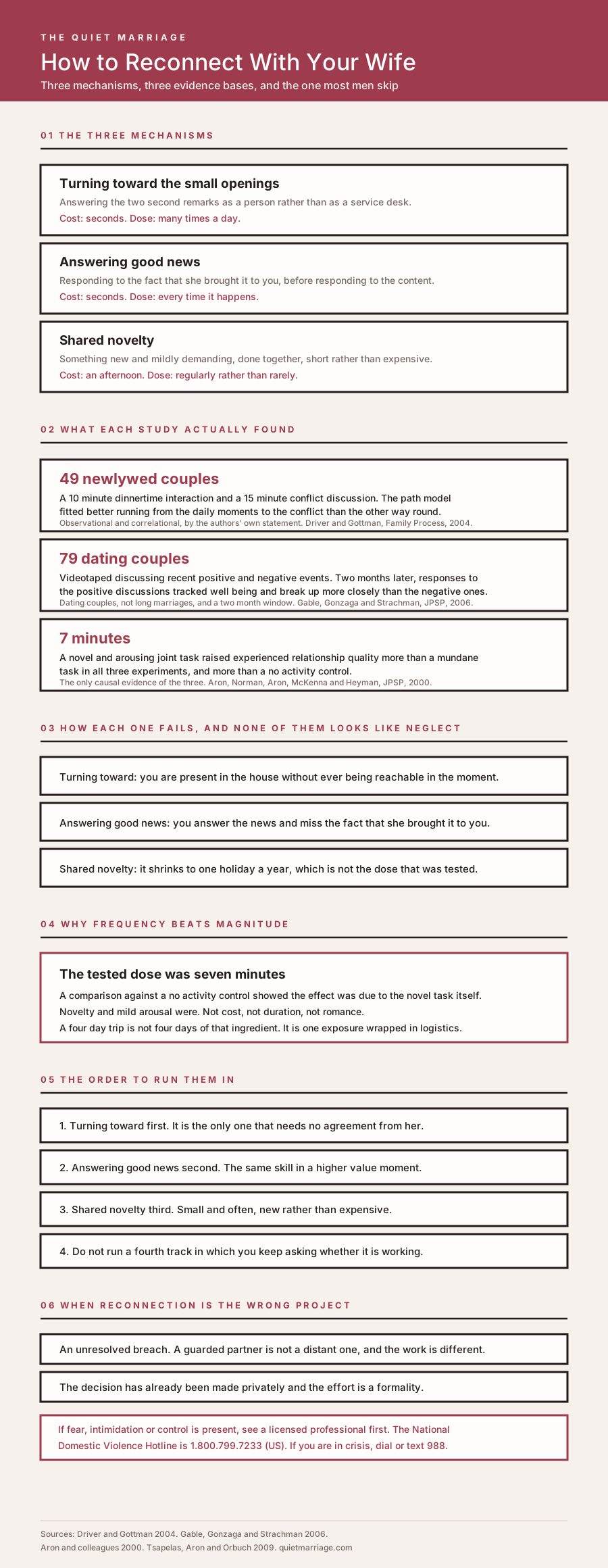
| Turning toward | Good news | Novelty | |
|---|---|---|---|
| What it is | The small daily openings | How you react to her good news | Something new, done together |
| Evidence | Observed, not causal | Two months, not causal | Three experiments, causal |
| Studied in | 49 newlyweds | 79 dating couples | A survey and three experiments |
| Cost each time | Seconds | Seconds | An afternoon |
| Dose | Many times a day | Every time it happens | Often, not rarely |
| How it fails | Present but not reachable | You answer the news, not the event | It becomes one trip a year |
The last row is the one to read twice. Each mechanism has a characteristic failure that looks nothing like neglect from the inside. A man who is in the house every evening, who answers every question he is asked, and who books a good holiday every summer can be failing all three at once and can produce a completely honest account of himself in which he is doing everything.
Mechanism one: the ordinary moments, and what they predict
In 2004 Janice Driver and John Gottman published a study in Family Process asking whether the small stuff has any measurable relationship to the big stuff. They took 49 newlywed couples, recorded a 10 minute dinnertime interaction in a seminatural setting, and separately recorded a 15 minute conflict discussion coded with the Specific Affect Coding System. The question was whether playfulness and enthusiasm in everyday life had anything to do with the use of humour and affection during an argument.
The path analysis produced a stronger model when the direction of the correlation moved from the daily moments to the conflict discussion rather than the other way round. In plain terms, the dinner table looked more like the cause and the argument looked more like the consequence than the reverse.
The authors are careful about the limit and it deserves to be repeated rather than buried. The research was strictly observational and therefore correlational, and they say directly that further work is needed to determine the direction of causation. A stronger path model is not proof of a mechanism. It is the shape you would expect if the mechanism were real, measured in 49 couples who had recently married.
What that does support is a modest and useful claim. The couples whose ordinary evenings contained playfulness and enthusiasm were also the couples whose arguments contained humour and affection, and the pattern fitted better in that order. If your arguments have gone cold and hard, the place the evidence points is not the argument. It is the forty ordinary exchanges that happen before it.
Practically, this is the mechanism that costs the least and gets skipped the most, because each individual instance is too small to feel like an action. She mentions the neighbour's extension. She reads out something from her phone. She asks whether you saw the thing on the news. None of these are requests for a conversation and none of them are important. What they are is a test of whether you are reachable, and the test is passed or failed inside two seconds.
The failure mode is specific and it is not silence. It is a correct, informative, complete answer delivered without any sign that a person spoke. Answering the question is not the same as answering the bid.
Mechanism two: how you answer when something goes right
The second mechanism is the one almost nobody has heard of, and it has the most surprising finding attached to it.
In 2006 Shelly Gable, Gian Gonzaga and Amy Strachman published a study in the Journal of Personality and Social Psychology on what happens when a partner shares good news. Seventy nine dating couples completed measures of relationship well being and then took turns, on video, discussing recent positive events and recent negative events. The people doing the disclosing rated how understood, validated and cared for they felt in each discussion. Outside observers separately coded how the responder behaved.
Two months later, the self report data and the observational codes agreed on something counterintuitive. Responses to the positive event discussions were more closely related to relationship well being, and to whether the couple had broken up, than responses to the negative event discussions were.
Read that again with your own marriage in mind. How you behave when she brings you a problem is the thing every article tells you to work on. In this study, how you behaved when she brought you something good was the better predictor.
Two limits before anyone treats that as settled. These were dating couples, not couples twenty years into a marriage, and the two populations are not obviously interchangeable. And the follow up was two months, which is long enough to catch a break up in a dating sample and far too short to say anything about a long marriage. What the study establishes is that the positive exchange is doing real work rather than being decorative, which is a genuinely new place to look, not a rule you can apply with confidence to year twenty three.
Here the failure looks nothing like inattention, and it is easy to recognise once it is named. She tells you her thing went well. You respond to the content: a question about the logistics, a note about what happens next, a comparison to the last time. Every one of those is a reasonable sentence and none of them is a response to the event, which was that something good happened to her and she came to you with it first. Answering the news is not the same as answering the fact that she brought it to you.
Mechanism three: doing something new, and why seven minutes was enough
The third mechanism is the only one with genuinely causal evidence behind it, and the shape of the evidence is not what most people assume.
In 2000 Arthur Aron and colleagues published a set of studies in the Journal of Personality and Social Psychology examining shared participation in novel and arousing activities. The package included a newspaper questionnaire, a door to door survey and three laboratory experiments. The questionnaire and survey found the predicted correlation between reported shared exciting activities and relationship satisfaction, and found that relationship boredom mediated it, which is the correlational half.
The experiments are the half that matters. In all three, couples who participated together in a seven minute novel and arousing task showed a greater increase in experienced relationship quality, measured before and after, than couples given a more mundane task. A comparison against a no activity control showed the effect was due to the novel and arousing task itself. The same effect appeared in ratings of videotaped discussions taken before and after. The results held after controlling for relationship social desirability.
Seven minutes. In a laboratory. Against a control that also spent time together.
That is the finding to hold onto, because it inverts the usual advice. The active ingredient identified in these experiments was novelty and arousal, not duration, not cost and not romance. A seven minute awkward joint task moved the measure. That points toward frequency rather than magnitude as the better bet, though no study here tested repeated short sessions against one large one, and it suggests that a great deal of what gets booked as reconnection is the wrong shape at considerable expense.
The companion finding sits in a brief report Tsapelas, Aron and Orbuch published in Psychological Science in 2009, whose title states the result plainly: marital boredom now predicts less satisfaction 9 years later. We cite it at the level of the finding its authors state, because the full text is behind a publisher paywall we did not read, so treat it as a direction of travel from the same research group rather than as a number you can lean on. It is consistent with the mediation the 2000 paper found, where boredom was the thing sitting between shared exciting activity and satisfaction.
Why the grand gesture underperforms its cost
Set the grand gesture against the experimental finding and the problem is arithmetic rather than sentiment.
The Aron experiments moved the measure with a seven minute task, and the comparison against a no activity control showed the effect was due to the novel and arousing task itself. Whatever the active ingredient was, it was available in seven minutes and it was not romance, expense or duration. A four day trip is not four days of that ingredient. It is one or two exposures to it wrapped in a great deal of logistics, and logistics is exactly the thing that has been quietly making the marriage feel like an operation rather than a relationship.
There is a second problem the research does not address and experience does. A gesture large enough to be an event is also large enough to be an argument. Its cost, its timing and whose idea it was are all now on the table, and if there is a ledger running in the marriage the gesture becomes an entry in it. The piece on resentment in marriage covers what happens to a ledger that nobody audits, and a booked holiday is not an audit.
None of this makes the trip a bad idea. It makes it a poor first instrument. The gesture works best after contact has been reestablished, when it reads as an expression of something that is already true. Offered as the opening move it reads as an attempt to buy an outcome, which is how it is often meant, and both of you will know.
The order to run them in
The mechanisms are not sequential in the research. They become sequential in practice for a reason that is about cost and about credibility rather than about the studies.
Start with turning toward, because it is the only one you can do today without her participation. It requires no plan, no conversation and no agreement. It requires that you notice the two second openings and answer them as a person rather than as a service desk. Give it several weeks before you look for anything. The Driver and Gottman study measured a pattern across a marriage, not a good evening.
Add answering good news second, because it is the same skill in a specific and higher value moment. When she brings something that went well, respond to the fact that she brought it before you respond to the content. This is one of the few places where the counterintuitive finding gives you a concrete instruction, and it is worth noticing that most men have been coached hard on the opposite half, the problem half.
Introduce shared novelty third, small and often. New rather than expensive. Something neither of you has done, mildly demanding, short. A class in something neither of you can do, an unfamiliar walking route, a recipe from a cuisine you have never cooked, a market in a part of town you do not go to. The experimental result gives you permission to do this cheaply and frequently instead of expensively and rarely, which is fortunate, because a marriage that has gone quiet usually cannot support a large joint plan yet.
Do not run a fourth track alongside these in which you keep asking whether it is working. That converts the whole project into another thing she has to manage and evaluate, which is the shape of the household load rather than the shape of reconnection. The piece on the mental load covers why that particular offer lands as more work rather than less.
The lag is real and it is the reason most attempts stop. Nothing in any of these studies happens in a week. What you are rebuilding is a pattern, and a pattern is only visible in aggregate. How to save your marriage when nothing is actually wrong goes further into what to do when the waiting stays one sided for a long time.
What this article does not cover
This is about a marriage that has gone quiet, where nobody has broken anything and nobody is leaving. Four neighbouring cases need different pieces.
The closest neighbour is the general question rather than the specific one. How to save your marriage when nothing is actually wrong covers the whole sequence of moving first when there is no crisis to point at, including how to decide what you are saving and how long to give it. This piece is narrower on purpose: three named mechanisms, the evidence behind each, and the order to run them in.
If something was broken and she is guarded rather than distant, reconnection is the wrong project and it will not work until the repair is done. Trust rebuilding after a real breach covers that case, and rebuilding relationship trust when nothing was betrayed covers the slower version where no single incident is identifiable.
If the flatness is coming from your side and you recognise yourself as the one who is hard to reach, your husband is emotionally unavailable describes four different interiors that produce the same flat surface from the outside, and the moves that fit each one are not the same. If what you are living with is the particular isolation of being lonely three feet from someone, lonely in marriage is the piece for that.
And if the honest answer is that this has been decided already and reconnection is a formality you are performing, that is worth saying to someone. Divorce for men after forty covers what that decision actually involves rather than what it feels like at two in the morning.
If fear, intimidation or control is present in either direction, none of the above applies and this is not a reconnection project. Speak to a licensed professional first. In the United States the National Domestic Violence Hotline can help you think through safety, at 1.800.799.7233. If you are in crisis, dial or text 988 for the Suicide and Crisis Lifeline.
Last reviewed by The Quiet Marriage Editorial Team on September 3, 2026. This piece was reviewed editorially, against its published sources. It was not reviewed by a licensed therapist, attorney or physician, and it is not a substitute for one. Our sourcing and AI use rules are public on the editorial standards page. This is general editorial content and not professional, legal, medical or psychological advice. Decisions about separation, custody and finances should be taken with a licensed professional in your own jurisdiction. If you are in crisis in the United States, dial or text 988 for the Suicide and Crisis Lifeline, which is free and available 24 hours a day.
FAQ
How do you reconnect with your wife when she has stopped responding?
Start with the mechanism that needs no agreement from her. When she mentions the neighbour's extension, reads something off her phone, or asks whether you saw the thing on the news, answer the person and not only the question. That is entirely unilateral and it needs no conversation to set up. In the study of 49 newlywed couples the ordinary daily moments fitted better as the cause of the tone in conflict than as its consequence, which is correlational rather than proven. Expect several weeks before anything is visible, because what is being rebuilt is a pattern rather than an evening.
What is the fastest way to reconnect with my wife?
There is no fast way, and the closest thing to one is the least impressive. The only causal evidence in this area comes from three laboratory experiments in which a seven minute novel and arousing joint task raised experienced relationship quality more than a more mundane task, with a separate no activity control showing the effect was due to the novel task itself. That result argues for small and frequent rather than large and rare. A short new thing done this week is closer to the tested intervention than a weekend booked for next month.
Does a romantic holiday fix a marriage that has gone quiet?
It is a poor first instrument, and not because it is unromantic. It is the wrong shape for the thing that was actually tested, which was brief and cheap rather than long and expensive. A gesture that size also arrives with a cost, a date and an owner attached, so in a marriage already carrying resentment it becomes another entry in the ledger rather than a way out of one. It does better as a follow up once contact is improving than as the opening move.
Why does she say I do not listen when I answer every question?
Because the remark was not a request for information. It was a two second test of whether you are reachable, and that test can be failed by a reply that is entirely correct. From the inside this looks like nothing at all, which is why it runs for years without either of you being able to name it, and why she reaches for the word listen when the problem is not your hearing.
Is it better to be supportive when things go wrong or when things go right?
The counterintuitive answer from the research is that the good news case is doing more work than most advice gives it credit for. In a study of 79 dating couples, self reports and outside observer codes agreed that two months later, responses to positive event discussions were more closely related to relationship well being and to break up than responses to negative event discussions were. Two limits matter: these were dating couples rather than long marriages, and two months is a short window. It is a strong reason to look at the positive exchange, not a reason to stop responding well to problems.
How long does it take to reconnect with your wife?
No study in this area gives a timeline for a long marriage, and any specific number you are offered was invented. What the evidence describes is patterns rather than events, which means the unit is weeks and months rather than evenings. The practical consequence is the one that stops most attempts: you will be doing the work for a while before anything comes back, and reading that silence as failure is the most common reason men abandon a method that was working.
Should I tell her I am trying to reconnect?
Say it once if you want to, then stop. Repeating it, or asking whether it is working, hands her one more thing to track and score, which is the opposite of what you are trying to take off her. The conduct accumulates whether or not it is narrated. Being asked to grade it does not.
What if we have nothing in common any more?
That is the case the third mechanism was built for, and the requirement is lower than it sounds. The active ingredient in the experiments was novelty and mild arousal, not shared interest and not enjoyment, and the tested version lasted seven minutes and was somewhat awkward by design. Something neither of you has done before qualifies: a class, an unfamiliar route, a cuisine you have never cooked. Something you both already like is pleasant and is not the thing that was tested.
When is reconnection the wrong thing to be working on?
When there is an unresolved breach, when fear or control is present, or when the decision has already been made privately and the effort is a formality. A guarded partner is not a distant one and the work is different, which is covered in trust rebuilding after a real breach. If fear, intimidation or control is present, speak to a licensed professional before anything else, and in the United States the National Domestic Violence Hotline is at 1.800.799.7233. If you are in crisis, dial or text 988.
Sources
- 49 newlywed couples (pubmed.ncbi.nlm.nih.gov)
- Seventy nine dating couples (pubmed.ncbi.nlm.nih.gov)
- three laboratory experiments (pubmed.ncbi.nlm.nih.gov)
- marital boredom now predicts less satisfaction 9 years later (pubmed.ncbi.nlm.nih.gov)
- National Domestic Violence Hotline (thehotline.org)
- Suicide and Crisis Lifeline (988lifeline.org)