The Mental Load in Relationships: Why the Imbalance Holds Even When Nobody Is the Villain
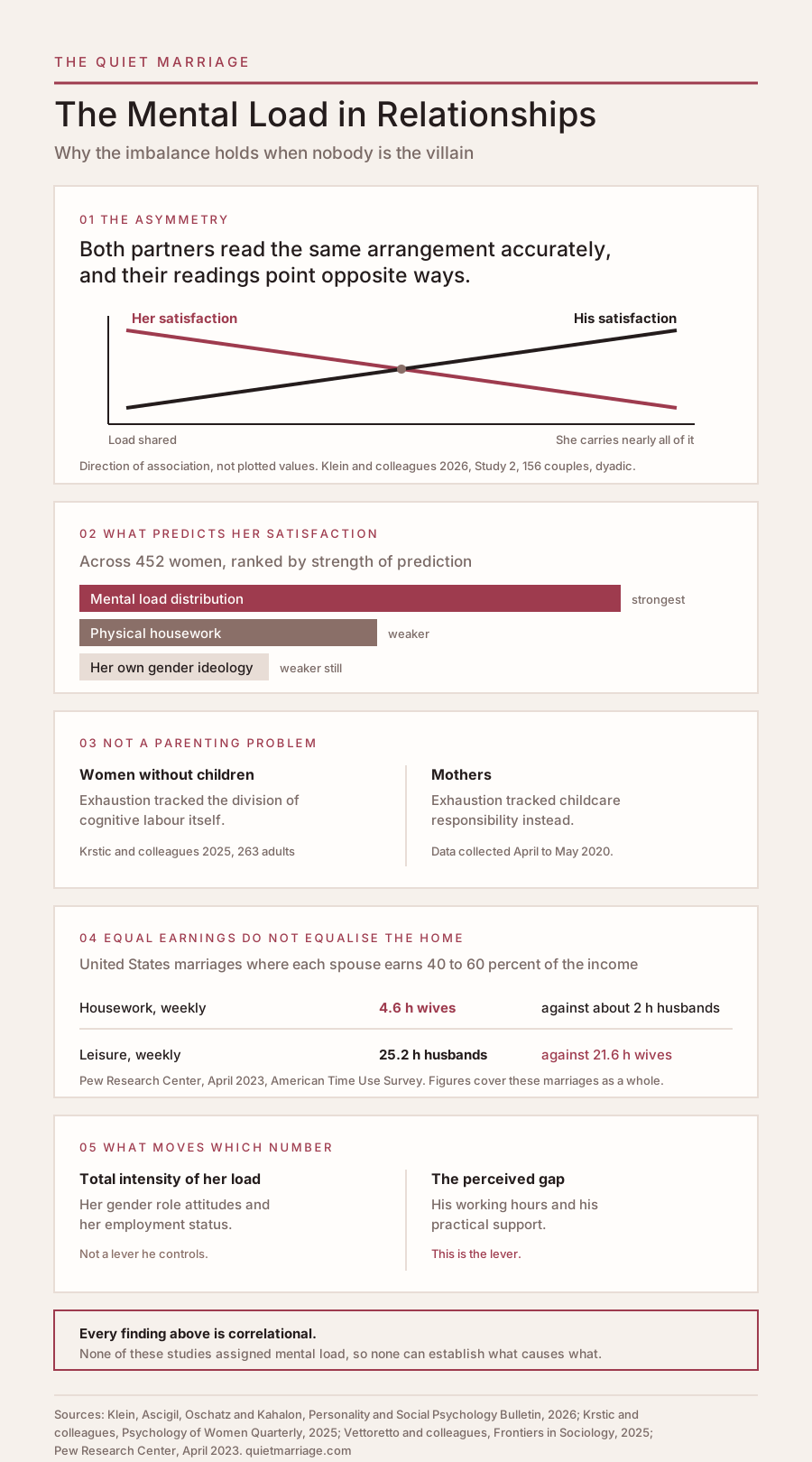
The imbalance in the mental load holds because it is not costing the two of you the same thing. In a 2026 study that measured both partners in 156 couples, women's relationship and sexual satisfaction were higher when the mental load was more evenly shared, while men's satisfaction on those same two measures was higher when their female partners carried a greater share. An arrangement associated with a cost to one partner and a benefit to the other does not need a villain to persist. It needs only that the person it suits has no reliable internal signal that anything is wrong. That is how a household stays like this for years while he considers himself a reasonable man doing his share, and it is why goodwill alone tends not to hold. We have covered what the mental load is and how to inventory it already. This is about what the load does to the relationship itself.
The usual explanations are that he is selfish, or that she has not asked clearly enough. The better one arrived in a 2026 paper that measured both partners instead of one.
The finding that explains why the arrangement holds
Klein and colleagues ran two studies. The second is the one that matters here, because it collected data from both people in 156 couples rather than asking women to describe households men could not answer for.
Women's relationship satisfaction and sexual satisfaction were both higher when the mental load was more evenly shared. Men's satisfaction, on the same two measures, was higher when their female partners took on a greater share.
Take the design seriously before taking the interpretation. This is a cross-sectional association, not an experiment, so it cannot tell you that the imbalance produces his contentment. What it does show is that the two partners' satisfaction scores move in opposite directions across the same arrangement, which is a harder thing to explain away than either partner's report on its own.
Sit with that direction for a moment. The arrangement that is associated with less satisfaction for her is associated with more of it for him. Nothing in that requires him to have schemed for it, or to enjoy her exhaustion. A household where somebody else holds the running list of everything that must happen is a more comfortable household to live in, and comfort tends to register as satisfaction whether or not the person feeling it can name the source.
That pattern makes the long stalemate legible. An arrangement associated with a cost to one partner and a benefit to the other does not need a villain to persist. It needs only that the person it suits has no reliable internal signal that anything is wrong. He is not necessarily ignoring the problem. From inside his own experience there may not be one, which is precisely why his sense that things seem fine is not usable as evidence about the state of the marriage.
It also suggests why goodwill alone tends not to hold. Goodwill produces a good month. Then the old arrangement reasserts itself, because nothing structural has changed and one of you is working against the grain while the other is not. That is the case for a permanent, defined transfer rather than an attitude adjustment.
Mental load predicts satisfaction better than the housework does
Study 1 in the same paper surveyed 452 women, and its finding is the one that should redirect the argument you have been having.
It out-predicted the women's own gender ideology, which is the polite way of saying that women who believe firmly in equal partnership were not protected from the effect by believing in it. The authors note that even egalitarian women disproportionately carried this labor.
The practical consequence is that the ledger you have been keeping is measuring the wrong quantity. If your defence has been the list of tasks you perform, and it has never landed, this is why. You have been producing evidence in a category that predicts less of her satisfaction than the category she is actually talking about. The contribution that moves the number is contribution to the thinking, and within that, the paper singles out emotional labor as the component most associated with her satisfaction.
This is not a parenting problem
The mental load is usually discussed as something that happens to mothers, which lets couples without children at home conclude it does not apply to them. The evidence does not support that exit.
Krstić and colleagues, writing in Psychology of Women Quarterly in 2025, tracked 263 people weekly over seven weeks and separated two things that usually travel together. For mothers, emotional exhaustion and its downstream costs were driven by disproportionate responsibility for childcare. For women without children, it was the division of cognitive labor itself that did the work. The mental load was not a side effect of having children. It was operating on its own, in households where no childcare existed to explain it.
Two things constrain that study before you lean on it. It measured work outcomes, emotional exhaustion, turnover intentions and career resilience, rather than relationship satisfaction, so it is not direct evidence about marriages. And its data were collected in April and May 2020, during the early phase of the COVID-19 pandemic, when schools were shut and work had collapsed into the home, which is an unusual period for any household. Neither limit explains why the effect split along the presence of children rather than showing up evenly, and that split is the part relevant here: the imbalance is not manufactured by children, which is the claim couples past the school years most often use to rule themselves out.
The Pew time-use figures point the same way. In marriages where each spouse earns between 40 and 60 percent of the household's income, husbands and wives without children at home both spend under an hour a week on caregiving, so childcare is not what is being divided. Pew does not publish separate housework and leisure figures for that childless subgroup, so the housework figures, 4.6 hours a week for wives against roughly 2 for husbands, and the leisure figures, 25.2 hours for husbands against 21.6 for wives, describe earnings-equal marriages as a whole, parents and non-parents together. Read at that resolution it still says something the exit ignores: equalise the earnings and the domestic gap does not equalise with them.
If your children left years ago and the house went quiet rather than easy, that is the finding to sit with. Nothing was resolved by their leaving. The load simply lost the explanation that had been covering for it, which is often when the distance underneath becomes audible.
Where the imbalance actually sits
A systematic review is useful here because it tells you which part of the job is contested. Reich-Stiebert, Froehlich and Voltmer reviewed 31 peer-reviewed articles on mental labor in the household and childcare, following PRISMA methodology, across samples that were mostly United States and European, middle class, married or partnered.
We have already drawn on that review's inventory of what the load contains, in the checklist. The reason to return to it here is narrower. Among the consequences it catalogues across those 31 studies, lower relationship satisfaction appears as a repeatedly observed correlate rather than the result of any one paper. That is the appropriate confidence level for the central claim of this article: not a single striking result, but the same direction turning up across a literature.
What actually moves the gap
The most operationally useful study for a man who has already accepted all of the above comes from Italy. Vettoretto, Minello, Ortensi and Tosi surveyed 2,309 Italian mothers of one child and did something the other papers do not. They separated two different questions and modelled them independently.
The first is how much mental labor she carries in total. The second is how large she perceives the gap to be between her contribution and her partner's. These are not the same number, and they do not have the same predictors.
| What is being predicted | What predicted it in the Italian data |
|---|---|
| The total intensity of her mental labor | Her own characteristics, including her gender role attitudes and her employment status |
| The perceived gap between her share and his | Relational factors, most strongly his working hours and his degree of practical support |
The second row is the one a partner can act on. His hours and his practical support are levers he controls. Her gender role attitudes and her employment status are not, and a man who treats them as the target ends up arguing his wife out of her own convictions, which is a different and worse conversation than the one he meant to have.
Two cautions before you use it. This is a cross-sectional survey of Italian mothers of exactly one child, so the specific coefficients are theirs and not yours. And it measures her perception of the gap rather than an audited division, a limitation the authors state plainly. That is a reason for caution and not for dismissal, because in the separate Klein data it was the distribution as reported, rather than any audited tally of tasks, that tracked her satisfaction. Those are different samples in different countries, so this is a reason to keep a perception measure in evidence, not proof that perception is the better instrument.
What this evidence does not say
Every study cited here is correlational. Not one of them randomly assigned mental load to households, because no ethics board would approve it and no couple would comply. That has a specific consequence, and it applies to the central finding as much as to the peripheral ones.
The Klein dyadic result establishes that the two satisfaction patterns point in opposite directions. It cannot tell you that carrying the load is what produces her dissatisfaction. A relationship that is already deteriorating could plausibly produce both an unequal load and a low satisfaction score, with the causal arrow running the other way or running in both directions at once. Treat it as a well-evidenced pattern whose mechanism remains open.
The samples are also narrower than the conclusions people draw from them. Reich-Stiebert and colleagues describe their reviewed samples as mostly United States and European and mostly middle class. The Italian study is mothers of one child. Ciciolla and Luthar's 393 mothers, whose thirteen item instrument sits behind our checklist, skewed heavily white, suburban and high income. This body of work describes a real and repeatedly observed pattern in Western middle-class heterosexual households. It is not a statement about all households everywhere, and a man whose own arrangement genuinely differs is not required to adopt a problem he does not have.
What none of it supports is the reading that the mental load is a rhetorical device. Thirty-one studies, four separate samples cited here, and consistent direction across all of them is not how a rhetorical device behaves.
What you are actually aiming at
The asymmetry finding changes what you are trying to achieve in the conversation, and it is a smaller target than most men aim at.
You are not trying to feel the load. You will not, and waiting until you do means waiting forever, because the entire finding is that your instruments read this situation as satisfactory. You are trying to act against a reading you do not share, on the evidence that the reading is unreliable rather than because you have been persuaded you are a bad person.
That is a workable position and it does not require you to agree that you have been failing. It requires accepting that your own comfort is not diagnostic here, and handing over a defined piece of the thinking permanently rather than offering to help more.
In practice the opening is smaller than most men expect, and it is not an apology. It is closer to: I want to take one thing over completely, not help with it. Pick which one, and I will own noticing it, not just doing it. That sentence concedes nothing about the past, and it moves the only variable the evidence points at. What the full transfer looks like item by item is the checklist.
If resentment has already hardened to the point where a fair division no longer reads as a fair division, that is a different problem and it has to be addressed first. Reorganising the chores while it is live will not touch it.
If any of this is happening alongside despair, hopelessness or thoughts of self harm, in either of you, it has stopped being a division of labor question. In the United States the 988 Suicide and Crisis Lifeline is available by call or text at 988. A licensed couples therapist or individual clinician is the correct next step for a marriage in crisis, and no article, including this one, substitutes for one.
Last reviewed by The Quiet Marriage Editorial Team on September 9, 2026. This piece was reviewed editorially, against its published sources. It was not reviewed by a licensed therapist, physician or attorney, and it is not a substitute for one. This is general editorial content and not professional, medical, legal or psychological advice. Every study cited here is correlational, and none of them can establish what causes what. If the pressure in your household has reached the point of despair, speak to a licensed professional. If you are in crisis in the United States, dial or text 988 for the Suicide and Crisis Lifeline, which is free and available 24 hours a day.
FAQ
What is the mental load in a relationship?
The thinking behind the doing: noticing a thing needs doing, deciding when, remembering it until it is done, and owning it if it is not. The fuller mechanism is here.
Does the mental load actually affect the relationship, or only her stress levels?
Both, and the relationship effect has been measured directly rather than inferred. Across 452 women, mental load distribution predicted relationship satisfaction more strongly than the division of physical housework did (Klein and colleagues, 2026). A systematic review of 31 studies lists lower relationship satisfaction among the documented correlates (Reich-Stiebert and colleagues, 2023). Every one of those findings is correlational.
Why would my satisfaction go up while hers goes down?
Start with what was measured. Klein and colleagues surveyed both partners in 156 couples, which is unusual: most work on this asks women to describe households men are never asked about. Women in that sample reported higher relationship and sexual satisfaction when the load was shared. Men reported higher satisfaction when their partners carried more of it.
The plain reading is that you are each reporting your own experience accurately, and your experiences disagree. Living in a household where somebody else holds the running list is genuinely more comfortable, and comfort tends to surface as satisfaction whether or not you can trace where it came from. None of this requires bad intent on your part, and the study cannot prove the arrangement caused either feeling.
The consequence is narrow but firm. Your sense that things seem fine is not evidence that they are, because in this specific domain your instrument reads high precisely where hers reads low.
We do not have children at home. Does this still apply?
Probably, though the evidence here is thinner than for households with children. Research tracking 263 adults found the division of cognitive labor drove exhaustion and work outcomes specifically among women without children, while for mothers it was childcare that did so (Krstić and colleagues, 2025). That study measured work outcomes rather than marriages, and its data come from the spring of 2020. Pew's figures separately show that childless couples in earnings-equal marriages spend under an hour a week on caregiving, so whatever is being divided in those homes, it is not childcare.
We earn the same. Does that not settle it?
No. Pew Research Center's analysis of American Time Use Survey data found that in marriages where each spouse earns between 40 and 60 percent of the combined income, wives still did 4.6 hours of housework a week against roughly 2 for husbands, and had about 3.6 fewer hours of leisure.
Is the mental load only a problem for women?
The research base is almost entirely about women in heterosexual couples, so that is the limit of what can be claimed with evidence behind it. The mechanism itself, one partner holding the anticipating and monitoring for a whole household, carries no requirement about who that partner is, and a man holding it is holding the same weight. How often that happens is a question the literature has not answered.
I already do half the housework and this still came up. What now?
Expect that, rather than treating it as a contradiction. Housework and mental load are separate quantities, they are divided separately in most homes, and the second one tracks more of her satisfaction than the first. A man can hit fifty percent on tasks while holding close to zero percent of the noticing, and from the inside those two feel like the same contribution.
So change the question. Not who did the thing, but who knew it needed doing, who tracked it, and who would have carried it if nobody mentioned it. Go through a normal week and count that column instead. If it comes out lopsided, you have found the argument you have actually been having, and it was never about the dishes.
What is the one thing most likely to change her perception of the gap?
Practical support. In a survey of 2,309 Italian mothers, the perceived gap tracked his working hours and his practical contribution rather than her own attitudes. One study, one country, so read it as a direction and not a prescription.
Should we see a therapist about this?
If the conversation reliably turns into the same argument, or if contempt or hopelessness has entered it, a licensed couples therapist is the appropriate step, and earlier beats later. If either of you is experiencing despair or thoughts of self harm, contact the 988 Suicide and Crisis Lifeline in the United States by call or text at 988.
Is the mental load the same thing as emotional labor?
Not the same thing, and the relationship between them is the useful part. The mental load is the thinking: the noticing, the anticipating, the deciding and the remembering that sits behind the tasks. Emotional labor is one component inside that thinking, and in the paper this article rests on it is the component most associated with her satisfaction. So emotional labor is not a synonym for the mental load, and it is not a separate ledger running alongside it either. It is the part of the thinking that carries the most weight for how she rates the relationship, which is why a defence built on the list of tasks you perform keeps failing to land.
Sources
- Klein and colleagues (pubmed.ncbi.nlm.nih.gov)
- Krstić and colleagues (pubmed.ncbi.nlm.nih.gov)
- Pew time-use figures (pewresearch.org)
- Reich-Stiebert, Froehlich and Voltmer (pubmed.ncbi.nlm.nih.gov)
- Vettoretto, Minello, Ortensi and Tosi (pubmed.ncbi.nlm.nih.gov)
- Ciciolla and Luthar's (pubmed.ncbi.nlm.nih.gov)
- 988 Suicide and Crisis Lifeline (988lifeline.org)