Communication Skills in Marriage: What the Evidence Actually Supports
The evidence that communication skills drive marital satisfaction is far thinner than the confidence of the advice suggests. The single most careful test of the proposition, published in 2016, set out to check whether communication actually drives satisfaction or whether it is mostly a symptom of it, and came back with an answer that rarely makes it into the advice: both directions exist, and neither one is strong. That matters more here than it would elsewhere. In a marriage that has gone quiet, the problem is rarely that two people are communicating badly. It is that they have stopped communicating at all, about anything beyond logistics, and no amount of technique fixes a conversation that never starts.
Every piece of marriage advice ends in the same place. Communicate better. Use I statements. Practise active listening. Repeat back what your partner said before you respond. It is the universal prescription, dispensed by therapists, by magazines, by well meaning friends across a kitchen table, and by anybody who has ever been asked what is wrong with a marriage and needed something to say.
Thin is not the same as absent, and it is not the same as fabricated. The research exists. It simply does not carry the weight the advice puts on it.
What the research actually found
The assumption underneath all communication advice is a causal one. Talk to each other better, and you will feel better about each other. Talk to each other badly, and the feeling erodes. It sounds so obviously true that almost nobody has bothered to test the reverse: that couples who already feel good about each other simply talk to each other better, and the communication is the readout rather than the cause.
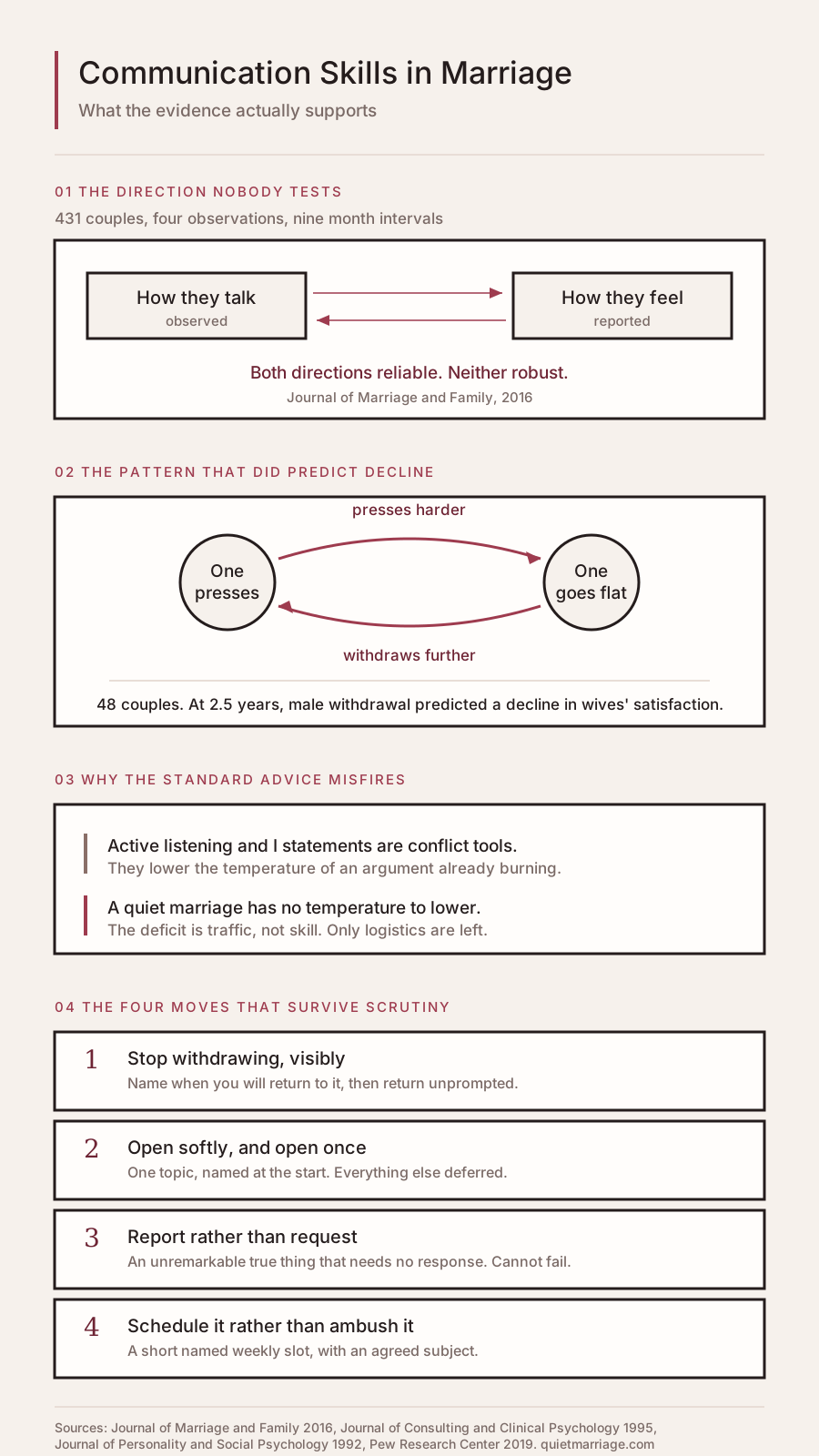
Lavner, Karney and Bradbury tested exactly that in the Journal of Marriage and Family in 2016. They followed 431 newlywed couples, observing their positivity, negativity and effectiveness in conversation four separate times at nine month intervals, and matching each observation against the couple's own reported satisfaction at that point. That design lets you ask the question in both directions at once. Does this wave's communication predict the next wave's satisfaction, and does this wave's satisfaction predict the next wave's communication.
The cross sectional result was the expected one. At any given moment, relatively satisfied couples were talking to each other more positively, less negatively and more effectively. That is the uncontroversial half of it.
The longitudinal result is the one that matters. Both pathways showed up as reliable, communication leading to satisfaction and satisfaction leading to communication, and in the authors' own words neither pathway was particularly robust. Their conclusion, stated plainly in the abstract, is that this raises important doubts about theories and interventions that prioritise couple communication skills as the key predictor of relationship satisfaction.
Two limits matter here, before this gets carried too far. The sample was newlyweds, studied across the first three years of marriage, which is not the population this publication is usually writing for. It was also a low income, ethnically diverse sample, which the authors describe as a strength for range but which is still one specific population. What the study establishes is not that communication is irrelevant in a twenty year marriage. It is that the confident causal story everybody repeats has been tested carefully in one place and did not come back strong.
The one pattern that does predict decline
Weak evidence for communication skill in general is not the same as no evidence for anything. One specific pattern has held up across decades of separate research, and it is not a skill deficit. Two people fall into a shape together, and the shape runs itself.
One person raises an issue and presses for a response. The other person goes flat, changes the subject, agrees in order to end it, or physically leaves the room. The first person, receiving nothing, presses harder. The second withdraws further. Researchers call it demand and withdraw, and the reason it matters is that it feeds itself. Each move is a reasonable response to the previous one, and the whole thing runs without either person choosing it.
Heavey, Christensen and Malamuth followed 48 couples in the Journal of Consulting and Clinical Psychology in 1995. Each couple had two recorded problem solving conversations, one about an issue the woman had chosen and one about an issue the man had chosen. Thirty six men and thirty six women completed the satisfaction measure again two and a half years later. Withdrawal by men, and the pattern of woman demanding while the man withdrew during discussions of issues the woman had raised, reliably predicted a decline in wives' relationship satisfaction over that interval.
Note what is being measured. Not whether either person used the right phrasing. Not whether anybody reflected back what they heard. The predictive variable was one person going absent inside a conversation the other person needed to have.
Gottman and Levenson found the same element from a different direction in the Journal of Personality and Social Psychology in 1992. Seventy three married couples were studied in 1983 and again in 1987. Couples the authors classed as nonregulated, compared with regulated couples, showed more negative emotional expression, less positive emotional expression, greater defensiveness, and more stubbornness and withdrawal from interaction, alongside lower satisfaction and a higher rate of separation. Withdrawal appears again, in a separate sample, a decade earlier, with a different research team.
Across all three studies the finding is narrower than the advice industry claims, and more useful than that sounds. General conversational polish is a weak lever. One person reliably going absent is not.
Why the standard advice misfires in a quiet marriage
The reason communication advice lands so badly in a long marriage that has gone silent is that it was designed for a different problem. Active listening, I statements and reflective paraphrasing are conflict management tools. They exist to lower the temperature of an argument that is already happening.
A quiet marriage has no temperature to lower. Two people are being unfailingly pleasant to each other about the car insurance. Nobody is interrupting, nobody is escalating, nobody needs to be taught to let the other person finish. Handing that household a conflict de escalation technique is like handing somebody a fire extinguisher because the house is cold.
What these marriages are missing is traffic rather than skill. There is no longer any category of conversation left except administration, and administration is the one category that does not require you to know the other person. It is the exact texture described in a marriage that works perfectly well and connects nobody, where everything works and nothing connects.
There is a second reason the advice misfires. In many quiet marriages one person has been carrying an unstated tally for years, and no communication technique reaches it, because the content was never the problem. Resentment that has been accruing without ever being itemised does not respond to better phrasing. It responds to being read out loud in specifics. That is a different move, and this article's techniques will not do it for you.
| What people call it | What is usually happening | What actually changes it |
|---|---|---|
| We have a communication problem | Only logistics get discussed, and competently | A fixed slot for talk with no task attached |
| He shuts down when I bring things up | Demand and withdraw, running on its own momentum | He names a time to return, and returns |
| We just argue in circles | One conversation carrying six unrelated grievances at once | One topic at a time, stated at the start |
| She never tells me anything is wrong | Small items were raised, went nowhere, then stopped | Answer one small item within a week, visibly |
| We are fine, we just do not talk | Nothing withheld, simply no traffic left | Report rather than request, for several weeks |
The four moves that survive scrutiny
Because the general case is weak, this list stays short, specific and modest about what it claims. Each of these is aimed at the thing the research actually implicated, which is presence rather than polish.
Stop withdrawing, and make the stop visible. Withdrawal is the single behaviour with the most consistent evidence against it across separate studies and separate decades. The realistic version is not forcing yourself to sit through a conversation you cannot handle. It is saying, out loud, that you cannot handle it right now and naming when you will come back to it, then coming back to it unprompted. The unprompted return is the entire move. Coming back only when chased is still withdrawal, with an extra step.
Open softly, and open once. The opening of a difficult conversation tends to set its shape, and the most common failure is loading a single opening with the whole ledger. One topic, named at the start, with everything else explicitly deferred to another day. This costs the raising partner something real, because the other items are still true and now have to wait. It is still the version that gets anywhere.
Report rather than request. In a marriage with no traffic left, requests are the worst possible restart, because every request is a demand and demands invite withdrawal. Reporting means saying an unremarkable true thing about your own day that nobody asked for and that requires no response. It feels pointless for the first few weeks. It is the only opening move that cannot fail, because it does not depend on the other person doing anything.
Schedule it rather than ambushing it. Serious conversations in long marriages tend to happen at the worst available moment, because that is when the feeling finally overflows. A named slot, weekly, short, with an agreed subject, removes the ambush. It also removes the excuse, which is why most couples quietly resist it. What a sustained version of this costs, and how long it takes before anything in the house feels different, is covered in what a genuine repair attempt costs.
None of the four is a skill in the training sense. They are decisions about presence, timing and scope, and they are all available to one person acting alone.
One note before the rest. If your marriage has moved past silence into territory that frightens you, no article is the right instrument for it. In the United States the Suicide and Crisis Lifeline answers around the clock on 988, by call or by text, free of charge. The American Psychological Association maintains public material on relationships and on finding a licensed practitioner, and a marriage in genuine difficulty rather than ordinary disrepair belongs in a room with one.
What to expect, and what not to
The Pew Research Center's 2019 survey of 9,834 United States adults, including 5,579 married adults, found that 58 percent of married adults say things are going very well in their marriage. Read against the way marriage is usually discussed, that number cuts in two directions at once. A clear majority are not in trouble. A substantial minority are somewhere else, and most of them are not in crisis either. They are in the flat middle, which is the least written about condition in marriage and the most common one.
For a marriage in that middle, the realistic expectation from any of this is small and slow. Nobody in the research above changed a marriage in a fortnight. The 1995 study measured two and a half years. The 1992 study measured four. The 2016 study measured three, and its finding was that the effect everybody assumes is enormous is in fact modest in both directions.
What that argues for is a lower bar and a longer clock. Not a marriage where two people communicate beautifully, which was never the realistic target and may not even be the operative variable. A marriage where nobody disappears mid conversation, where one topic gets one hearing, and where somebody says an unnecessary true thing out loud on a Tuesday for no reason at all.
If several years of that produces nothing, the question stops being technique and becomes whether the marriage continues at all. That is separate work, and starting it in the same season as this one helps nobody.
Last reviewed by The Quiet Marriage Editorial Team on August 22, 2026. This piece was reviewed editorially, against its published sources. It was not reviewed by a licensed therapist, counsellor or physician, and it is not a substitute for one. Our sourcing and AI use rules are public on the editorial standards page. This is general editorial content and not professional, medical or psychological advice. A marriage in genuine difficulty should be discussed with a licensed professional in your own jurisdiction. If you are in crisis in the United States, dial or text 988 for the Suicide and Crisis Lifeline, which is free and available 24 hours a day.
FAQ
Do communication skills actually improve marital satisfaction?
The evidence is much weaker than the advice implies. The most direct test, published in the Journal of Marriage and Family in 2016, observed 431 newlywed couples four times at nine month intervals and matched each observation to the couple's own reported satisfaction. At any single moment, satisfied couples did communicate more positively and more effectively. Over time, the study found reliable associations running in both directions, communication to satisfaction and satisfaction to communication, and described neither pathway as particularly robust. Its authors concluded that this raises doubts about interventions that treat communication skill as the key predictor of satisfaction. Two limits matter for how far to take it. The sample was newlyweds in their first three years, not couples decades in, and it was one specific low income population. The finding is not that communication is irrelevant. It is that the confident causal story has been tested carefully and did not come back strong.
What is the demand and withdraw pattern?
One person raises an issue and presses for a response while the other goes flat, deflects, agrees in order to end it or leaves the room. The first person presses harder because nothing came back. The second withdraws further because the pressure increased. Neither move is unreasonable given the previous one, which is why the loop runs without either person choosing it. A 1995 study in the Journal of Consulting and Clinical Psychology recorded 48 couples in two problem solving conversations each, one on the woman's chosen issue and one on the man's, and re measured satisfaction in 36 men and 36 women two and a half years later. Withdrawal by men, and specifically woman demanding while the man withdrew on issues the woman had raised, reliably predicted a decline in wives' satisfaction. The predictive element was one person going absent, not anybody's phrasing.
Why does active listening not help our marriage?
Because it was built for a problem you may not have. Active listening, reflective paraphrasing and I statements are conflict management tools. They exist to calm a fight already underway. In a quiet marriage there is no fight to calm. Two people are perfectly civil about the car insurance, nobody interrupts, nobody escalates, and the technique has nothing to work on. A quiet marriage is not short on skill. It has stopped generating anything to talk about. Every remaining conversation is administrative, and administration is the one category that does not require either person to know the other. The move that fits that problem is adding a kind of conversation back, not refining the ones that are left.
My husband shuts down whenever I bring something up. What actually works?
Two changes, and one of them is his. His is to stop withdrawing in a way that is visible, which realistically means saying out loud that he cannot do this right now, naming when he will come back to it, and then coming back to it without being chased. The unprompted return is the whole move, because a return that only happens under pressure has not actually stopped anything. Yours is to open softly and open once, with a single named topic and everything else explicitly deferred. That costs you something real, because the deferred items are still true, and it is still the version that gets somewhere. If three attempts at this are met with flat refusal to engage at all, the problem is no longer conversational technique and it is worth reading what saving a marriage actually requires.
How long before better communication changes anything?
Longer than any advice column suggests. The studies that found anything at all were measuring in years. The 1995 demand and withdraw study re measured satisfaction after two and a half years. The 1992 Gottman and Levenson study compared couples in 1983 and again in 1987. The 2016 study ran four observations across roughly three years and still described its effects as not particularly robust. None of those studies found movement on a timescale shorter than years. A realistic horizon for a marriage that has been quiet for years is months before the atmosphere shifts and considerably longer before it holds, and the first several weeks of any restart will feel like talking into a room with nobody in it. If you want the size of the gain rather than the timescale of it, the largest randomized test in the United States put a number on it and the number is smaller than the advice implies.
Is it possible to improve communication if only one person is trying?
Partly, and it is worth being precise about which parts. Two of the four moves are entirely unilateral. Reporting rather than requesting depends on nothing the other person does, because an unremarkable true statement about your own day requires no response to have been said. Opening softly and on one topic is also yours alone. Scheduling requires minimal agreement, usually just a yes to a specific short slot. The fourth, stopping withdrawal, belongs to whichever person is doing the withdrawing, and if that is not you then you cannot supply it. What one person can reliably do is stop feeding the loop from their own side, which means dropping the pursuit when nothing comes back rather than pressing harder. That is not a fix and it does not restore a marriage on its own. It stops the pattern with the most evidence against it from getting worse while you decide what else to do.
How do you improve communication in a marriage that has gone quiet?
Not by practising skills, because a quiet marriage is not communicating badly, it has stopped communicating at all beyond logistics. Four changes survive scrutiny and all four are decisions about presence, timing and scope rather than technique. Stop withdrawing, and make the stop visible by naming when you will come back to it and then coming back unprompted. Open softly and open once, one topic named at the start with everything else explicitly deferred. Report rather than request, which means saying an unremarkable true thing about your own day that nobody asked for and that needs no response, because a request is a demand and demands invite withdrawal. Schedule it rather than ambushing it, a named weekly slot with an agreed subject. All four are available to one person acting alone, and all four work on a longer clock than the advice usually implies.
How do you stop arguing with your spouse?
Arguing in circles is usually one conversation carrying six unrelated grievances at once, so the first repair is scope rather than tone. Name the single topic at the start, hold the conversation to it, and let the other five wait for a slot of their own. The second half of the problem is the demand and withdraw loop. One person presses because nothing came back, the other withdraws because the pressure rose, and neither move is unreasonable given the one before it, which is why the loop runs without either person choosing it. What breaks it is not better phrasing but the withdrawing person naming a time to return and then returning. The third change is timing. Serious conversations in long marriages tend to happen at the worst available moment, because that is when the feeling finally overflows, so a named weekly slot with an agreed subject removes the ambush. Note what the research actually measured. The element that predicted declining satisfaction was one person going absent inside a conversation the other needed to have, not anybody's choice of words.
What are the most common communication problems in a marriage?
Five complaints cover most of them, and in every case the name people give the problem is not what is actually happening. We have a communication problem usually means only logistics get discussed, and discussed competently. He shuts down when I bring things up is the demand and withdraw loop running on its own momentum. We just argue in circles is one conversation carrying six unrelated grievances at once. She never tells me anything is wrong usually means small items were raised, went nowhere, and then stopped being raised. We are fine, we just do not talk means nothing is being withheld and there is simply no traffic left. Only the second of those five has strong research behind it as a predictor of decline, and what the studies measured was one person going absent inside a conversation the other person needed to have. The other four are real problems of traffic, scope and timing rather than of skill, which is why a technique aimed at phrasing rarely moves any of them.
Sources
- Lavner, Karney and Bradbury tested exactly that (pubmed.ncbi.nlm.nih.gov)
- Heavey, Christensen and Malamuth followed 48 couples (pubmed.ncbi.nlm.nih.gov)
- Gottman and Levenson found the same element (pubmed.ncbi.nlm.nih.gov)
- Suicide and Crisis Lifeline (988lifeline.org)
- American Psychological Association (apa.org)
- 2019 survey of 9,834 United States adults (pewresearch.org)