Empty Nest Syndrome: What Actually Happens to a Marriage When the Children Leave
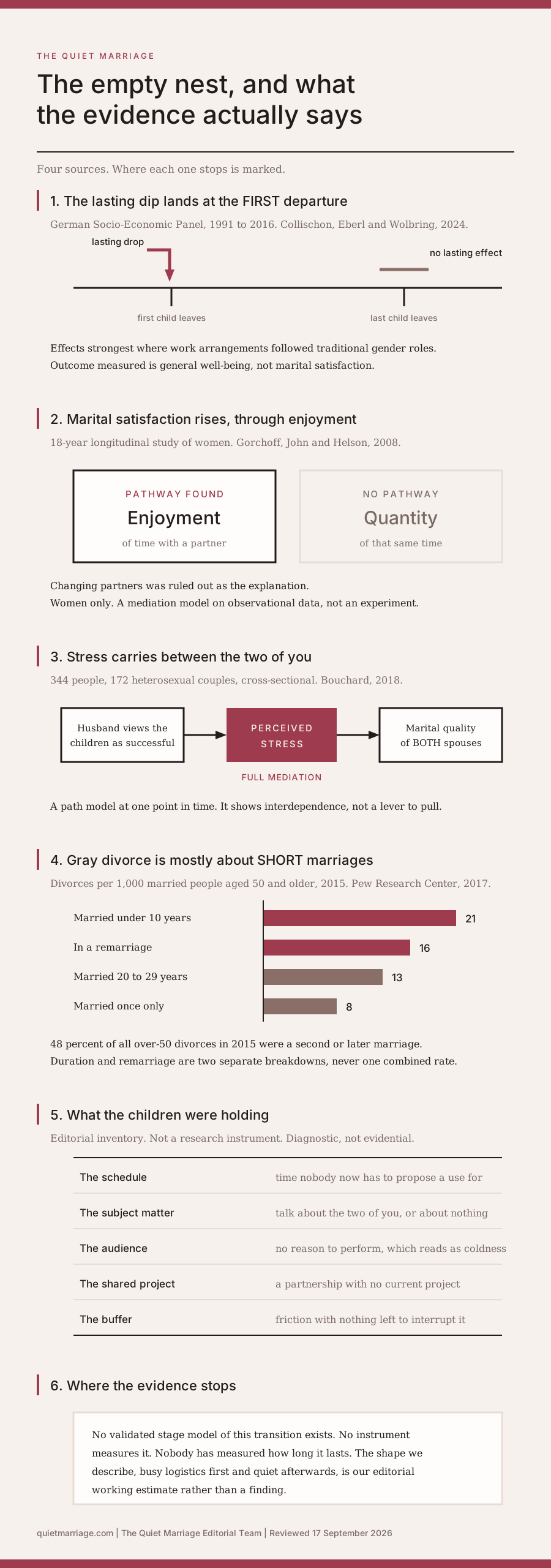
Empty nest syndrome is a real experience with a misleading name, and the best available evidence points somewhere other than where the name points. Two findings carry most of the weight, and they measure two different things. A German panel study running from 1991 to 2016 found that only the first child moving out produced a lasting drop in parental well-being, while the departure of the last child, the empty nest move itself, did not. Separately, an 18-year longitudinal study of women through middle age found that marital satisfaction increased at the transition to an empty nest, through greater enjoyment of time with their partners rather than through more of it. Keep those apart: the lasting cost to a parent's general well-being lands at the first departure, and for the marriage specifically the evidence points upward at the last one. Neither study says the quiet house damages a marriage. Both make it easier to believe the quiet house mostly makes an existing silence audible.
Which is the frame for the year you are probably in. If the last one left and the two of you have been polite strangers in a clean house ever since, the departure did not create that. It removed the last thing that was standing in for a conversation.
What empty nest syndrome is, and what it is not
Empty nest syndrome has no clinical status. It is a descriptive label for a cluster of ordinary reactions to a real life transition: grief, loss of role, disorientation about how the days are meant to be shaped, and in some households a sudden awareness of the person on the other side of the kitchen. Nobody is diagnosed with it, nobody is treated for it as such, and no validated instrument measures it. Stating that plainly matters, because a large share of what is written about it borrows the authority of a medical term it does not have.
A separate research literature uses the same phrase for a different population, and reading the wrong one does real damage. In that literature "empty nest elderly" means older adults living apart from their adult children in later life. Xu and colleagues, drawing on 2018 data from the China Health and Retirement Longitudinal Survey, compared 4,630 empty nest elderly with 6,188 non-empty nest elderly and found higher raw proportions reporting several chronic conditions, alongside higher reported marital satisfaction, 71.6 percent against 66.2 percent. Every one of those differences lost significance once the authors adjusted for other factors in logistic regression. Whatever that literature is measuring, it is a population in their seventies, not a couple in their early fifties whose youngest has gone to university, and the two should not be read as one body of evidence.
What remains once you separate those two things is a smaller, more honest claim. The transition is real, the feelings are real, and the evidence on what it does to well-being and to marriages is more interesting than the folklore.
The finding that reorders the question: the first child, not the last
Collischon, Eberl and Wolbring used the German Socio-Economic Panel, a survey that has followed the same households since the 1980s, and looked at what happened to parents' well-being when an adult child moved out. Panel data matters here. Instead of comparing empty nesters to non-empty nesters, who differ in a hundred other ways, it follows the same parent across the event, so each person acts as their own control.
They separated two things that are usually collapsed together: the first child's move, and the move that leaves the nest empty. Only the first showed a long-lasting negative effect on parental well-being. The empty nest move did not.
The story is usually told the other way round. If the loss were about the children's absence as such, the last departure should hurt most, since it takes the final child. The data puts the lasting effect at the first one instead.
Our editorial reading of why, which the panel data itself does not test, is that the first departure ends the household as a going concern. What a Tuesday looks like gets renegotiated at the first move, along with who fills it and how loud it is, and the later departures happen inside a structure that has already been rebuilt once.
Two limits on that study before you lean on it. It is German, and how families launch children differs by country, by housing costs and by welfare system. And its outcome is a general well-being measure, not marital satisfaction, so it tells you about the parent rather than directly about the marriage. The authors also note that the effects were strongest for respondents whose work arrangements followed traditional gender roles, which is a real qualifier: the parent whose daily identity was most bound up in running the household is the parent for whom this lands hardest, whichever one that is in your house.
What happens to the marriage itself
Gorchoff, John and Helson tracked women's marital satisfaction across 18 years of middle age and asked not only whether it changed but why. Marital satisfaction increased, the increase was linked to the transition to an empty nest, and their mediation model located the pathway in greater enjoyment of time with a partner. The model found no matching pathway through the quantity of that time.
The authors also ruled out the obvious deflating explanation. The rise was not attributable to changing partners.
That distinction between enjoyment and quantity is the most practical thing in the literature on this transition, and it cuts against the advice most couples give themselves in the first empty year. The instinct is to fill the hours: book something, take up a hobby, eat at the table instead of on trays. None of that is wrong. But this is a mediation result from an observational study rather than an experiment, and what it associates with rising satisfaction is the quality of the hours and not the count of them. Two people can spend every evening of a decade in the same room without enjoying one of them. A plan for the empty year built around more time is built around the variable the evidence does not support.
Note the sample before you generalise: this study followed women, so it is direct evidence about women's marital satisfaction and only indirect evidence about the marriages those women were in. Nothing in it licenses a claim about how the men in those households experienced the same years.
There are no stages of empty nest syndrome
This is one of the most searched questions about the transition, so it deserves a direct answer rather than a hedge. No validated stage model of empty nest syndrome exists, and no validated instrument measures it. The staged lists that circulate are usually borrowed from the grief-stage model popularised in the 1960s. In our editorial reading, which this article does not source to a study, that model was built from observing terminally ill patients facing their own deaths rather than people grieving a loss, and it has drawn sustained criticism as a description of how bereavement unfolds. Treat that as our judgement rather than as a finding we are citing.
What can be said, and this is an editorial working estimate rather than a finding, is that the transition has a shape rather than stages. The weeks immediately after a departure are usually busy, because there is a logistics tail: the room, the phone calls, the first visit home. The quiet tends to arrive later, once the tail runs out and there is nothing scheduled. That is when couples report the disorientation, and that is also when a marriage that had been running on shared operations rather than shared interest becomes visible as such.
Treat any list that tells you which week you should be in as decoration. Nobody has measured it.
What the children were actually holding
If the marriage went quiet and the children's departure was the occasion rather than the cause, it helps to be specific about what left with them. In most long marriages the children were not only children. They were carrying several jobs that nobody had assigned deliberately, and each one leaves a different hole.
| What the children were holding | What it did for the marriage | What is left when they go |
|---|---|---|
| The schedule | Decided what both of you did with an evening, without either of you having to propose anything | Unstructured time that has to be filled by someone actually suggesting something |
| The subject matter | Supplied a constant, renewable topic that was safe and shared | Conversation that has to be about the two of you, or about nothing |
| The audience | Made you both perform a functioning marriage in front of someone | No reason to perform, which reads as a drop in warmth even when nothing changed underneath |
| The shared project | Gave two people a goal they both wanted, with visible progress | A partnership with no current project, which is not the same as a partnership with no future |
| The buffer | Absorbed friction; arguments got postponed because a child walked in | Friction that now has nowhere to go and arrives without an interruption to stop it |
This inventory is editorial judgement, not a research instrument. Its use is diagnostic rather than evidential: the hole you actually feel tells you which repair is worth attempting, and the five repairs are not interchangeable. A couple who lost the subject matter needs something new to talk about. A couple who lost the buffer needs a way to have an argument on purpose. Those are different projects, and starting the wrong one is how a good year gets spent on nothing.
Why it can look like stress broke the marriage
Bouchard studied marital quality specifically at the empty nest phase, with 344 participants forming 172 heterosexual couples, and modelled both partners rather than one. The variable that did the work in that model was perceived stress. Husbands' and wives' perceived stress fully mediated the relationship between a husband's tendency to view his children as successful adults and both spouses' marital quality.
Read that carefully, because it is easy to inflate. The claim is narrower than "thinking well of your children saves a marriage". In this sample, the association between one partner's satisfaction at having raised successful children and the marital quality of both partners ran through stress, in a cross-sectional path model that demonstrates no cause. The authors frame it as interdependence between spouses rather than as a lever to pull.
It does support one claim this publication has reached from other directions: at this stage the two of you are not having independent experiences. Stress carried by one partner shows up in the other's report of the marriage. If one of you is quietly not sleeping about whether the launch went well, the other partner is very likely already sensing it, and reading it as distance.
Gray divorce, and the number that gets misused
The empty nest is routinely blamed for the rise in later-life divorce. The numbers are real and the inference is not.
Pew Research Center found that among United States adults aged 50 and older the divorce rate roughly doubled between 1990 and 2015, from five to ten per 1,000 married people, and roughly tripled among those 65 and older. Those are the figures everyone quotes.
The figures nobody quotes sit two paragraphs further down the same analysis, and they point the other way for the reader of this site. Within that 50-and-older group, the divorce rate was 21 per 1,000 for people married under ten years and 13 per 1,000 for people married 20 to 29 years. The rate for those in a remarriage was 16 per 1,000 against eight for those married only once, and 48 percent of everyone over 50 who divorced in 2015 was in a second or later marriage. Pew attributes much of the overall rise to the Baby Boomers' unusually high earlier-life divorce rates feeding a large stock of less stable remarriages.
So the gray divorce statistic is substantially a statistic about remarriages and shorter marriages. A first marriage of 25 years that has just gone quiet sits on the lower-risk side of both factors Pew breaks out: duration, at 13 per 1,000 against 21, and remarriage status, at eight per 1,000 against 16. Pew publishes those as two separate breakdowns and never reports a combined rate for that exact pairing, so this is an inference from two figures rather than a number anyone measured. It corrects the specific fear that a long marriage becomes fragile the moment the children leave, which is the part that gets left out when the transition is described as a countdown.
If the decision is genuinely live in your household, what the decision actually involves after forty takes it up separately. That piece is written to husbands weighing it, and a wife reading it should expect the same arithmetic to apply even where the framing does not.
What to do with the first year
The evidence points at one instruction directly. The other three below are editorial judgement, flagged as such, drawn from the same material.
The instruction the evidence supports is to aim at enjoyment rather than hours. Gorchoff and colleagues found the rise in satisfaction associated with enjoying the time, not accumulating it, so a weekly two hours that neither of you would cancel is worth more than four evenings a week in front of the same television. The corollary is the trap most couples walk into: replacing the children's calendar with a couple's calendar of the same density reproduces the arrangement that hid the problem. If the two of you had nothing to say over dinner, a full itinerary supplies something to do and still nothing to say.
The first editorial call is about timing, and it comes with an action rather than a reassurance. If the first months feel survivable, that is the logistics tail, and it runs out. Put something specific in the diary now for month six to eight, before the quiet arrives, rather than waiting to notice it and improvising badly.
The second is to name the hole before choosing the repair. Use the inventory above and pick one row. Losing the subject matter and losing the buffer feel identical from inside and need opposite responses, and a year spent on the wrong one is a year.
The third concerns stress, and the dyadic evidence sets its limit as well as its case. What Bouchard's model shows is that a partner's stress is perceived by the other partner whether or not it has been spoken, which is an argument for saying the specific worry out loud once, in one sentence, instead of letting your partner read it off your mood for a month. It is not an argument that anyone owes anyone an account of their interior on demand. Noticing and asking with care is the move here. Treating a partner's privacy as a betrayal is not, and a marriage where that line is being pushed has a different problem than this article describes.
If the quiet predates the departure by years rather than months, the departure is not the subject. A marriage where nothing is actually wrong is its own condition with its own repair, and the particular isolation of living beside someone describes what it feels like from inside. If the silence has a ledger behind it, resentment is the more accurate diagnosis. And if your household's quiet is really about who has been running it, the mental load does not leave with the children: it loses the explanation that was covering for it.
When this is not an adjustment problem
Most of what is described here is an ordinary transition that ordinary people get through. Some of it is not. Persistent low mood, loss of interest in things you previously cared about, sleep or appetite changes that last for weeks, or any thought of harming yourself are not empty nest adjustment and should not be managed as a stage to sit out. They warrant a licensed professional. Isolation compounds this, and the National Institute on Aging publishes practical guidance on loneliness and social isolation for adults in later life.
In the United States, the American Psychological Association maintains a psychologist locator. If you are in crisis, dial or text 988 for the Suicide and Crisis Lifeline, free and available 24 hours a day.
Last reviewed by The Quiet Marriage Editorial Team on September 17, 2026. This piece was reviewed editorially, against its published sources. It was not reviewed by a licensed therapist, attorney or physician, and it is not a substitute for one. This is general editorial content and not professional, legal, medical or psychological advice. Our sourcing and AI use rules are public on the editorial standards page.
FAQ
What is empty nest syndrome?
It is a descriptive label for the grief, loss of role and disorientation some parents feel when their children leave home. It has no clinical status, it appears in no diagnostic manual, and no validated instrument measures it. That matters because much of the writing about it borrows authority the term does not carry. A separate research literature uses "empty nest" for older adults living apart from adult children in later life, a population in their seventies rather than their fifties. In the largest Chinese comparison, 4,630 empty nest against 6,188 non-empty nest elderly, the raw group differences did not survive adjustment in regression. Those findings are about a different situation and should not be read as evidence about a couple whose youngest has just left.
How long does empty nest syndrome last?
Nobody has measured a duration, so any specific number you are given is invented. What panel data does show is that the lasting well-being cost attaches to the first child's departure rather than the last, and that marital satisfaction tends to move upward across the empty nest transition rather than downward. In practice, and this is an editorial working estimate rather than a finding, the difficult part often arrives later than people expect, once the logistics of the move are finished and the time is genuinely unstructured.
How do you deal with empty nest syndrome?
Aim at enjoyment rather than hours. The 18-year longitudinal study that found marital satisfaction rising at this transition located the pathway in greater enjoyment of time with a partner, with no matching pathway through the amount of it, which is the opposite of the fill-the-calendar instinct. The section "What to do with the first year" above sets out the rest, including the three calls this publication is making on editorial judgement rather than on evidence.
What are the stages of empty nest syndrome?
There are none that have been validated, and no instrument measures the thing a stage would be a stage of. The staged lists in circulation are usually borrowed from the popular 1960s grief-stage model. Our editorial reading, not a claim this article sources to a study, is that the model was built from observing terminally ill patients rather than grieving ones and does not describe bereavement well. The transition does have a shape, in that the busy logistics come first and the quiet comes after, but that too is an editorial observation and not a measured sequence. A list that tells you which week you should be in is decoration.
Does the empty nest cause divorce?
The evidence does not support that as a general claim. Divorce among United States adults aged 50 and older roughly doubled between 1990 and 2015, but the rise is concentrated in remarriages and in shorter marriages rather than in long first ones. The section on gray divorce above gives Pew's breakdowns and says plainly which of them are separate figures rather than one combined rate. The short version is that the headline statistic describes a population most readers of this article are not in.
Is empty nest syndrome the same as depression?
No, and the distinction is worth holding. Ordinary transition grief lifts between waves, tracks to reminders, and leaves your interest in other things intact. Persistent low mood, loss of interest in what you used to care about, sleep or appetite changes lasting weeks, or any thought of harming yourself are not an adjustment stage and should not be waited out. Those warrant a licensed professional. In the United States the APA psychologist locator is a starting point, and 988 reaches the Suicide and Crisis Lifeline at any hour.
Why does only one of us seem to be struggling with it?
Because the transition does not cost both partners the same thing, and the panel evidence gives a clue about who it costs more. The German study found the well-being effects strongest among respondents whose work arrangements followed traditional gender roles, meaning the partner whose daily identity was most bound up in running the household takes the larger hit, whichever partner that is. The partner whose working life continued unchanged loses less structure and often cannot see what the other has lost. That asymmetry is not the same thing as indifference, though it reliably gets read as indifference. Which makes it the more affected partner's job to say so plainly rather than wait to be noticed, and the less affected partner's job to ask rather than wait to be told.
Our child moved back in. Does that reset it?
It changes the logistics without necessarily changing what the departure exposed. If the marriage went quiet because the children had been supplying the schedule, the subject matter and the buffer, a returning adult child can restore those temporarily, which is a relief and also a postponement. The panel data offers a related caution: it was the first departure that carried the lasting well-being effect, so the events are not simply reversible in sequence. Use the interval rather than spending it.
We have more time together now and it is worse, not better. Why?
Because quantity of time is not the variable the evidence points at. The study that found marital satisfaction rising at this transition traced it to enjoyment of shared time, with no comparable pathway through the amount of it. If the added hours are unstructured and neither of you proposes anything, they end up functioning as evidence that there is nothing to say, which is worse than being busy apart.
How do we start talking to each other again?
Start with something that has no stakes riding on it, and keep it short and scheduled rather than waiting for a natural opening that will not come. The marriage has probably not been out of practice at communicating so much as out of practice at having a subject that is not logistics. Pick one, agree a time, and stop before either of you wants to. The mechanisms are set out in more detail in how to reconnect with your wife, which is addressed to husbands; the mechanisms themselves do not depend on which of you is reading. If attempts keep ending badly rather than going nowhere, that is a different problem from the one this article describes.
What is gray divorce?
Gray divorce is the term for divorce later in life, and on the figures behind it the headline is accurate while the inference usually drawn from it is not. Pew Research Center found that among United States adults aged 50 and older the divorce rate roughly doubled between 1990 and 2015, from five to ten per 1,000 married people, and roughly tripled among those aged 65 and older. The breakdowns underneath that number point the other way for anyone in a long first marriage. Within the same group the rate was 21 per 1,000 for people married under ten years against 13 per 1,000 for people married 20 to 29 years, and 16 per 1,000 for those in a remarriage against eight per 1,000 for those married only once, with 48 percent of everyone over 50 who divorced in 2015 being in a second or later marriage. Pew attributes much of the overall rise to the Baby Boomers' unusually high earlier-life divorce rates feeding a large stock of less stable remarriages. One honest limit on reading a long first marriage as lower risk on both counts: Pew publishes duration and remarriage status as two separate breakdowns and never reports a combined rate for that exact pairing, so that reading is an inference from two figures rather than a number anyone measured.
Sources
- Xu and colleagues (pubmed.ncbi.nlm.nih.gov)
- Collischon, Eberl and Wolbring (pubmed.ncbi.nlm.nih.gov)
- Gorchoff, John and Helson (pubmed.ncbi.nlm.nih.gov)
- Bouchard (pubmed.ncbi.nlm.nih.gov)
- Pew Research Center (pewresearch.org)
- loneliness and social isolation (nia.nih.gov)
- psychologist locator (locator.apa.org)
- Suicide and Crisis Lifeline (988lifeline.org)