The Mental Load Checklist: What Belongs On It and How to Take Half
A chore list and a mental load checklist are two different documents. A chore list records tasks. A mental load checklist records who is holding the thinking around each task, and the two overlap far less than either of you assumes. That is why you asked her to write the list and nothing moved. She wrote it, or she did not, and either way nothing changed. If she wrote it, you did the things on it and were told a week later that she is still carrying everything. If she did not write it, you concluded she would rather be aggrieved than organised. Both readings are wrong. The document you asked for is not the document you need.
There is a better place to start than a blank page, because researchers have already built and tested an inventory of exactly this. It has thirteen items, it was answered by 393 married and partnered mothers, and the pattern in the answers is more useful to you than any list you could draft at the kitchen table, because it tells you in advance which items are likely to be the real problem and which ones you have probably already got right.
Both percentages above are mothers' own reports of who was responsible. Fathers in those households were not surveyed, and the same caveat governs every percentage in the table further down.
Why the chore list came back and nothing changed
The most useful finding in this field is not that women do more. You already knew that, and the argument about hours is one you can always win on a technicality about commuting. The useful finding is about which part of the work is unevenly held.
A systematic review published in Sex Roles in 2023 gathered the research on the cognitive side of unpaid work. Reich-Stiebert, Froehlich and Voltmer followed PRISMA guidelines and included 31 full-text peer-reviewed articles, drawn from interviews, surveys, observations of family routines, time estimates and experiments, with samples made up mostly of American and European middle-class women and men. Their summary of the field is that women perform the larger share of mental labor, particularly around childcare and parenting decisions, and carry more of the related consequences, including stress, lower life and relationship satisfaction, and effects on their careers.
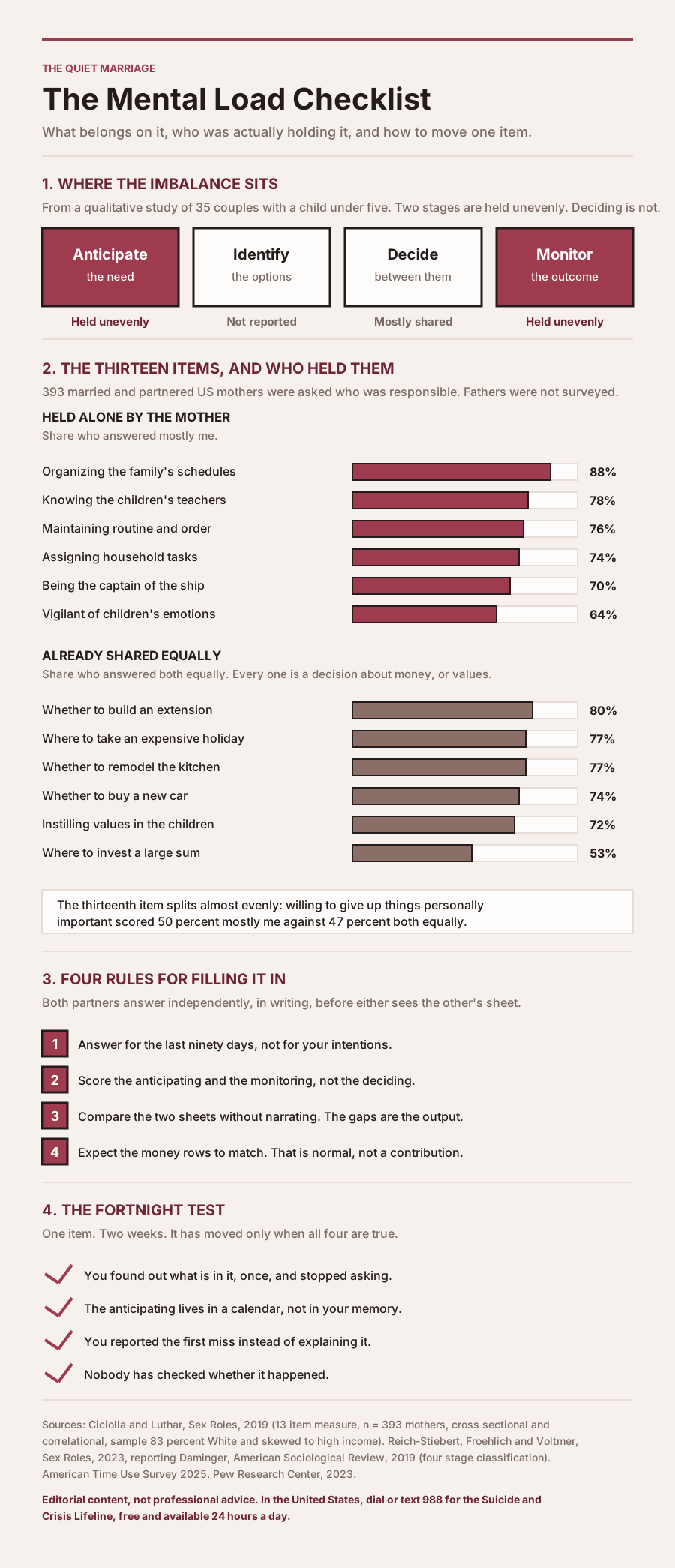
Inside that review sits the classification that explains your failed list. Allison Daminger's study of cognitive labor, published in the American Sociological Review in 2019, is a qualitative interview study of 70 married US individuals, 35 couples, college educated and middle to upper middle class, each living with at least one child under five. Participants recorded their household and child-related decisions over 24 hours, and fathers and mothers were then interviewed separately about how those decisions got made. As the review reports her finding, cognitive labor turns out to be a four-part phenomenon: anticipating needs, identifying options for meeting them, deciding between options, and monitoring outcomes. And the split is not even across the four. Women do a disproportionate amount of the anticipating and the monitoring. The deciding is mostly collaborative.
That sentence is the entire finding. The part of the work you are certain you participate in fully is the part the research says is already shared. When you say you are involved in every major decision in this house, you are almost certainly telling the truth, and it is almost certainly beside the point. Nobody is short of a co-decider. What is missing is the person who noticed the decision was due.
That is also why a chore list fails as a diagnostic. A chore list is a list of executions. Anticipation happens weeks before an execution and monitoring happens for months afterwards, so neither one ever appears on it. You can complete every line on the list and touch none of the load.
If you arrived here after being sent a link rather than after an argument, we have written separately about what that comic actually argues and how to answer it.
The thirteen items, and who was actually holding them
Rather than invent an inventory, start from one that was built and factor-analysed. Ciciolla and Luthar asked 393 married or partnered mothers with dependent children who was responsible for thirteen areas of household management, with three answer options: mostly me, mostly my spouse or partner, or both equally. The items sorted into three groups: household routines, child adjustment, and household finances.
Here is the full instrument with the mothers' own answers. Read it as a diagnostic rather than a verdict, and note before you start that the third group is where the good news lives.
| The item, as the researchers worded it | Mostly me | Both equally |
|---|---|---|
| Organizing schedules for the family | 88% | 10% |
| Knowing the children's school teachers or staff | 78% | 20% |
| Maintaining standards for routine and order | 76% | 22% |
| Assigning tasks to keep the household running | 74% | 23% |
| Being the captain of the ship, ensuring tasks are covered | 70% | 25% |
| Being vigilant of the children's emotions | 64% | 35% |
| Willing to give up things personally important | 50% | 47% |
| Instilling values and shaping character in children | 27% | 72% |
| Where to have an expensive family vacation | 18% | 77% |
| Where to make a major financial investment | 15% | 53% |
| Whether to have the kitchen extensively remodeled | 15% | 77% |
| Whether to construct an extension on the house | 12% | 80% |
| Whether to buy a new car for the family | 10% | 74% |
Every figure in that table is a mother's own answer. Fathers in those households were not surveyed, so read the whole thing as what one half of 393 households believed, which is still the half that decides whether the arrangement feels fair.
The shape of that column is the finding. The bottom five items, every one of them a decision about money, are shared by three quarters or more of these couples. The top five, every one of them a coordination job, are held alone by seven in ten women or more. Instilling values, which sounds like the deepest parenting work on the page, is shared by 72 percent. Knowing the name of the child's teacher, which sounds trivial, is held alone by 78 percent.
That contrast may explain why the accusation feels unfair to some men in long marriages. On the items that feel weighty and consequential, the ones a reader might reach for first when defending his contribution, the data says he is already there. On the items that feel administrative, he is not, and the administrative ones are the ones that never stop.
One further limit before you use the table. It records who was responsible, not how heavy each responsibility was, so an item held alone is not automatically a bigger burden than an item shared. Use it to find where the holding is uneven, then let the two of you argue about weight.
The two jobs hiding inside every item
Take any line from that table and it opens into the four stages. The item is not the unit of work. It is the label on a folder.
Take the school. Anticipation is knowing that the parents evening will be announced, that the form will need signing, that the shoes will not fit by October. Identification is working out the options: which evening slot, which shop, whether it is a shoe problem or a growth-spurt problem. Decision is picking one, and this is the stage you are almost certainly in already. Monitoring is checking a fortnight later that the thing you both picked actually happened, and noticing, when it did not, before anyone else has to tell you.
The stages the research finds unevenly held are the first and the last. They are also the two you cannot do on request, because a request is itself the evidence that somebody else is still anticipating. This is where an attempt at fixing this often stalls. He asks what needs doing. She tells him. He does it well and promptly. And she is still doing all of the anticipating, plus the new job of briefing him. On our reading that is why the phrase "just tell me what you need" so often adds a job instead of removing one.
How to fill the checklist in without starting a fight
Print the thirteen items. Both of you answer independently, in writing, before either of you sees the other's answers. Three options per item, the same three the researchers used: mostly me, mostly you, both equally.
Four rules make this produce information rather than an argument.
Answer for the last ninety days, not for your intentions. The question is who held it, not who would hold it if asked. If you would have picked up the school forms had anyone mentioned them, that item was hers.
Do not answer for the version of yourself who is trying. A common way this exercise fails is a man scoring "both equally" on an item where he participates energetically at the deciding stage and not at all at the other three. Score the anticipating and the monitoring, since those are the stages the evidence says are unevenly held. If you did not know the item was coming and you did not check afterwards that it landed, it was not both equally.
Compare the two sheets without narrating. The gaps are the whole output. An item you both scored the same is settled whether or not it is fair. An item where you wrote both equally and she wrote mostly me is the actual subject of the conversation, and it will not survive being explained away in the first thirty seconds. Sit with the disagreement before you resolve it. That restraint is a specific, learnable habit, and on our reading it is close to the one that helps in most difficult conversations in a long marriage.
Expect the finance rows to be fine and do not celebrate them. If your sheets match on the car and the kitchen, you have confirmed that you are normal rather than that you are contributing. Three quarters of the couples in that study matched there too.
Taking an item, and the fortnight that proves it
An item moves when the anticipating and the monitoring move with it. Everything short of that is assistance, and assistance is not a transfer, because the person supervising the assistant still holds the folder. That is the same principle set out in our account of why the mental load is invisible from where you stand, applied here to a specific list rather than to the idea.
Pick one item. Not five. The top of your gap list, which if your household resembles the one in that study will be a coordination item rather than a financial one.
Then do four things over roughly two weeks, in this order.
Start by finding out what is actually in it, because every item has an operating history: the dates, the names, the recurring deadlines, the thing that only happens in March. Ask once, write it down, and do not ask again, since a man still asking in week three has taken the executions and left the anticipation exactly where it was. Then put that anticipation somewhere outside your head, in a calendar or a recurring reminder rather than in memory. That sounds trivial and it is the whole mechanism, because anticipation is unpaid attention running in the background all day, and memory alone tends to hand it back within a few weeks without the man noticing that it has gone. When you miss something, and you will, absorb it without a paragraph of context, because the explanation is the thing that tells her the folder is still hers. And say once, at the start, that you are taking the item, so a silent transfer is not mistaken for a good week. A good mood is not something a partner can reasonably be expected to plan around.
Two weeks is the test because it is long enough to include one thing you did not see coming and short enough that nobody has to pretend it is a personality change. If the item is still yours in a fortnight, take the next one. If it has drifted back, the useful question is not whether you tried but which of the four stages it drifted at, and the answer is usually anticipation, which is where the research puts the imbalance.
The reason to bother, beyond fairness, is what the unaddressed version travels with. Ciciolla and Luthar found that after controlling for emotional and physical intimacy, feeling disproportionately responsible for household management was associated with strain on mothers' well-being and with lower satisfaction with the relationship. Their design is cross sectional, so it cannot say which way that runs, and a strained relationship making the burden feel heavier fits their data as well as the reverse. Hold it as an association worth not testing, which is the same caution we have applied elsewhere to a specific unfairness hardening into a general one. It is also why the fix is a permanent transfer rather than a good month, since a temporary improvement that reverses teaches the other person that the arrangement is unreliable, and unreliability is its own separate injury with its own separate repair.
What this evidence does not say
The numbers in that table are strong enough to plan with and weak enough that you should know their limits, so here they are plainly.
The Ciciolla and Luthar sample is not the country. It is 393 mothers, 83 percent White, 65 percent living in suburbs, 56 percent in the Northeast, and skewed to high income and high education, with roughly a fifth of the households reporting family income over 200,000 dollars. Their conclusions were also explicitly about mothers with dependent children at home. If your children have left, the childcare items in the table are historical for you and the routine items are not.
The design is cross-sectional and correlational. The association between holding the management burden and lower well-being is real in the data and it does not establish which way the arrow points. Both authors say so.
The 2023 review is a review, not an experiment. It describes the state of a literature that is largely made up of self-report from middle-class Western samples, and it says so in its own methods.
The four stage classification carries the most weight in this article and rests on the smallest sample in it. Daminger interviewed 70 people, 35 couples, all college educated, middle to upper middle class, and all living with a child under five. It is a qualitative study of a narrow group at one stage of life, not a national measurement, and the fact that its shape matches the pattern in the larger survey above is a reason to take it seriously rather than proof that it generalises.
The American Time Use Survey is the best national measure available and it cannot see any of this. In 2025 it found that 87 percent of women and 75 percent of men did some household activity on an average day, and that on the days they did, women averaged 2.8 hours to men's 2.1. That is time spent doing. A diary cannot record the fifteen minutes of low-grade attention a person spent on Tuesday knowing that the prescription would run out on Friday, which is precisely the work this article is about. Note also that the 2025 estimates carry a caveat of their own: a federal shutdown suspended all survey operations from October 1 to November 12 of that year, and the Bureau states that it cannot quantify the effect on the estimates.
Nor is the imbalance explained by who earns. Pew Research Center, analysing time use data alongside its own survey of 5,152 US adults in January 2023, found that in egalitarian marriages, where each spouse earns between 40 and 60 percent of the couple's combined income, husbands still spent about 3.5 hours more per week on leisure than wives, while wives spent roughly 2 hours more on caregiving and about 2.5 hours more on housework. In marriages where the wife was the primary earner the gap on caregiving and housework held. The only arrangement where husbands did more caregiving than wives was one where the wife was the sole earner.
A checklist cannot fix contempt, fear or coercion. If the conversation keeps ending there rather than at the list, that is a different problem, and the next step is a licensed professional rather than another draft of the sheet. The American Psychological Association publishes a plain guide to what couples therapy involves and when to seek it.
Last reviewed by The Quiet Marriage Editorial Team on August 30, 2026. This piece was reviewed editorially, against its published sources. It was not reviewed by a licensed therapist, attorney or physician, and it is not a substitute for one. Our sourcing and AI use rules are public on the editorial standards page. This is general editorial content and not professional, legal, medical or psychological advice. Decisions about separation, custody and finances should be taken with a licensed professional in your own jurisdiction. If you are in crisis in the United States, dial or text 988 for the Suicide and Crisis Lifeline, which is free and available 24 hours a day.
FAQ
What is a mental load checklist?
It is an inventory of who holds the thinking around each area of running a household, as distinct from a chore list, which records who performs the tasks. The closest thing to a tested version is the thirteen item household management measure used by Ciciolla and Luthar with 393 married and partnered mothers, which asks who is responsible for each area with three options: mostly me, mostly my partner, or both equally. Its three groups are household routines, child adjustment and household finances. Use it as a diagnostic that both partners complete separately, because the value is in the items where your two answers disagree.
What should actually be on the list?
Coordination, not chores. The items held alone by the largest margins in that study were organizing the family's schedules, knowing the children's teachers and school staff, maintaining standards of routine and order, assigning the tasks that keep the household running, being the person who ensures tasks are covered at all, and being vigilant of the children's emotions. Add anything in your household that requires somebody to notice a need before it becomes visible and to check afterwards that it was met. Prescriptions, birthdays, service intervals, the state of the shoes, the thing that only happens in March.
Why did nothing change when I did everything on the list she gave me?
Because a list of tasks omits the two stages where the imbalance sits. Cognitive labor breaks into anticipating a need, identifying options, deciding between them and monitoring the outcome, and the evidence summarised in the 2023 Sex Roles review is that women do a disproportionate share of the anticipating and the monitoring while the deciding is mostly collaborative. Executing the items on a list somebody else compiled leaves both uneven stages exactly where they were, and it does something worse than nothing: compiling the list in the first place cost her the anticipating work the list was supposed to hand off.
Is the mental load just a way of saying I do not do enough?
It is more specific than that and, on the numbers as mothers reported them, partly in your favour. In the thirteen item study the areas men were most involved in were the consequential decisions: whether to build an extension was shared equally by 80 percent of couples, the car by 74 percent, a major financial investment by 53 percent, and instilling values in the children by 72 percent. So the claim is not that you are absent. It is that your presence is concentrated at the deciding stage and thin at the anticipating and monitoring stages, which are the ones that run continuously and are therefore the ones that exhaust the person holding them.
How do you split the mental load fairly?
Transfer whole areas rather than dividing tasks inside them, and transfer the noticing along with the doing. An area has moved when nobody has to remind you it exists, nobody checks whether it happened, and a failure inside it is reported by you rather than discovered by her. Start with one area from the top of your disagreement list and expect about a fortnight before it holds. The part people underrate is what to do with the first miss inside that fortnight: say so plainly rather than explaining it, because an explained-away miss is the signal that tells her the area is still hers and that she had better keep watching it.
My wife works fewer hours than I do. Does the checklist still apply?
The evidence says earnings and hours do not settle it. Pew Research Center's analysis found the gap in caregiving and housework persisting in marriages where both spouses earned roughly the same, and persisting where the wife was the primary earner, disappearing only where the wife was the sole earner. That does not make any particular split in your house unfair, and it does mean the arithmetic of who works more hours will not resolve the question by itself. Fill the sheets in separately and look at the gaps instead of relitigating the hours.
What if we fill it in and she disagrees with every answer I gave?
That is a normal and useful result rather than a failed exercise. A wide disagreement usually means one of you is scoring intentions and the other is scoring the last ninety days. The way through it is to take a single item you scored differently and walk it through the four stages out loud: who knew it was coming, who worked out the options, who chose, and who checked afterwards. In many disputed items the deciding stage turns out to be genuinely shared while the two ends are not, and making that visible on one item often takes some of the heat out of the rest.
Does a chore chart or an app fix this?
It fixes the wrong stage. A chart or a shared app is an excellent place to hold identification and deciding, and it does nothing about anticipation unless somebody is populating it, which is itself the anticipating job. A shared calendar helps only once the recurring items are already in it and the person who put them there is not the same person every time. Judge any tool by one question: after a month of using it, is she still the one who notices what is missing from it?
Sources
- Reich-Stiebert, Froehlich and Voltmer (pubmed.ncbi.nlm.nih.gov)
- As the review reports her finding (pmc.ncbi.nlm.nih.gov)
- Ciciolla and Luthar (pubmed.ncbi.nlm.nih.gov)
- American Time Use Survey (bls.gov)
- Pew Research Center (pewresearch.org)
- American Psychological Association (apa.org)
- Suicide and Crisis Lifeline (988lifeline.org)