Your Husband Is Emotionally Unavailable: What That Phrase Is Actually Describing
Emotionally unavailable is a precise description of what it is like to live with him and a very imprecise description of him. The phrase names an effect. It tells you, accurately, that you put something in and nothing comes back, that you have learned to stop expecting a response, that you are managing your own weather alone in a house with another adult in it. What it does not tell you is why. At least four quite different men produce that identical flat surface, they need opposite responses, and three of the four get worse if you use the move that works on one of the others.
That is the useful question, and it is almost never the question the advice answers. The advice assumes one mechanism, usually a wilful one, and prescribes for it. Tell him how you feel. Use I statements. Be vulnerable first. If the mechanism happens to be the one that advice was built for, it helps. If it is not, you have just handed a man who is already overwhelmed one more thing to fail at, and the flatness deepens.
What the phrase is actually measuring
Start with what you can trust. Your reading of the room is data. You know when a question lands and nothing comes back. You know the difference between a man thinking about his answer and a man who has quietly closed a door. Years of that is not a misperception and it is not something to be talked out of.
What it cannot do is tell you which interior is producing it. Unavailable is a word about supply, and it says nothing about whether the shelves are empty, the door is locked, or there is a queue you cannot see. Those three are not variations on one problem. They call for opposite responses.
This matters practically rather than philosophically. Each mechanism below has a different first move, and the first move is the only one you get before he decides what this conversation is. Choose from the wrong model and you spend the one opening you had.
The man who cannot name it
There is a measurable trait for difficulty identifying and describing your own feelings. It is called alexithymia, it is assessed with a standard twenty item scale, and it exists on a continuum rather than as a condition you either have or do not.
A study of parents to be published in Comprehensive Psychiatry in 2014 looked at 151 mothers and 106 fathers, 102 of them couples, measuring alexithymia against relationship satisfaction and against attachment anxiety and avoidance. The result is more interesting than the one people assume. Alexithymia was not directly related to marital satisfaction. The strongest predictor of how satisfied a person was turned out to be how satisfied their partner was. What alexithymia did predict, significantly, was attachment related anxiety and avoidance, and among the fathers there was a further association between the third subscale of that measure, externally oriented thinking, meaning a tendency to attend to outside events rather than inner states, and their partners' avoidance scores.
Read that carefully, because it cuts against the obvious story. A man's inability to name what he feels does not, by itself, reliably wreck the marriage. What it does is produce avoidance, and avoidance is what wrecks things. The naming problem is upstream. The distance is what arrives.
Two limits are worth stating. This was a pregnancy cohort, a specific population at a specific moment, and the design was cross sectional, so it captures associations at one point in time rather than one thing causing another over years. It establishes that the link runs through avoidance rather than through satisfaction directly. It does not establish that a twenty year marriage works the same way.
What this man looks like from the outside is someone who genuinely does not know the answer to how do you feel about that. Not refusing. Not stalling. He goes to look, finds nothing labelled, and comes back with fine, or with a description of the situation instead of a description of himself. Ask him what he thinks and you often get plenty. Ask him what he feels and you get a man searching a room with no lights on.
The man who feels it too much
The opposite interior produces the same exterior. In 1980, Levenson and Gottman recorded 30 married couples through a low conflict and a high conflict conversation while taking continuous physiological measurements, then had each spouse watch the videotape and report their own moment by moment feeling. In 1983 they located 19 of those couples again and measured how relationship satisfaction had moved over the three years.
Hold the size of it in mind while reading what follows. Thirty couples at baseline, only 19 of them reachable three years later, recorded in 1980. That is a small and dated cohort rather than a large modern trial, and the attrition is not accounted for in the abstract. Two findings from that paper matter here. The first is that a broad pattern of physiological arousal during the 1980 conversations predicted decline. The more aroused the couple had been while talking, the further their satisfaction had fallen by 1983. The second is the one almost nobody quotes. Satisfaction declined most where husbands did not reciprocate their wives' negative feeling, and where wives did reciprocate their husbands'.
A flat face during a hard conversation is not evidence of an empty interior. In a fair number of marriages it is evidence of the opposite, a man whose body has gone to full alarm and whose visible response has gone to nothing, because going to nothing is the only regulation strategy he was ever taught. From the inside it feels like holding a lid on. From the outside it is indistinguishable from not caring, which is precisely why it does so much damage.
The practical consequence is that pressing harder does the reverse of what it should. Every additional degree of intensity raises the arousal that the flatness is trying to manage, and the flatness deepens in response. This is the loop underneath most of what gets called stonewalling, and it is the same shape described in the article on why standard communication advice misfires in a quiet marriage, where the tools on offer are conflict management tools handed to a household that has no conflict left to manage.
The man with one channel
The third mechanism is architectural rather than personal, and it sits outside him entirely.
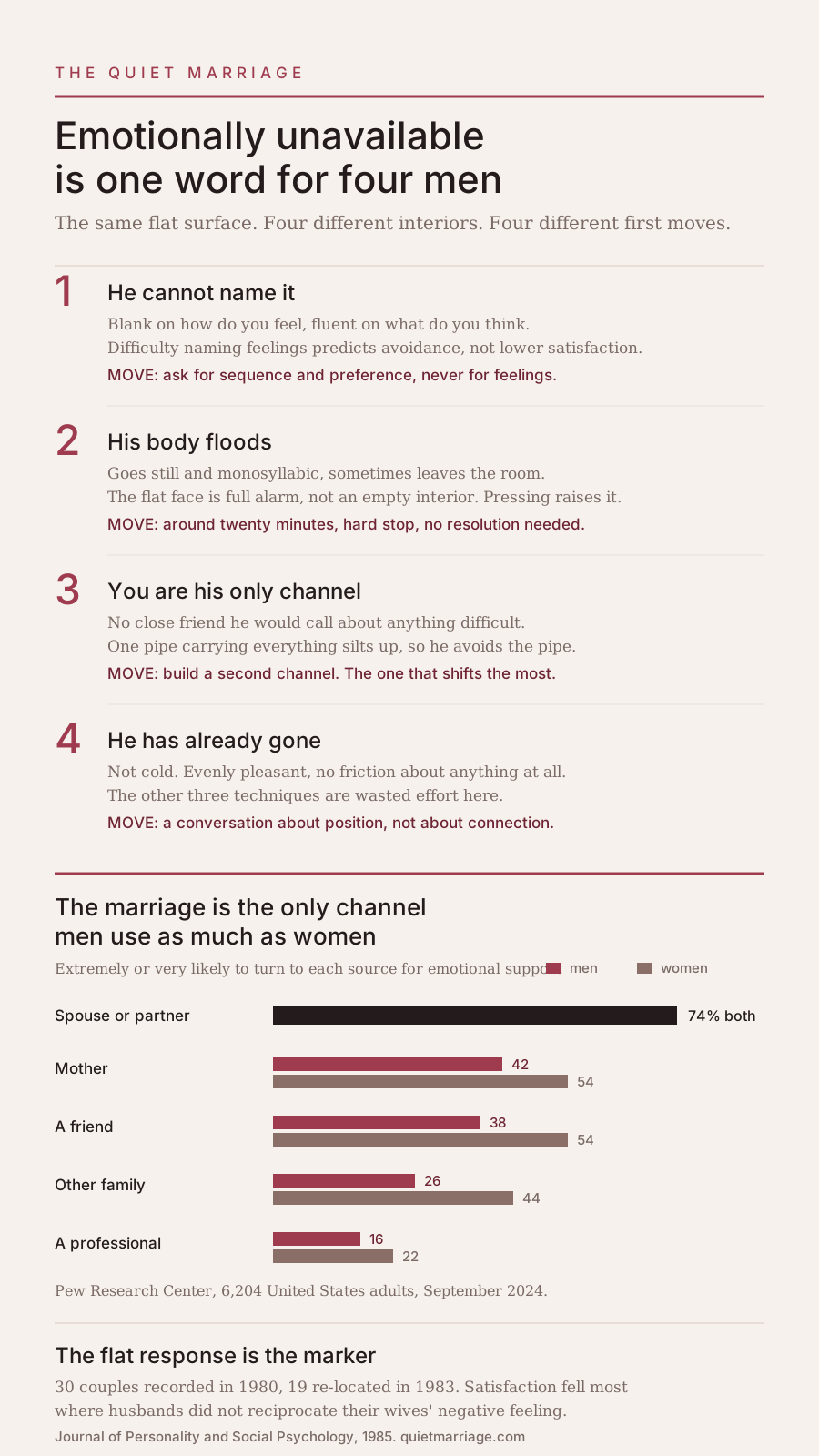
The Pew Research Center surveyed 6,204 United States adults in September 2024 and asked where they would go if they needed emotional support. Roughly three quarters of adults, 74 percent, named their spouse or partner, and on that item men and women answered at the same rate. Every other channel showed a gap. Forty two percent of men said they would turn to their mother against 54 percent of women. Thirty eight percent of men said a friend against 54 percent of women. Twenty six percent of men named another family member against 44 percent of women. Sixteen percent of men said a mental health professional against 22 percent of women.
Set those numbers side by side and a shape appears. The marriage is the one place a man is as likely as his wife to take something heavy. On the three family and friend channels he is between twelve and eighteen points less likely to go, and on turning to a professional the gap is six points on a much smaller base, since only 16 percent of men said they would. For a large number of men the marriage is the only channel that is open, rather than the main one among several.
A channel carrying the entire load behaves differently from one carrying a share of it. When it is the only one, everything has to go through it, including the things he has no practice saying and no other rehearsal space for. So it silts up. He avoids the channel because the channel has become the whole job, and the more he avoids it the more the backlog grows.
The Centers for Disease Control and Prevention describes emotional support as having people you can turn to in good times and hard ones, plural by construction. One person is a single point of failure that both of you are standing on, and a single point of failure is what a network exists to prevent.
There is some empirical support for the pathway, though it needs to be held loosely. A path analysis published in the Journal of Family Medicine and Primary Care in 2018 modelled alexithymia, social support, loneliness and marital satisfaction across 108 couples and found social support had a direct positive effect on marital satisfaction, with alexithymia and social support both acting on it indirectly. That was a single convenience sample of Iranian parents recruited at a school entrance assessment, so it is one thread of evidence rather than a settled finding. It points the same direction as the survey data: the support a man has outside the marriage is not separate from the marriage's health.
The man who has already gone
The fourth is the one nobody wants named, and the honest thing is to name it anyway.
Some men are not blocked, not overwhelmed and not short of outlets. They have finished. The decision was made privately, possibly years ago, and what you are living with is the administration of a marriage somebody has already left without moving out. This is not the most common case. It is not vanishingly rare either, and it is the one where every technique in the other three sections is wasted effort.
It is usually not coldness. Coldness takes energy and often means something is still live. What shows up instead is a specific evenness, an absence of friction about anything, including the things that used to produce friction. He is not fighting because there is nothing he wants from you badly enough to fight for. The household runs. He is pleasant. Nothing you say lands anywhere because there is no longer a surface for it to land on.
If this is your case, the first question is not how to reach him. It is what you want, and what your position actually is. That is a different set of decisions, taken in a different order, and the piece on what the separation decision actually involves for men over forty covers the other side of that ledger.
Telling them apart
The four are separable, and the separating questions are not the ones people usually ask. You are not looking for whether he can talk about feelings. You are looking at what happens in his body and his behaviour at the moment you ask.
| What you see | What is underneath | What moves it |
|---|---|---|
| Blank on feelings, fluent on thoughts | No reliable labels for internal states | Ask for facts and sequences, never for feelings |
| Goes flat, sometimes leaves the room | Arousal he manages by shutting down | Short, scheduled, ended by a clock |
| Talks to nobody but you | The marriage is his only support channel | Build a second channel, not necessarily therapy |
| Pleasant, no friction, nothing lands | He has finished it internally | A conversation about position, not about connection |
One caution about the table. Men are rarely one row. The common real world case is a man high on the naming difficulty who also has no other channel, whose arousal spikes because the one conversation that ever gets held is the one that has twenty years of backlog in it. When two rows apply, build the outside channel first. An outlet lowers the pressure on everything else, and it is the only one of the four moves that does not require him to perform in the moment.
What changes, per case
For the man who cannot name it, the change is to stop running an interview he cannot pass. Feelings questions produce failure, failure produces avoidance, avoidance is the thing you were trying to fix. Ask instead about sequence and preference. What happened first. What part of the day is worst. Would you rather do this or that. Those have answers, the answers are true, and the practice of producing true answers about himself is the thing that eventually reaches the harder register.
For the man whose body floods, the change is duration and temperature rather than content. The 1985 paper establishes that arousal predicts decline. It does not test any particular intervention, and no study cited here does, so what follows is an editorial working estimate rather than a finding. Short, scheduled, low stakes, ending on time whether or not anything got settled, and not immediately after work. Roughly twenty minutes is the figure many practitioners work with. The point of a slot with a hard stop is that it is survivable, and survivable is what makes the next one possible.
The man with one channel needs a structural fix, and it is the one you have least control over, which is exactly why it is worth naming out loud rather than engineering silently. A standing thing with another man, a shared task with a brother, a group that meets for a reason other than talking. It rarely starts as emotional support and does not need to. What matters is that the marriage stops being the only place anything heavy can be set down.
One thing sits underneath all four rather than beside them, and it is worth separating out because it is not a mechanism and not a technique. A large amount of what reads as unavailability in a long marriage is not about emotion at all. It is an unstated ledger, and gentle questioning does not reach a ledger, because there was never a feelings problem there to solve. An unspoken tally of who gave up what will make any of the four look worse than it is, and the same silence can be produced from the other direction by a man who has no idea what is being carried on his behalf, which is the territory covered in the piece on the mental load. Clear that layer and you get a truer reading of which row you are actually in.
One note before the rest. If your marriage has moved past silence into territory that frightens you, or if his flatness looks less like withdrawal and more like something has gone out in him, no article is the right instrument for it. In the United States the Suicide and Crisis Lifeline answers around the clock on 988, by call or by text, free of charge. The American Psychological Association publishes public material on relationships and on finding a licensed practitioner, and a marriage in genuine difficulty rather than ordinary disrepair belongs in a room with one.
What to expect, and what not to
Nothing here produces a conversation in which he finally opens up. That scene is a fiction of the genre and expecting it is one of the reasons this hurts as much as it does. What the evidence supports is smaller and slower. Attachment avoidance is a stable trait, not a mood. The 1985 arousal pattern was measured across three years. A man who has had one channel for two decades does not acquire a second one in a month.
If you are the one trying to close the distance rather than the one being described here, how to reconnect with your wife sets out the three mechanisms that have actually been measured and the order to attempt them in.
What you can reasonably expect, in the cases that move at all, is a change in texture before a change in content. Slightly less flatness at the start of a difficult subject. One answer that is about him rather than about the situation. A conversation that ends without either of you leaving the room. Those are the real markers, and they are worth noticing precisely because they are small enough to miss.
What you should not do is run any of this indefinitely without a review date. Set one, and be specific with yourself in advance about what would count as movement. Six months is this publication's editorial working estimate rather than a figure from any study, chosen because it is long enough for a textural change to show and short enough to still be a decision. The most common failure here is running the right approach for four more years without ever checking whether it worked. The question of what to do when nothing is technically wrong is a different one from this, and it is the one waiting on the other side of the review.
There is one last thing worth saying plainly, because the framing of this whole subject tends to obscure it. Understanding which mechanism you are dealing with does not obligate you to solve it. Four explanations are four explanations. They make his behaviour legible. They do not make it your job, and a marriage in which one person does all the diagnostic work and all the accommodation is its own kind of unavailable.
Last reviewed by The Quiet Marriage Editorial Team on August 26, 2026. This piece was reviewed editorially, against its published sources. It was not reviewed by a licensed therapist, counsellor or physician, and it is not a substitute for one. Our sourcing and AI use rules are public on the editorial standards page. This is general editorial content and not professional, medical or psychological advice. A marriage in genuine difficulty should be discussed with a licensed professional in your own jurisdiction. If you are in crisis in the United States, dial or text 988 for the Suicide and Crisis Lifeline, which is free and available 24 hours a day.
FAQ
Is emotionally unavailable a real diagnosis?
No, it names an effect and there is no test for it. The nearest measured trait is alexithymia, assessed on a continuum with a twenty item scale, and what the 2014 cohort found is that the trait tracks how a person attaches far more closely than it tracks how a marriage feels. So the label describes your experience of him accurately and diagnoses him not at all, which is the reason four different men fit under it.
Does he even know he is doing it?
In two of the four cases, not really. The man who has no labels for his internal states experiences your question as unanswerable rather than unwelcome, and the man whose body floods during hard conversations experiences himself as holding on rather than as withdrawing. The man who has finished the marriage generally does know. Which is why the diagnostic question matters more than the accusation.
Why does he open up to other people but not to me?
Usually because the conversation with you carries a backlog that a conversation with a colleague does not. Talking to somebody with no history costs nothing. Talking to you means opening a subject with years attached to it. That is a load problem rather than a preference, and it is the same overload described earlier in this piece: a channel carrying everything backs up faster than one carrying a share of it.
He says he is fine. Is he lying?
Usually not, in the sense you mean. There is a cheap test for it. Ask him what he thinks about the same subject and watch whether the fluency comes back. If a man can be articulate about the situation and stays blank about himself, you are looking at a vocabulary gap rather than a door being held shut, and those need opposite handling.
Will couples counselling fix an emotionally unavailable husband?
It depends entirely on which mechanism you have. A licensed professional is the right call in every one of the four cases, but for different reasons, and only 16 percent of men in the Pew survey said they would be extremely or very likely to turn to one for emotional support, so the first obstacle is usually attendance rather than efficacy. If he has already left the marriage internally, counselling is more useful for clarifying that than for reversing it.
How long should I give this before deciding?
Decide in advance what would count as movement, then give it long enough for that to show. The markers worth naming are textural rather than conversational: a shorter flat stretch at the start of a hard subject, one answer that is about him rather than about the situation, a difficult exchange that ends without either of you leaving the room. Those are the things to write down beforehand. Writing them down is the whole point, because it stops you grading generously later, which is what happens when the review is a feeling rather than a list.
Can this get better if only one of us is working on it?
Partly, and it is worth being honest about the ceiling. You can lower the intensity of the conversations, change what you ask for, and stop running an interview he fails. Those are real and they are yours to do. What you cannot do alone is build his second channel, and that is the one that shifts the most. One person can change the conditions. One person cannot supply both sides of a relationship indefinitely without the arrangement becoming something else.
Is my husband emotionally unavailable?
The phrase describes an effect on you rather than a condition in him, so the more useful question is what happens at the moment you ask him something. Not whether he can talk about feelings in general, but what his body and his behaviour actually do right then. Four patterns cover most of it: blank on feelings but fluent on thoughts, going flat and sometimes leaving the room, talking to nobody but you, or pleasant with no friction and nothing landing anywhere. If you put something in and nothing comes back, the label fits your experience accurately. It simply does not tell you which of the four you are living with, and that is the part that decides what to do next.
How do you deal with an emotionally unavailable husband?
There is no single move, and that is the practical finding rather than a dodge. What helps depends on which of the four interiors you are dealing with, and three of the four get worse under the advice written for the fourth. If he is blank on feelings and fluent on thoughts, ask about facts and sequence rather than about feeling. If he goes flat and sometimes leaves the room, shorten the conversation and end it on a clock rather than on a resolution. If the marriage is his only outlet, the useful work is building a second channel, not improving the first. If nothing lands at all and there is no friction left in the house, the conversation to have is about position rather than about connection. When two of those apply at once, which is the common real world case, build the outside channel first, because it is the only one of the four moves that does not require him to perform in the moment.
When should you leave an emotionally unavailable husband?
Nobody outside your house can answer that. What this piece can settle is when the reaching work has stopped being the right work, and two conditions do it. One is the fourth pattern above: a man who is not blocked, not overwhelmed and not short of outlets, who finished privately, possibly years ago, leaving you with the administration of a marriage somebody has already left without moving out. In that case every technique in the other three sections is wasted effort, and the first question stops being how to reach him and becomes what you want and what your position actually is. The other is a review date that passed without the movement you wrote down in advance. Six months is this publication's editorial working estimate rather than a figure from any study, long enough for a textural change to show and short enough to still be a decision, and the common failure is running the right approach for four more years without ever checking whether it worked. Neither condition is an instruction to go. Both mean the question in front of you has changed shape, and the separation decision is a different set of decisions taken in a different order.
What is stonewalling in a marriage?
Stonewalling is the name usually given to the flat face and the shut mouth in the middle of a hard conversation. What sits underneath most of it is a loop rather than a refusal. A man whose body has gone to full alarm and whose visible response has gone to nothing is not showing you an empty interior. He is using the only regulation strategy he was ever taught. From the inside it feels like holding a lid on. From the outside it is indistinguishable from not caring, which is precisely why it does so much damage. The practical part is the loop itself: every additional degree of intensity raises the arousal the flatness is trying to manage, so pressing harder deepens the flatness rather than breaking it.
Sources
- A study of parents to be published in Comprehensive Psychiatry in 2014 (pubmed.ncbi.nlm.nih.gov)
- Levenson and Gottman recorded 30 married couples (pubmed.ncbi.nlm.nih.gov)
- Roughly three quarters of adults, 74 percent, named their spouse or partner (pewresearch.org)
- Centers for Disease Control and Prevention describes emotional support (cdc.gov)
- A path analysis published in the Journal of Family Medicine and Primary Care in 2018 (pubmed.ncbi.nlm.nih.gov)
- Suicide and Crisis Lifeline (988lifeline.org)
- American Psychological Association (apa.org)