Divorce Support Groups for Men: Which Kind Does What
Four different things go by the name divorce support group for men, and they are built to do four different jobs. Court-linked parenting education is for your children rather than for you. A clinician-led adjustment group is built to move symptoms and conflict. A peer-led mutual help group is built to replace structure, which is what collapses when a household ends. A guided online programme is built for reach, for the man with nothing inside an hour's drive. All four have research behind them, so the first question is not whether groups work. It is which job you need done. A man who walks into the wrong one of the four tends to go twice and stop, and on our reading it is that mismatch, rather than the idea of a group, that failed him.
One line that should not wait until the end. If you are having thoughts of harming yourself, or you are drinking to get through the evenings, a support group is not the first call and delay is not neutral. In the United States, dial or text 988 for the Suicide and Crisis Lifeline, which is free, confidential and available 24 hours a day, with call, text and chat options. A group is a good second step. It is a poor first one when the floor is moving.
What the group is actually replacing
Start with the thing the brochures do not name, because it changes which group you should pick.
Two large meta-analyses have looked at what happens to people after a marriage ends, and both find the same asymmetry. Shor and colleagues, pooling 625 mortality risk estimates from 104 studies published between 1955 and 2011, covering 24 countries and more than 600 million people, found a mean hazard ratio for mortality of 1.30 among estimates adjusted for age and other covariates. Split by sex, the figure was 1.37 for men, with a 95 percent confidence interval of 1.27 to 1.49, and 1.22 for women, interval 1.13 to 1.32, and the gap between men and women narrowed as the mean age of the sample rose. Sbarra, Law and Portley, working from 32 prospective studies involving more than 6.5 million people, 160,000 deaths and over 755,000 divorces across 11 countries, found the same direction: a significant increase in risk of early death among separated and divorced adults compared with married ones, with men and younger adults carrying greater risk than women and older adults.
Neither paper says the divorce caused those deaths, and both are careful about it. Sbarra and colleagues set out four candidate mechanisms rather than one: social selection, meaning the people who divorce may differ beforehand; resource disruptions; changes in health behaviours; and chronic psychological distress. That list is the useful part for anyone choosing a group, because three of the four are things a room full of other men on a Tuesday night can touch, and none of them is sadness.
This is the reframe worth carrying into the decision. The problem a group is good at is not feeling bad. It is that a long marriage routes an enormous amount of a man's social and practical life through one person and one household, and when the household ends, the routing ends with it. The friendships that ran through her. The reason to be home at seven. The person who noticed you had stopped eating properly. What is left is not primarily grief. It is an empty structure, and rebuilding one from nothing is a job a long marriage rarely asks a man to practise. The same unpractised skill is visible long before any separation, in the particular isolation of living beside someone.
A group replaces structure, and everything else it does is secondary. Stating plainly which half of that is evidence and which half is us: the mortality asymmetry and the four candidate mechanisms are the papers' findings, and reading a support group as primarily a structure replacement is this publication's inference from them. No trial cited below set out to measure it.
The four kinds, and the job each is built for
| The kind of group | The job it is built for | What the research supports |
|---|---|---|
| Court-linked parenting education | Your children's outcomes after the split | A randomised trial with 830 parents found stronger parenting and fewer child mental health problems at posttest and at ten months against an active short comparison, with effects moderated and many of them not replicated for Hispanic families |
| Clinician-led adjustment group | Symptoms, conflict, coparenting | An eleven week study of 62 divorced or separated parents found less distress and less covert conflict and more forgiveness across both formats |
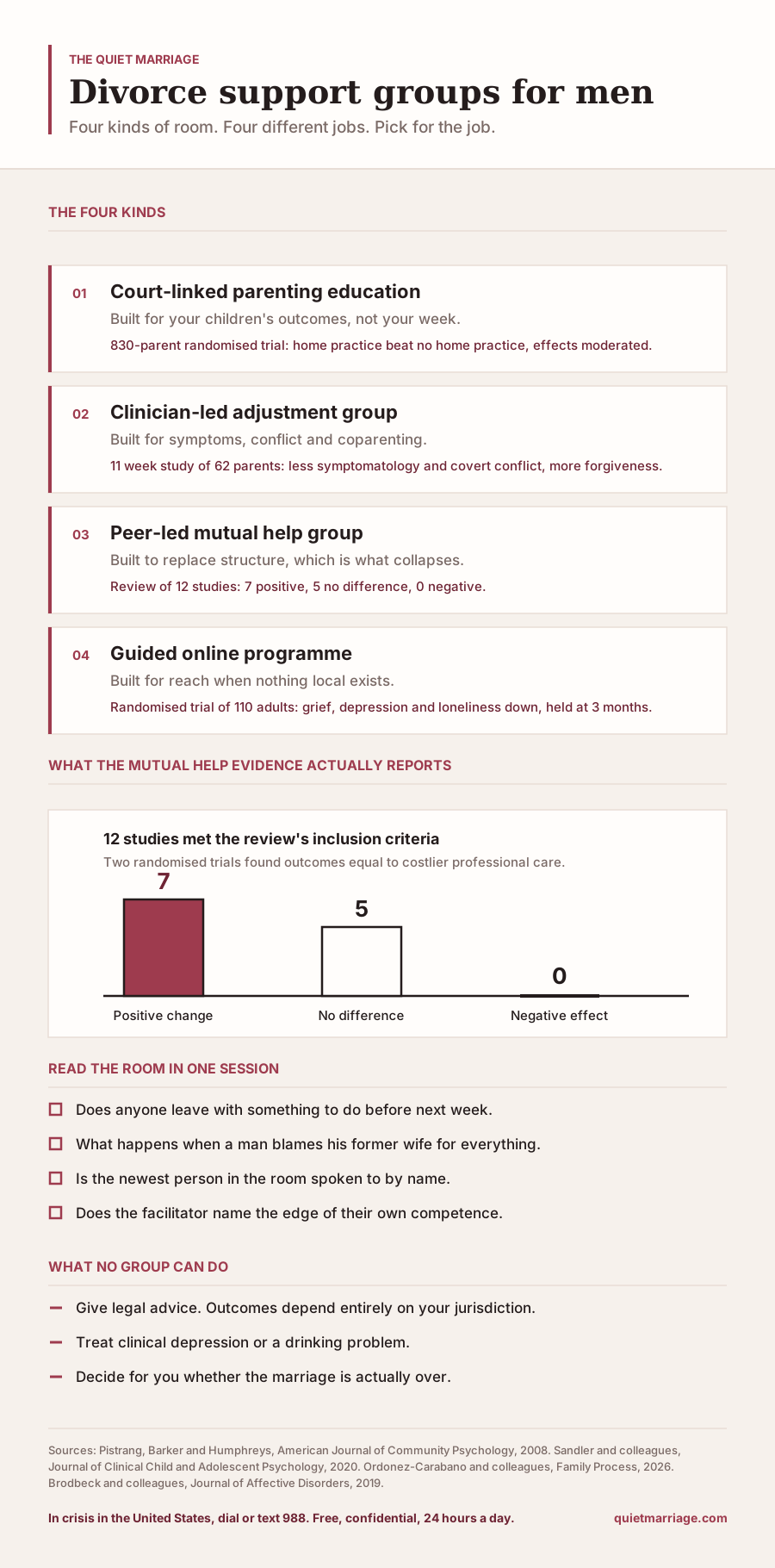
| Peer-led mutual help group | Structure, attendance, being known | A review of 12 studies found 7 reporting positive change, 5 finding no difference and none showing negative effects |
| Guided online programme | Reach, when nothing local exists | A randomised trial of 110 adults found reductions in grief, depression and loneliness, held at three months |
Each also has a wrong reason to pick it, and the wrong reasons are more common than the right ones. Do not take the court's programme hoping it will do something about your own week. Do not take a clinician-led group when what you actually wanted was a room and a coffee, because you will resent the syllabus. Do not take a peer group as a substitute for treatment of a depression that needs treating. And do not take the online option to avoid a room you are perfectly able to walk into.
Take them in order, because the differences are not cosmetic.
Court-linked parenting education. In many jurisdictions this one is not optional, and it is easy to resent: you arrive expecting help and are handed a curriculum about somebody else. The strongest evidence in the field belongs to programmes of this type. Sandler and colleagues ran a randomised effectiveness trial of the New Beginnings Program in which family courts in four counties recruited divorcing and separating parents and community agencies delivered the sessions. Eight hundred and thirty parents of children aged three to eighteen were randomised to either the ten session programme or an active two session comparison in which parents learned the same parenting skills without completing home practice. The ten session version produced positive moderated effects against that active control, strengthening parenting at posttest and reducing child mental health problems at posttest and at ten months.
Two honest qualifications, because the paper states both. The positive effects were moderated, and many of them appeared for non-Hispanic White families and not for Hispanic families, which the authors flag as needing further adaptation. And the ingredient that separated the long version from the short one was the home practice, not the room. A related analysis of the same trial is titled, plainly, Home Practice Is the Program. If you attend this kind of group and do not do the work between sessions, you have attended the comparison condition.
Clinician-led adjustment group. This is the closest thing to a course. A facilitator with training, a fixed number of weeks, a syllabus that moves through conflict, coparenting and what to do with the anger. Ordóñez-Carabaño and colleagues compared in-person and online delivery of an eleven week psychoeducational intervention with 62 divorced and separated parents, 41 in person and 21 online, with a six month follow-up. Across both formats participants showed reduced overall symptomatology and covert conflict and increased forgiveness. In the confirmatory analyses the in-person format showed greater improvement than the online one for total symptomatology, depression and forgiveness, with no other interactions reaching significance.
The sample is small and it is a study of parents, so treat the size of the in-person advantage as indicative rather than settled. The direction is still worth acting on. If both formats are genuinely available to you and nothing else separates them, take the room.
Peer-led mutual help group. Typically no clinician, no curriculum and no fee, and typically a hired hall rather than a clinic. Picture the kind of room where you would recognise most of the faces by the third week. The evidence here is quieter than the sales pitch around it and more useful than the scepticism. Pistrang, Barker and Humphreys reviewed effectiveness studies of mutual help groups for mental health problems against four sets of inclusion criteria. Twelve studies qualified. Seven reported positive changes for attenders. Five found no difference between members and non-members. None showed evidence of negative effects. The strongest single finding came from two randomised trials in which mutual help group outcomes were equivalent to those of substantially more costly professional interventions.
Read that carefully, because it is the most decision-relevant paragraph on this page. It is not a claim that a peer group will transform you. It is a claim that across the studied groups the downside was not observed and the upside was sometimes equal to paid professional care. That is a good bet for a man deciding whether to give up a Tuesday evening. It is a bad basis for skipping treatment he actually needs.
Guided online programme. Brodbeck and colleagues ran a randomised controlled trial of a guided internet-based self-help intervention for prolonged grief after spousal bereavement or separation and divorce, with 110 participants against a wait-list control. Average age was 51 and 77 percent were separated or divorced. Compared with the control group the intervention produced significant reductions in grief with an effect size of 0.81, depression at 0.59, general psychopathological distress at 0.39, embitterment at 0.37 and loneliness at 0.37, along with an increase in life satisfaction. The gains held over three months, and improvements were similar for participants who started with low, medium or high levels of grief.
The caveat matters more here than anywhere else on this page, and it is the authors' own: the sample was self-selected and 79 percent female.
The gap nobody mentions when they quote evidence at you
None of the studies above is a trial of a men-only divorce support group.
That is not a technicality. The parenting programme trial recruited parents of both sexes through family courts. The eleven week comparison studied 62 divorced and separated parents. The online trial was 79 percent female. The mutual help review covered groups for chronic mental illness, depression and anxiety, and bereavement rather than for divorce specifically. What exists is good evidence that structured groups and peer groups help people in the general neighbourhood of this problem, and an absence of evidence about the specific room you are being invited into on Thursday.
Anyone who quotes a percentage at you about men's divorce groups is either citing something narrower than they are implying or has made it up. The honest position is that the direction of the evidence supports going, the size of the effect for a men-only group is unknown, and the observed downside across the studied groups was zero. On those terms, going is a reasonable decision. Certainty is not on offer, and a group that sells you certainty has told you something about itself.
How to read a room in one session
You will know more in ninety minutes than in a month of reading reviews. Four things to watch for.
Does anyone leave with a task. The single ingredient that separated the effective version of the parenting programme from the ineffective one was home practice. A group that never asks anything of you between sessions is a social club, which is not worthless, but do not expect it to move anything.
What happens when a man blames his ex-wife for everything. Some blame is inevitable and healthy early. The question is whether the room lets it stand unchallenged every week. A group with no friction becomes a grievance circle, and a grievance circle rehearses the story rather than metabolising it. Watch whether anyone, facilitator or member, ever says a gentle version of "that might not be the whole picture."
Is the newest man spoken to by name. Structure is the mechanism. Structure means being expected. If nobody notices a new person, nobody will notice your absence either, and attendance is the whole intervention.
Does the facilitator know the edge of their competence. A good one will say out loud that the group does not give legal advice, does not diagnose, and is not a substitute for treatment. A facilitator who will answer anything is a liability in a room full of men making irreversible financial and custody decisions.
What a group cannot do
It cannot give you legal advice. In almost any peer group there is a man who has been through his own divorce and is certain about what you should do, and that certainty costs nothing to receive and a great deal to act on. Divorce outcomes depend entirely on jurisdiction, which is the actual reason to take independent advice from your own adviser rather than a general answer. The American Psychological Association maintains a public resource hub on divorce and child custody that is a better starting point than the room's collective folklore. It also cannot tell you whether the tactical advice circulating in the room is current, which is a separate check against the statutes and the tax topic.
It cannot treat clinical depression or a drinking problem. The mutual help evidence found equivalence with professional care in two trials, which is a real finding, and it is not a licence to substitute a peer group for treatment you have been told you need. In the United States, SAMHSA's FindTreatment.gov locates licensed treatment services, and the APA psychologist locator finds licensed psychologists by area.
It cannot decide whether the marriage is over. That is a separate question with its own order of operations, and it is worth settling before you look for a room, because the two kinds of group serve opposite ends. If you are still deciding, the three decisions that a separation after forty actually involves come first. If part of you suspects the marriage is not over so much as unattended, that is a different piece of work with a different starting move, and joining a divorce group in the middle of it will quietly answer the question for you.
How to find one without paying for the privilege
Four routes, in the order that costs you least.
Ask the court. If your jurisdiction runs parenting education, the court administration that runs it is often where a list of local adjustment and peer groups sits, and it is worth asking for by name rather than waiting to be handed one.
Ask a licensed professional you are already seeing, or find one through the APA locator above, and ask specifically what they refer men to. A clinician who works with separating clients is likelier than a search engine to know which local rooms are still meeting.
Call community and faith venues and ask, whether or not you belong to one. Ask the office whether they host a group or know who does, because peer-led groups tend to run out of halls rather than websites, which is exactly why a phone call finds them and a search does not.
Use a guided online programme as a bridge rather than a destination if nothing local exists, and hold the finding from the comparative study in mind: where both are genuinely available, the in-person format showed the larger gains on symptoms and depression.
The men who come out of this well are not the ones who found the perfect group. They are the ones who found an adequate one within a fortnight of needing it and then kept turning up to it, which is the same unglamorous rule that governs the division of household work in the marriage that ended. Rate beats intensity. A mediocre room attended for a year outperforms an excellent one attended twice.
If you are weighing a paid programme aimed at divorcing men against a group like the ones above, the two are not the same purchase and should not be priced against each other blind. Divorce for men only sets out what those services are, what a coach can and cannot do, and why a support group covers similar ground for less.
Last reviewed by The Quiet Marriage Editorial Team on August 29, 2026. This piece was reviewed editorially, against its published sources. It was not reviewed by a licensed therapist, attorney or physician, and it is not a substitute for one. Our sourcing and AI use rules are public on the editorial standards page. This is general editorial content and not professional, legal, medical or psychological advice. Decisions about separation, custody and finances should be taken with a licensed professional in your own jurisdiction. If you are in crisis in the United States, dial or text 988 for the Suicide and Crisis Lifeline, which is free and available 24 hours a day.
FAQ
Do divorce support groups for men actually work?
The direction of the evidence favours going, and the part nobody advertises is that no trial has ever tested a men-only divorce group. What exists is adjacent and reasonably strong. In a review of mutual help groups covering 12 studies, none reported a negative effect and two randomised trials found outcomes equivalent to substantially more costly professional interventions. Structured clinician-led programmes for divorced and separated parents have their own trial evidence. Treat that as a bet with a documented floor rather than a guarantee, and judge the particular room in front of you on the four questions below rather than on the reputation of the category.
Which type of group should a man join first?
Match the group to the job. If children are involved and the court offers parenting education, do that one properly, including the home practice, because that is the ingredient the research identifies as separating the effective version from the ineffective one. If the problem is that your weeks have lost their shape, a peer-led mutual help group is the right tool, because structure is what it replaces. If you are carrying symptoms that are interfering with work or sleep, a clinician-led adjustment group or individual treatment comes first. If nothing local exists, a guided online programme is a real option with trial evidence behind it, and it is a bridge rather than a destination.
Is an online divorce support group as good as meeting in person?
Both help, and the single head to head comparison puts the room slightly ahead. Ordóñez-Carabaño and colleagues split 62 divorced and separated parents across eleven weekly sessions, 41 in person and 21 online. Both arms improved, and the in-person arm improved more on total symptomatology, depression and forgiveness, with no other differences reaching significance. That is one small study rather than a settled result, so use it as a tiebreak and not as a verdict. Where both are genuinely available and nothing else separates them, take the room. Where the real choice is an online group or nothing, take the online group, because it has randomised evidence of its own and there is no benefit in waiting for a local room that may not exist.
Why do men seem to struggle more than women after a divorce?
The pattern is real in the mortality data and the reason is probably structural rather than emotional. Two meta-analyses find the asymmetry: Shor and colleagues pooled 104 studies covering more than 600 million people and reported a mean adjusted hazard ratio for mortality of 1.37 for men against 1.22 for women, with the gap narrowing as sample age rose, and Sbarra, Law and Portley found greater risk of early death for men and younger adults across 32 prospective studies. Neither paper claims the divorce caused it. Sbarra and colleagues name four candidate mechanisms rather than one, including resource disruptions and changes in health behaviours. The plausible explanation, and this is our reading rather than a measured finding, is structural. A long marriage tends to hold a man's friendships, his weekly shape and often his only confidant inside one household, so ending the household empties several categories at once instead of one.
How do I tell a good group from a bad one?
Go once and judge on four things, and judge after the visit rather than off a website, because not one of the four is visible in advance. Does anyone leave with something to do before next week, since between-session practice, rather than attendance by itself, is what the trial evidence identifies as the active ingredient. What happens when a man blames his former wife for everything, and whether anyone ever gently complicates that story, because a room with no friction rehearses the injury instead of working through it. Whether the newest person is spoken to by name, since being expected is the mechanism and a room that would not notice your absence cannot supply it. And whether the facilitator names the edge of their own competence out loud. One further signal only shows up over a few months: a group whose membership never changes has stopped being a place people finish and leave, which is a different institution from the one you thought you were joining.
Are divorce support groups for men free?
Peer-led mutual help groups carry no fee by design, since there is no clinician's time and no curriculum to pay for, and they run out of halls and faith venues rather than websites, which is why a phone call finds them and a search usually does not. Court-linked parenting education is mandated in many jurisdictions, as above, and the court that mandates it sets whatever fee applies. Clinician-led adjustment groups are paid, because a trained facilitator's time is what you are buying. The finding worth weighing before you assume price tracks value is the one from the mutual help review, where two randomised trials produced outcomes equivalent to substantially more costly professional interventions. That is a good reason to try the free room first. It is not a reason to treat cost as the only variable when a clinician has already told you what you need.
Can a support group replace a therapist or a lawyer?
No, in both directions, and a good facilitator will say so in the first session. On the legal side, outcomes depend entirely on jurisdiction, so the certainty of a man who has been through his own divorce is not transferable to yours, and the correct move is independent advice from your own adviser. The American Psychological Association hosts a public resource hub on divorce and child custody that is a better starting point than the room's folklore. On the clinical side, the equivalence finding in the mutual help review applies to the studied groups and the outcomes those studies measured. It was never a finding about any individual reader's diagnosis. If depression or drinking is in the picture, FindTreatment.gov locates licensed services and the APA psychologist locator finds licensed psychologists by area. If you are in crisis in the United States, 988 is free and available 24 hours a day.
Sources
- Suicide and Crisis Lifeline (988lifeline.org)
- Shor and colleagues (pubmed.ncbi.nlm.nih.gov)
- Sbarra, Law and Portley (pubmed.ncbi.nlm.nih.gov)
- Sandler and colleagues (pubmed.ncbi.nlm.nih.gov)
- Home Practice Is the Program (pubmed.ncbi.nlm.nih.gov)
- Ordóñez-Carabaño and colleagues (pubmed.ncbi.nlm.nih.gov)
- Pistrang, Barker and Humphreys (pubmed.ncbi.nlm.nih.gov)
- Brodbeck and colleagues (pubmed.ncbi.nlm.nih.gov)
- American Psychological Association (apa.org)
- FindTreatment.gov (findtreatment.gov)
- APA psychologist locator (locator.apa.org)