The Mental Load Comic: What It Actually Argues, and What to Do If Your Wife Sent You the Link
The mental load comic is a 2017 web comic by the French artist Emma, published in English on 20 May 2017 under the title You Should've Asked and later collected in book form. If your wife sent you the link, she was almost certainly not filing a complaint about chores. She sent a drawing because the drawing said something she had tried to say out loud and could not get to land.
That is the part most men miss on the first read. The comic is not an inventory of tasks. It is an argument about who holds the job of remembering the tasks exist, and it makes that argument in pictures because pictures do not sound like nagging. A woman who has already said this three times in conversation, and watched it be heard as a complaint about dishes, can send a link instead and let someone else do the explaining.
This piece is about what the comic actually claims, what the research since 2017 has confirmed and where it has qualified the picture, and what to do in the twenty four hours after it arrives in your messages.
If you want the short version before the long one: say one accurate sentence about what you recognised in it, then take one household domain end to end, permanently, without being reminded. Everything below is the case for why that specific move is the one that works.
What the comic actually argues
The comic follows an ordinary domestic evening and ends on a line a husband says in good faith, which is that he would have helped if she had asked. The comic's whole case is that this sentence, offered as cooperation, is the problem rather than the solution.
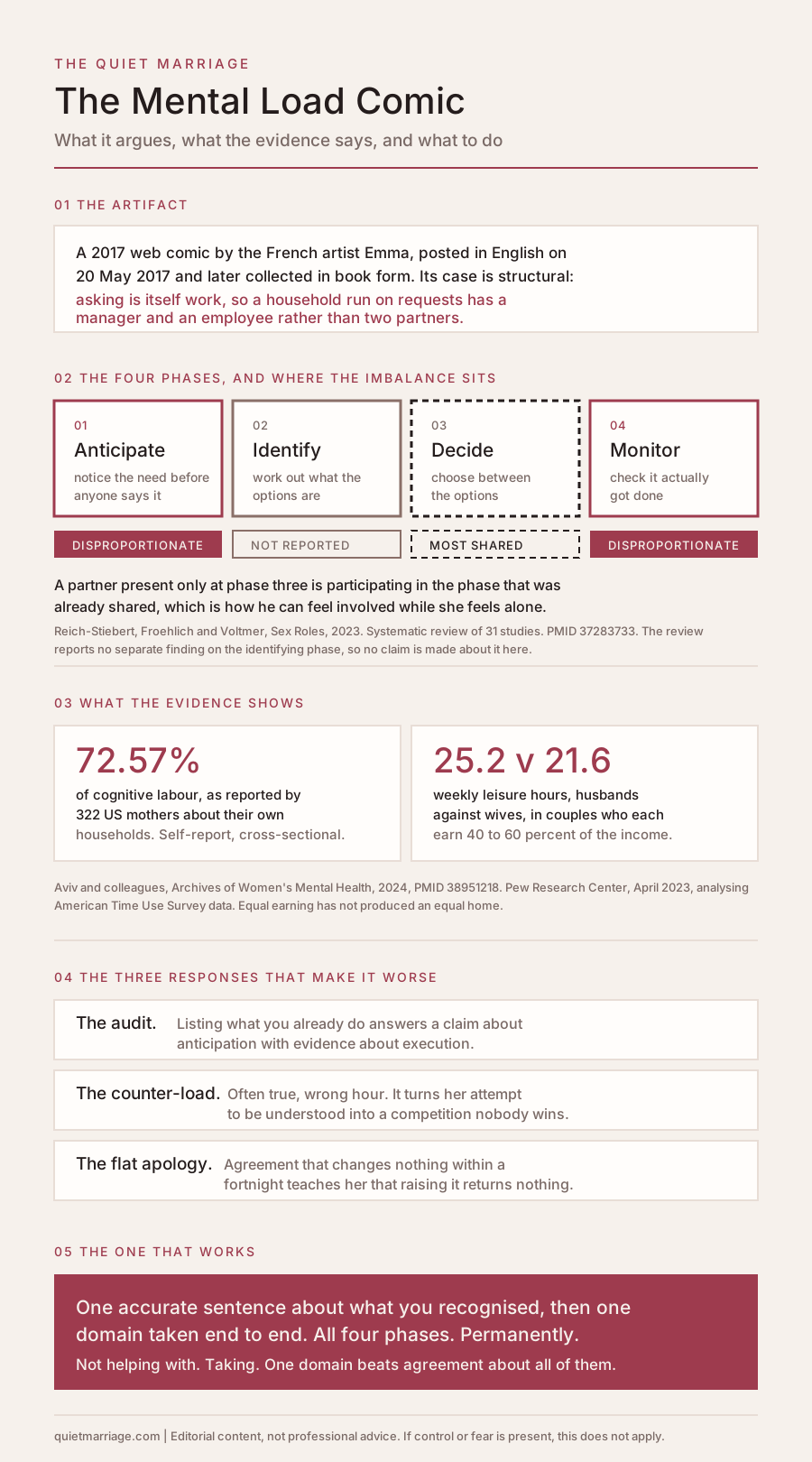
The claim underneath it is structural rather than moral. Asking is itself work. To ask, someone has to have already noticed the thing needed doing, worked out what doing it would involve, decided when it should happen and to what standard, and then remembered to raise it at a moment when raising it would be received. By the time a request is spoken, four separate jobs have already been completed by the person speaking. The person being asked arrives at step five and experiences the whole thing as one task.
A household where one partner does all the asking is not a household with an unequal chore split. It is a household with one manager and one employee, and the employee has the better job. That is the argument, and it is why a man who genuinely does half the physical work can read the comic and still recognise himself in it.
Emma's drawing did in a few panels what a great deal of academic writing had failed to move into ordinary conversation. The Guardian reported on its spread through English-speaking readers within a week of the translation going up, which is roughly the speed at which something people already felt gets a name.
Why a drawing worked when the conversation had not
Three things about the form did the work, and they are worth understanding because they tell you what your wife was attempting.
A drawing is not an accusation. When she says it, you are being told you have failed. When a stranger's comic says it, you are being shown a pattern that happens to include you. The same content arrives without the charge attached, which is precisely why she reached for it.
Then there is the problem of evidence. This is difficult to argue in speech because the labour in question leaves no trace behind it. Anticipation and monitoring produce no object at the end, so there is nothing to point at across a kitchen table. A comic can draw the thought bubble, and it is close to the only medium that can put the invisible layer in front of someone.
A drawing is finite. She can send it and stop. She does not have to defend it line by line, escalate when you push back, or manage your reaction while making her own case. Anyone who has been the only person raising an issue for years understands the appeal of handing the argument to someone else.
If a link arrived instead of a conversation, that is usually a sign the conversations have not been going well, which is a separate and prior problem. The opening sentence matters more than anything that follows in most of these exchanges, and a link is a way of skipping the opening sentence entirely.
What the research has confirmed since 2017
The comic was an artist's argument, not a study. Nine years on there is a body of peer-reviewed work on the same phenomenon, and it supports the core claim while sharpening it in a way the comic does not.
The sharpening matters, because it tells you which part of the work to take. A systematic review published in Sex Roles in 2023, covering 31 studies, breaks cognitive household labour into a four-part sequence: anticipating a need, identifying the options, deciding between them, and monitoring whether it got done. Its finding is that the imbalance is not spread evenly across the four. Deciding is the part couples most often share, while anticipating and monitoring fall disproportionately to women. The review reports no separate finding on the identifying phase, so we make no claim about it. We have set out that whole sequence, with worked household examples, in the checklist companion to this piece.
What matters here is the consequence for the man reading the comic. A husband consulted on every significant household decision, who takes those conversations seriously, is present for the one phase that was already shared. He experiences himself as fully involved. She experiences herself as the only person who noticed the decision needed making and the only one checking it got carried out. Both readings are sincere, which is exactly why the argument never resolves by talking about who does more.
That gap is the comic's actual subject, and it is easier to see laid out as a sequence than argued in a paragraph.
On consequences, a 2024 study in Archives of Women's Mental Health surveyed 322 United States mothers and found they reported carrying 72.57 percent of the household's cognitive labour against 27.43 percent for their partners. The same paper reported that a more unequal split was associated with higher depressive symptoms, higher stress, higher personal burnout, and lower relationship quality. Three limits belong with that number, and they matter more than the number does. It is a cross-sectional survey, so it identifies associations rather than causes. It records what mothers said about their households rather than a measurement taken from both partners, which is a real constraint given that spouses routinely disagree about who does what. And the sample is a narrow slice: mothers of young children drawn from an existing cohort, 81 percent White, 57 percent holding a master's or doctoral degree, and a third reporting household income above 150,000 dollars. The direction of that finding is worth knowing. The exact split should not be assumed to hold across income, education or race.
The time-use evidence points the same direction on the visible half. The Bureau of Labor Statistics reported that in 2025, 87 percent of women and 75 percent of men did some household activity on an average day, and that on the days they did any, women averaged 2.8 hours against 2.1 hours for men. The Pew Research Center's 2023 analysis is the more pointed one, because it holds earnings constant. In marriages where each spouse earns between 40 and 60 percent of the couple's income, husbands still averaged more weekly leisure than wives, 25.2 hours against 21.6, and wives averaged more housework and more caregiving. Equal earning has not produced an equal home.
Where a comic necessarily flattens things
Taking the comic seriously means being straight about what a nine-panel argument cannot carry, and a man who has read the research is entitled to hold both things at once.
| What the comic gets right | What it necessarily leaves out |
|---|---|
| Asking is work, and a household run on requests has a manager and an employee | Some households run this way by mutual arrangement rather than by default, and arrangement is different from imposition |
| The labour is invisible because anticipation and monitoring leave no object behind | The same invisibility can run the other way. Our editorial view, offered as observation rather than as a finding, is that financial exposure and job security are carried silently in many of these households. We have seen no comparable body of research measuring it |
| The imbalance is a pattern rather than a set of individual failures | A pattern is not a verdict on your particular marriage, and the research measures averages across populations |
| Willingness to help is not the same as taking ownership | A comic cannot show a partner who has genuinely taken domains and is still being managed, which does happen |
| It put a usable phrase into ordinary domestic argument, which is why a wife can now send a link instead of starting a fight | It ends at the moment of recognition. The transfer of a domain takes months and the comic offers no mechanism for it, so a couple who agree about the comic can still change nothing |
The comic also has a specific audience and a specific politics, which its author has never hidden. It was written to give women language for something, and it lands hardest on the reader who is being described. That is a fair thing for a piece of advocacy to do. It is not the same thing as a balanced account of your household, and treating it as a diagnosis of your particular marriage gives it a job it was never built for.
If she sent it to you: the three responses that make it worse
Being handed this without warning stings, and feeling got at is a normal reaction rather than a character flaw. It is also not much of a guide to what to do next. There is a predictable set of first responses here, all of them understandable, and all three of the common ones make the next week harder than it needed to be.
The first is the audit. You reply with a list of what you do, which may be long and may be accurate. The problem is that the list is made of execution, and execution was not the contested item. Answering a claim about anticipation with evidence about execution reads as a refusal to engage with what was actually said.
The second is the counter-load. You point out, correctly, that you carry things she does not see, and that nobody has drawn a comic about the mortgage. This is often true and it is the wrong hour to say it. Raised in the first exchange, it converts her attempt to be understood into a competition, and the competition has no winner. That conversation is worth having later, on its own, when it is not functioning as a rebuttal.
The third is the flat apology. You say she is right, you will do better, and nothing changes, which is the most damaging of the three because it spends her hope. A promise that produces no observable difference within a fortnight teaches her that raising it costs her something and returns nothing. That is the mechanism by which a specific grievance turns into an unspoken tally of who gave up what, and by the time it has hardened into a tally the conversation is much harder to reopen.
The response that works is smaller than all three. Read it properly, then say one accurate sentence about what you recognised, and name one domain you are taking end to end starting this week. Not helping with. Taking. Anticipation, options, decision and follow-through, all four phases, permanently, without being reminded. One domain done completely is worth more than agreement about all of them.
If you want to send it to her
Some men read the comic and want to send it back with the roles reversed, because the invisible labour in their house runs the other way. That happens, and the research on cognitive labour is about a population average rather than a law of nature.
Sending it is still usually a poor move, for the same reason it was a blunt instrument when it arrived in your messages. A link is an argument delivered by proxy. It puts your wife in the position you were just in, which is being handed a general case and asked to find herself in it. If your load is genuinely unseen, the version that works is the one you would have wanted: a plain sentence about one specific thing you carry that she may not know you carry, said at a calm hour, with no link attached.
Which household this is actually about
There is a version of this where the comic is a useful shock to a marriage that is basically working, and a version where it is the surface of something older. If the link arrived after years of the same conversation going nowhere, the comic is a symptom rather than the issue. A household load argument that has been running for a decade is usually carrying resentment that has been accruing without ever being itemised, and load rebalancing alone will not settle that account.
The practical follow-through is a separate job from understanding the argument. If you want the mechanics of splitting it rather than the case for splitting it, we have written a checklist for splitting the load in practice, and a longer account of why the man who runs operations at work cannot see the job at home.
What this article does not cover
This is about the comic and the evidence around it. It is not about households where the imbalance is being enforced rather than defaulted into, or where raising the subject is unsafe. If control, intimidation or fear is present in either direction, this is not a division of labour problem and none of the above applies. Speak to a licensed professional first. In the United States the National Domestic Violence Hotline is available on 1.800.799.7233.
Last reviewed by The Quiet Marriage Editorial Team on September 7, 2026. This piece was reviewed editorially, against its published sources. It was not reviewed by a licensed therapist, physician or attorney, and it is not a substitute for one. This is general editorial content and not professional, medical, legal or psychological advice. If the pressure in your household has reached the point of despair, speak to a licensed professional. If you are in crisis in the United States, dial or text 988 for the Suicide and Crisis Lifeline, which is free and available 24 hours a day. Disclosure regarding one source, because the number it produced is the most quoted one in this article: the 2024 Archives of Women's Mental Health paper lists among its authors a person affiliated with the Fair Play Institute, and the instrument the study used to measure cognitive labour was adapted from that same commercial product, which the paper notes has not been validated. The paper itself declares no competing interests. It is peer reviewed, we have cited only its own reported figures, and readers can weigh the 72.57 percent figure knowing how it was generated.
FAQ
What is the mental load comic?
It began in French as Fallait demander before the English version appeared in May 2017 as You Should've Asked, and it was later collected in book form. Its argument is that asking is itself work, so a household where one partner does all the asking has a manager and an employee rather than two partners. The reason it is still circulating nine years on is that it describes a household most people recognise without ever accusing a specific person of anything.
Who wrote the mental load comic?
The French comic artist who publishes as Emma. The English version on her own site credits an outside translator for the text, and her site describes the French original as her best known strip. She draws on domestic labour and politics generally, and this is the strip that carried furthest outside France.
Why did my wife send me the mental load comic?
Most often because she has tried to say this in conversation and it was heard as a complaint about chores. A link arrives without the charge of an accusation, it can draw the invisible part in a way speech cannot, and it lets her raise the subject without having to defend it point by point. Reading it as an attack is the most common misreading. It is usually an attempt to be understood after several attempts that did not work.
Is the mental load comic backed by research?
The comic is an artist's argument rather than a study, but the thing it describes has been measured since, and the measurement is younger and thinner than the idea. Researchers only began treating the thinking half of housework as a separate variable in the last decade, which is why the strongest work available is a 2023 systematic review of 31 studies and a set of surveys rather than large representative samples. Most of those surveys ask mothers about their own households rather than measuring both partners, and several use instruments that have not been independently validated. The direction of the evidence is consistent. The precision people quote it with is not earned.
What should I say after reading it?
Something short, specific and checkable. Name one thing in the comic you recognised, then name the single household domain you are taking over completely, starting this week, including the noticing and the following up rather than only the doing. Then stop talking and do it for a month. The sentence is worth very little on its own. It only counts as an answer because of what it commits you to, which is why a shorter promise you keep beats a fuller one you do not.
Does the mental load only apply to women?
The research measures a population average, not a rule about individuals, and averages say nothing about which side of them your house sits on. There are households where the anticipating and the monitoring run the other way, and the studies cited here would not detect them, because they sampled mothers. That is a real limit on the evidence rather than a rhetorical concession. What the work establishes is a direction and a rough size for a population, which is why the comic recognises a great many households without describing every one.
Do the numbers hold up in couples who earn the same?
They narrow but they do not close, and the Pew figures have a detail worth pulling out. In the one arrangement where wives are the sole earners, husbands recorded more caregiving time than their wives and the housework gap closed. That is the only marriage type in the whole analysis where it happens. Sole earning shifted the pattern where equal earning did not, which suggests what moves the load is not who brings in the money but who is at home holding the day.
Is it fair to judge my marriage by a comic?
No, and it was not built for that. It is a piece of advocacy that names a pattern. An assessment of your household is a separate job that only you and your wife can do. The useful question is narrower than whether the comic is right about marriages in general. Ask which of the four phases you are actually present for in your own house, and whether there is any domain your wife has genuinely stopped thinking about because you own it.
What if I do half the housework already and this still came up?
That is the common case rather than the strange one, and it is the exact situation the comic is written about. Physical work and cognitive work are different jobs. A man can do half the tasks and none of the anticipating, because the tasks he does are the ones he was told about. So the useful test is not how much you do overall, and it is not a pass or fail on your whole marriage. Ask whether there is at least one area of the house your wife has genuinely stopped thinking about, and whether there is one that still only runs because she is watching it. Most households have some of each, and the honest count is the thing worth having.
Sources
- published in English on 20 May 2017 (english.emmaclit.com)
- reported on its spread through English-speaking readers within a week (theguardian.com)
- Deciding is the part couples most often share (pmc.ncbi.nlm.nih.gov)
- lower relationship quality (pmc.ncbi.nlm.nih.gov)
- 87 percent of women and 75 percent of men (bls.gov)
- husbands still averaged more weekly leisure than wives (pewresearch.org)
- National Domestic Violence Hotline (thehotline.org)
- Suicide and Crisis Lifeline (988lifeline.org)