Divorce for Men Only: What Those Services Are, and What the Numbers Can and Cannot Tell You
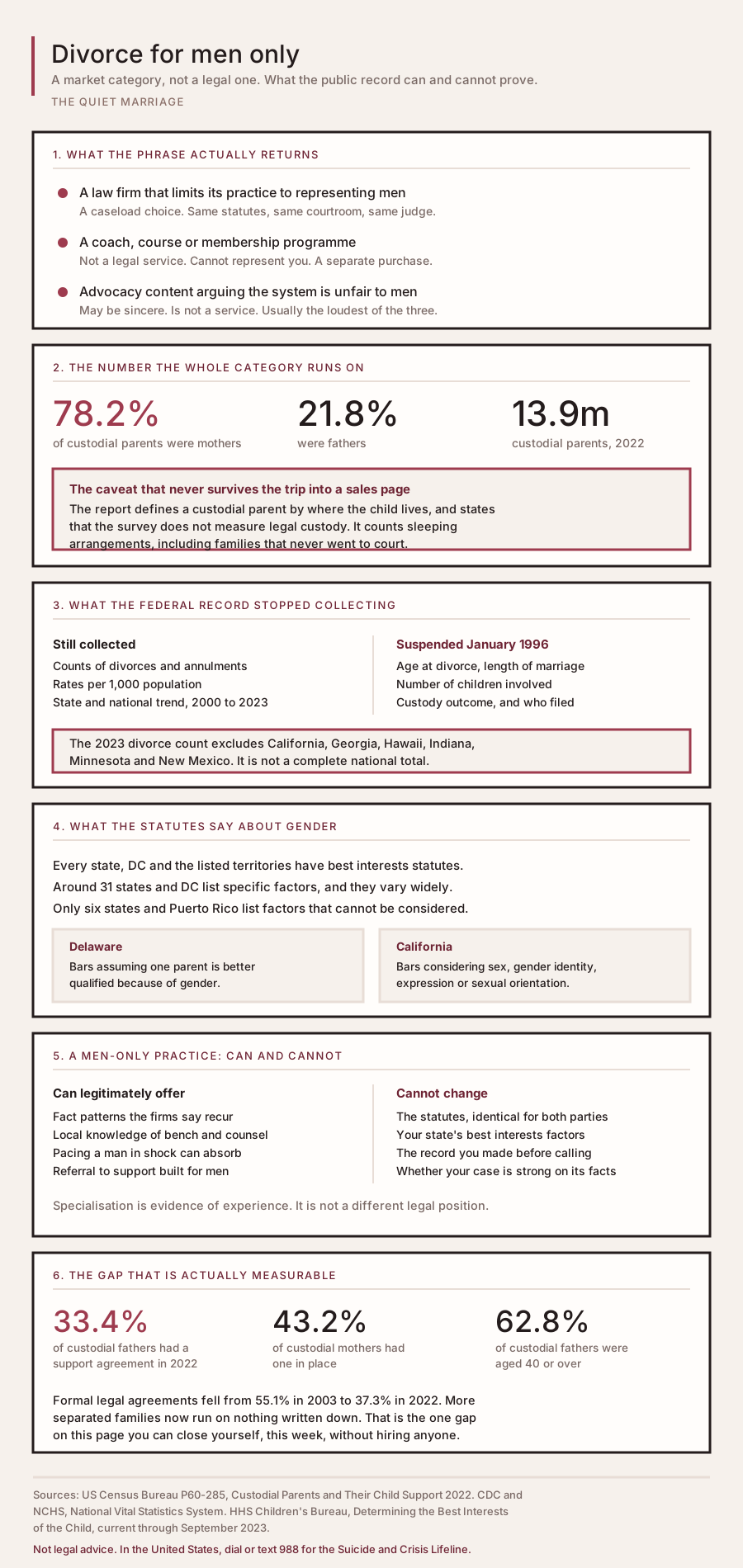
Divorce for men only is a market category rather than a legal one, and the statistic the whole category runs on comes from a federal dataset that states in its own text that it does not measure legal custody. There is no separate body of law for men. There is no men's version of a divorce decree. What exists is a set of firms, coaches and membership sites that have chosen to market to one half of the people going through the same statutory process, and the ones worth hiring are worth hiring for reasons that have almost nothing to do with the marketing.
This piece is about the difference. It is about what those services can honestly deliver, what the public record actually contains, and why the confident national numbers you will be quoted are weaker than they sound. A man deciding how to be represented deserves to know which parts of the story are measured and which parts are inferred.
What the phrase divorce for men only actually returns
Searching that phrase returns three different things wearing similar language, and separating them is the first useful thing you can do.
The first is a law firm that limits its practice to representing men in family law matters. This is a marketing and caseload decision, permitted because a lawyer may choose whose cases to take. The lawyer is applying the same statutes as everyone else in that courthouse.
The second is a coach, a course or a membership community aimed at divorcing men. These are not legal services, cannot represent you, and are not bound by the professional duties a lawyer owes a client. Some are genuinely useful for the part of this that is not legal at all. That is a different purchase from representation, and it should be priced and judged as one.
The third is advocacy content, which argues that the system treats men unfairly and offers the reader membership in that argument. It may be sincere. It is not a service, and it tends to be the loudest of the three.
The confusion between these three is the whole business model of the weakest operators in the category. A firm that is excellent at family law and happens to take only male clients is a legitimate thing to hire. A course that borrows the authority of the first thing to sell you the third thing is not.
The number the whole category runs on, and where it comes from
Almost every pitch in this space leans on one figure: mothers end up with the children roughly four times out of five. That number is real, it is federal, and it does not mean what it is used to mean.
It comes from the Census Bureau's Child Support Supplement to the Current Population Survey. In the most recent report, covering 2022, 13.9 million parents lived with 22.2 million children under 21 while the other parent lived elsewhere. Of those custodial parents, 78.2 percent were mothers and 21.8 percent were fathers.
Here is the part that never survives the trip into a sales page. The report defines a custodial parent as a parent living with their own child under 21 while the other parent lives outside the household, and it says directly that the survey does not measure legal custody. It counts where children sleep, not what any judge ordered, and it cannot separate an arrangement two people agreed between themselves from one a court imposed over an objection.
That distinction carries the entire weight of the claim. A figure about living arrangements across every separated family in the country, including parents who were never married and never appeared before a judge, is being presented as a figure about how judges rule in contested custody cases. Those are not the same population and the gap between them is not small.
The concern behind the claim is not imaginary. The narrower point is that the most quoted number in the category cannot settle it, and anyone using that number as proof either has not read the source or is counting on you not to.
What the federal record stopped collecting in 1996
There is a second reason the confident national claims are thinner than they appear, and it is structural.
The National Center for Health Statistics suspended the collection of detailed marriage and divorce data beginning in January 1996, citing limitations in the information states collected along with budgetary considerations. The most recent comprehensive analyses of detailed divorce data it points to are advance reports covering 1989 and 1990. What continues is the count: totals and rates, published from provisional state figures.
So the United States has not maintained a detailed national picture of who divorces, at what age, after how long, or with what result, for close to thirty years. Any claim that quotes a precise national statistic about how divorces resolve is drawing on something other than federal vital statistics, because that collection stopped.
The count that does continue carries its own warning label, and it is worth reading it in the original. In the 2023 table, the divorce figures exclude data for California, Georgia, Hawaii, Indiana, Minnesota and New Mexico. That is why the population denominator for divorces that year is 279.8 million while the denominator for marriages is 334.9 million. The published 2023 figure of 672,502 divorces and a rate of 2.4 per 1,000 is a real number about the states that reported. It is not a national total, and it leaves out the largest state in the country.
A man in Los Angeles being quoted the national divorce rate is being quoted a number that by construction does not include him.
What the statutes say about gender, which is mostly nothing
If the system were formally weighted against men, you would expect to find it written down. The place to look is the statutory standard courts apply when they decide where a child should be, and there is a federal survey of exactly that.
The Child Welfare Information Gateway, published by the Children's Bureau within the US Department of Health and Human Services, surveys state law on best interests determinations. Its findings, current through September 2023, are worth stating precisely.
Every state, the District of Columbia and the listed territories have statutes describing the factors that must be considered so that a decision about a child's custody or placement serves that child's best interests. Approximately 31 states and the District of Columbia list specific factors in statute, and the factors vary considerably between them. Most states have no standard definition of the phrase best interests of the child at all, with Montana and Puerto Rico named as the exceptions.
Then the part that matters here. Six states and Puerto Rico list factors that cannot be considered. Delaware prohibits courts from assuming that one parent, because of gender, is better qualified than the other to act as custodian or primary residential parent. California states that the sex, gender identity, gender expression or sexual orientation of a parent, guardian or relative cannot be considered.
Most readers will assume the opposite. An explicit statutory ban on reasoning from gender exists in only a small number of states. Elsewhere the statutes are largely silent on gender, which is not the same as endorsing a preference and is also not the same as forbidding one.
One honest limitation, stated rather than buried. That publication surveys best interests determinations across child welfare law broadly, covering placement, permanency and termination of parental rights alongside custody, rather than being a survey of divorce custody practice specifically. It tells you what the statutory factors are. It does not tell you how any individual judge weighs them on a Tuesday afternoon, and no document does.
Which leaves the question genuinely open, and that is the honest answer. The statutes mostly do not encode a gender rule. Whether outcomes diverge in practice is an empirical question that the suspended federal collection makes hard to answer at national scale. Certainty in either direction is being sold to you by someone.
What a men-only practice can and cannot change
| What it can legitimately offer | What it cannot change |
|---|---|
| Repetition on the fact patterns these firms say recur among male clients, such as being the higher earner, the parent with less documented daily caregiving, or the one who moved out first | The statutes, which are the same for both parties in the same courtroom |
| Familiarity with your local bench and opposing counsel, which is jurisdictional knowledge rather than gendered knowledge | The best interests factors your state has enacted |
| Practical readiness for the specific ways these cases fall apart, such as leaving the house without an interim schedule agreed in writing | The evidentiary record you created before you called anyone |
| Referral to a support structure built for men, which is a real and separate need | Whether your case is strong on its facts |
| Language and pacing that a man in shock can absorb at the first meeting | The outcome your conduct during the process earns you |
The pattern is consistent. Everything in the left column is competence, communication and local knowledge. None of it requires the practice to exclude women, and a firm that takes all clients can have every item on that list. Specialisation is evidence of experience with certain fact patterns. It is not evidence of a different legal position.
The asymmetry that is real and measurable
There is one gap in the Census data that deserves attention, and it points somewhere more useful than the custody argument.
In 2022, 41.0 percent of all custodial parents had either a court order or an informal agreement for financial support from the other parent. Custodial mothers were more likely to have one in place, at 43.2 percent, against 33.4 percent of custodial fathers. Roughly a third of custodial fathers had any arrangement at all.
Alongside that, the share of custodial parents with formal legal agreements fell from a high of 55.1 percent in 2003 to a low of 37.3 percent in 2022. More separated families are operating on nothing written down, or on an understanding between two people.
An informal understanding is only as durable as the goodwill behind it, and goodwill is the first thing to go when one household becomes two, one of you meets someone new, or a job ends. This is a documentation gap rather than a courtroom gap, and it is the one thing on this page you can close by yourself, this week, without hiring anyone.
One more figure sits underneath all of this and speaks directly to readers of this site. Of custodial fathers, 62.8 percent were aged 40 or over, against 43.1 percent of custodial mothers. Fathers who are living with their children after a separation are, as a group, notably older. If you are a man over forty reading this, you are inside the part of the distribution the category's own marketing rarely describes.
How to evaluate a firm that markets to men only
The questions that separate a good practice from a good pitch are not about gender at all.
Ask how many cases the lawyer has taken to final hearing in your specific county in the past two years, because family law is local and the answer is either a number or an evasion. Ask what your state's statute actually lists as best interests factors, and whether your state is one of the small group that names gender in its statute in any way. Ask what the realistic range of outcomes looks like on your facts, and treat a confident promise as a warning rather than a reassurance. Ask what happens to your fee if the matter settles early, which tells you how the incentives are arranged.
Then apply one test to the marketing itself. If the material leans on the four out of five custody figure, ask where the number comes from. A practice that can tell you it is a Census living arrangements measure that does not track legal custody is a practice that reads its own sources. A practice that cannot is telling you something about the rest of its work.
What actually moves your outcome
Almost everything that decides how this goes is unglamorous and mostly within reach.
Get any interim arrangement in writing, including the schedule for the children and who pays what, before the informal version has a chance to harden into an assumed status quo. Keep an ordinary contemporaneous record of the caregiving you actually do, because the parent who cannot evidence daily involvement is at a disadvantage that has nothing to do with the statute and everything to do with proof. Take advice before you move out rather than after. Conduct yourself throughout as though everything you send will be read aloud, since it may be.
None of that is gendered. All of it is the same advice a competent lawyer gives any client. The instructions that circulate informally are a different matter, and four of the most repeated ones are checked against the statute, the regulation and the tax topic here.
What this article does not cover
This is a piece about a market category and about what the public record can support, written for a general reader in the United States. It is not legal advice, it is not specific to your state, and it does not attempt to tell you whether to divorce.
It also does not cover the emotional half of this, which is usually the harder half and rarely the one men prepare for.
If you have not actually made the decision yet and you are researching representation as a way of rehearsing it, that is worth naming. Divorce for men after forty covers what the decision itself involves, in the order the three separate questions inside it should be taken.
If the decision is made and the part you are dreading is the year afterwards, the structure that helps most is other men who are further along. Divorce support groups for men covers what those groups do, how to tell a good one from a bad one, and what a group cannot replace.
If some part of you is still weighing whether this is over, how to save your marriage when nothing is actually wrong is the piece for the case where there is no single incident to point at, and trust rebuilding after a real breach is the piece for the case where there is one.
If fear, intimidation or control is present in either direction, none of the above applies and this is not a representation-shopping problem. Speak to a licensed professional first. In the United States the National Domestic Violence Hotline can help you think through safety, at 1.800.799.7233. If you are in crisis, dial or text 988 for the Suicide and Crisis Lifeline.
Last reviewed by The Quiet Marriage Editorial Team on September 6, 2026. This piece was reviewed editorially, against its published sources. It was not reviewed by a licensed therapist, attorney or physician, and it is not a substitute for one. Our sourcing and AI use rules are public on the editorial standards page. This is general editorial content and not professional, legal, medical or psychological advice. Decisions about separation, custody and finances should be taken with a licensed professional in your own jurisdiction. If you are in crisis in the United States, dial or text 988 for the Suicide and Crisis Lifeline, which is free and available 24 hours a day.
FAQ
Is there a separate divorce law for men?
No. There is no men's version of divorce in any United States jurisdiction. The phrase divorce for men only describes a marketing and caseload choice by a firm or a coaching service, not a distinct legal process. The statutes applied to your case are the same ones applied to the other party in the same courtroom.
Do mothers really get custody 80 percent of the time?
That figure is a misreading of a real number. The Census Bureau reported that 78.2 percent of the 13.9 million custodial parents in 2022 were mothers, but the report defines a custodial parent by where the child lives and states that the survey does not measure legal custody. It includes families who never went to court and parents who were never married. It is a living arrangements statistic, not a record of judicial decisions.
Are family courts biased against fathers?
The honest answer is that the public record cannot settle it. Most state statutes do not encode a gender rule either way. Only a small group name gender at all, with Delaware prohibiting the assumption that one parent is better qualified because of gender, and California barring consideration of a parent's sex or gender identity. The detailed federal data that could test outcomes at national scale has not been collected since January 1996. Anyone offering you certainty in either direction is going beyond the evidence.
Is a men-only divorce lawyer better than a general family lawyer?
Not by virtue of being men-only. Specialisation can mean genuine repetition on fact patterns common among male clients, which is worth something. It cannot mean a different set of statutes or an advantage over the law. Judge the firm on hearing experience in your county, candour about the realistic range of outcomes, and fee structure, which are the same tests you would apply to any family lawyer.
What is the national divorce rate in the United States?
The most recent provisional national figure from the National Center for Health Statistics covers 2023 and reports 672,502 divorces and annulments, a rate of 2.4 per 1,000 population. That table excludes data for California, Georgia, Hawaii, Indiana, Minnesota and New Mexico, which is why its population base is 279.8 million rather than the 334.9 million used for marriages on the same page. It is a real number about the reporting states rather than a complete national total.
Why is there so little reliable national data on divorce?
Because the collection was stopped. The National Center for Health Statistics suspended detailed marriage and divorce data collection beginning in January 1996, citing limitations in what states collected along with budgetary considerations. Counts and rates continue. Age at divorce, length of marriage, number of children and custody outcome do not, and the most recent detailed reports cover 1989 and 1990.
What should a man do first if he is facing divorce?
Take advice before you move out rather than after, and get any interim arrangement written down, including the children's schedule and who pays what. Census data shows the share of custodial parents with formal legal agreements fell from 55.1 percent in 2003 to 37.3 percent in 2022, so operating on an unwritten understanding is now common and it is fragile. Documentation is the part of this you control without hiring anyone.
Are men's divorce coaching programmes worth the money?
They are a different purchase from legal representation and should be judged separately. A coach cannot represent you, is not bound by the professional duties a lawyer owes a client, and cannot affect the legal outcome. The need they address, which is the emotional and practical half that men are least prepared for, is real. Compare the cost against a support group, which covers similar ground and is often free.
Why are custodial fathers older than custodial mothers?
The Census report records the difference without explaining it, and this site will not invent a cause. What it shows is that 62.8 percent of custodial fathers were aged 40 or over in 2022, against 43.1 percent of custodial mothers. Fathers living with their children after a separation skew notably older as a group, which is worth knowing if you are a man over forty and have been told this outcome is rare for someone like you.
Sources
- most recent report (census.gov)
- suspended the collection of detailed marriage and divorce data (cdc.gov)
- 2023 table (cdc.gov)
- state law on best interests determinations (childwelfare.gov)
- National Domestic Violence Hotline (thehotline.org)
- Suicide and Crisis Lifeline (988lifeline.org)